
When a woman mentions the marriage crisis, she means by it young men's holding
back from marriage.
If there is a crisis, that holding back is its cause.
And the holding back, naturally, goes back to several causes — some educational, some economic, and some created by other conditions.
Here in the East we have two kinds of law, of which we apply one to the young man and the other to the girl. We allow the young man absolute freedom to enjoy, and all the pleasures to taste, uncensured. Then, if we advise him to marry, he sees in marriage — set against the freedom he enjoys — a bond and a responsibility which he sometimes fears. I understand what some say about the indulgence nature has provided for man and the fetters with which it has bound woman; yet our own indulgence toward man is of our making, not nature's.
We do not fight dissipation only because it may lead to illegitimate children, but because it wrecks morals and destroys principles, upbringing, and health. If we want the boy to be raised to respect decency as the girl is raised, we must plant in his tender mind respect for the family, for the choosing of a wife, and for the striving to found a home in which the two of them will feel conjugal happiness. When the young man in our country is raised to know that drunkenness, gambling, bad company, and illicit relations lower his standing, then he will feel the restraints of society and think of early marriage — if his financial circumstances allow. I say if his financial circumstances allow, because it is no good for a man to marry and become a father when he possesses nothing with which to support his family. That is why financial condition is the chief cause of the marriage crisis. Life demands expenses, and children and homes require money — not because woman is extravagant or the fiancée demanding, for there are among our girls, thank God, those who have been raised so soundly that
they are content to bear hardships alongside the husband, who try not to burden him with demands, who respect him and regard him as the head of the house. As for what we hear about women's demands and their extravagance from some of our young men — those who choose badly and are led by their whims, heedless of sincere advice — it is nothing but talk they utter to console and amuse themselves.
Among the causes that lead young men to hold back from marriage is how rarely conjugal happiness is found among the married. This time allow me to lay the greater part of the responsibility upon men, if only because it is man who holds the right of choosing and of asking. That young man who dissipated himself until he had his fill, or was broken, and dissipation told upon his nerves and his health, comes back to his senses and begins searching for a girl to share life with him — influenced by the theory which holds that a man's past does not matter, and that a man is young until the age of fifty, so let him look for the young thing not yet past twenty-five. How can happiness abound in a house whose man is gray-haired and which holds a young wife? How is it right
that we fling her into a world where experiences pile up, and ignore her youth, her strength, her energy, and her ardor, asking her to lock them all away in a box her husband keeps shut? How can she be happy to the utmost bounds of happiness while every day she sacrifices her youth — and is anything dearer to a woman than her youth?
The bachelor looks at one of the houses around him and sees happiness incomplete in it — and why? Is it not because the young man was bewitched by the beauty of a girl between whom and himself there was no true understanding? Her childhood is different, her environment different, her schooling different, her upbringing different, and the family of each differs from the other in station, in refinement, and in principles. They marry and enjoy happiness at first; but after a while, when their opinions, their inclinations, and their points of view diverge in all things, the illusory happiness melts and burns away before the temple of practical life and daily sacrifices.
Then the young man turns to another house and sees happiness incomplete there too, because the husband is Eastern and the wife Western. We all know that the Western woman's view of the husband differs from the Eastern woman's view of him, just as the demands of the Eastern husband differ from those of the Western. Here, too, the difference of language does its work — and the bonds of language are among the strongest of bonds. The pet names by which the two were called in their childhood differ, and the expressions each heard from his parents, whether in endearment or in rebuke; and the kinds of food that each grew used to and loved differ. These differences, though no one of them taken alone is of importance, together obstruct the road to understanding — and happiness cannot live except with complete understanding.
These are some of the causes of the marriage crisis, mentioned by way of example; and every rule has its exceptions.
(Delivered at the Cooperation Club in Beirut)
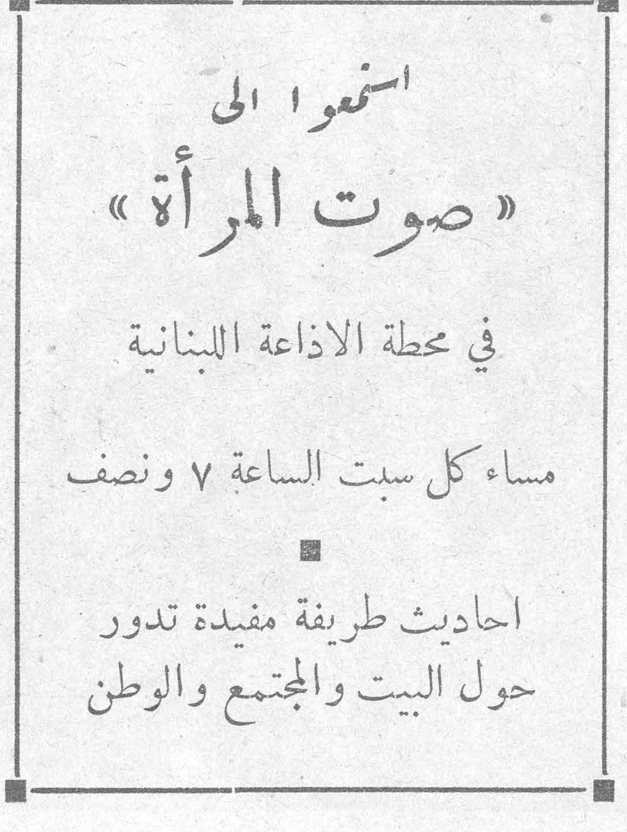
Listen to
"The Woman's Voice"
on Radio Lebanon
every Saturday evening at half past seven
Delightful and useful talks on the home, society, and the homeland