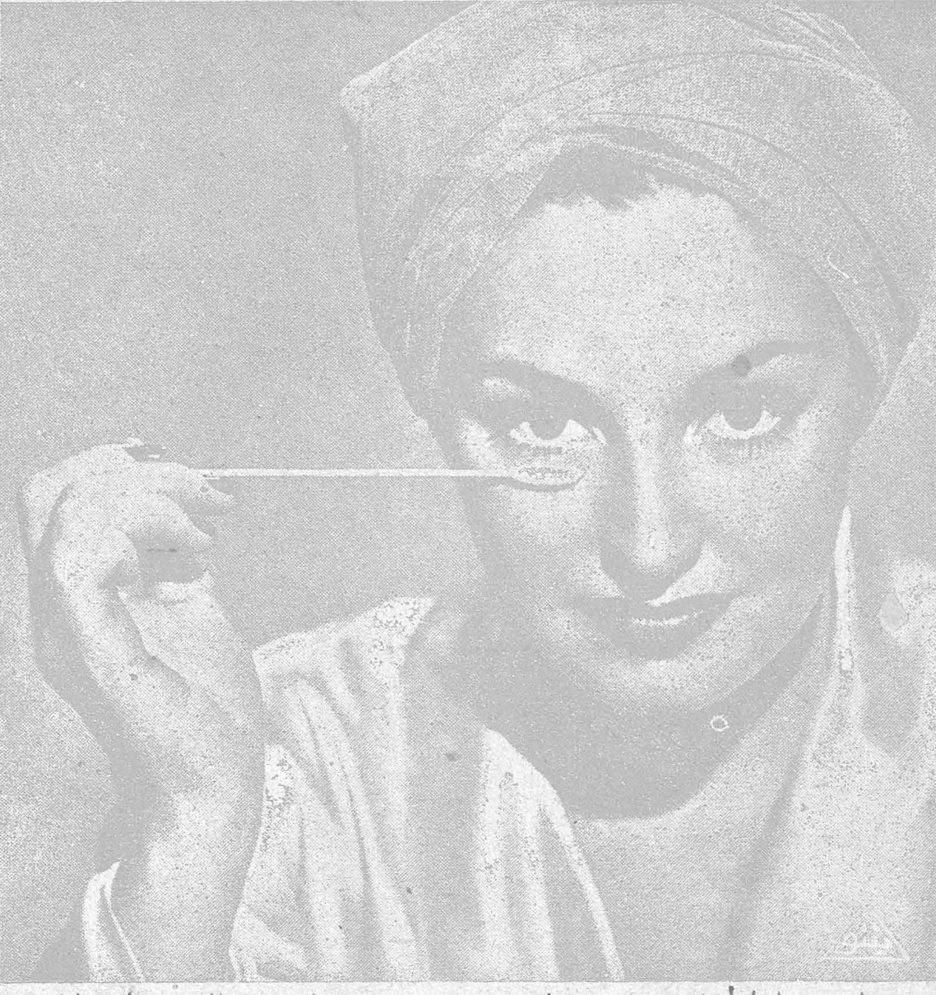
The face is the mirror of the body, for upon its surface the emotions are imprinted — joy and sorrow, vexation and contentment — and upon its surface too, unless we take care, the years, in their advance and retreat, leave their hateful traces. Now the eyes are the most expressive features of the face, and for that reason they demand special care — as to their state of health and their adornment.
The women of ancient Egypt understood this, and they devoted themselves to the care of adorning their faces, as witness the head of the beautiful Egyptian Queen Nefertiti, which is counted among the splendid wonders of the art of antiquity. How often I have been captivated by the harmo
nious modeling of that exquisite head, the magic of its black eyes, the fine arch of its beautiful brows, and the marvelous perfection of the painting of its eyes. In all the tombs of the great ladies of Egypt there have been found numbers of exquisite toilet vessels made of alabaster, most notable among them the kohl pot — the eye paint of ages gone by. These ladies passed, in their dazzling adornment, into the pages of history by way of statues and reliefs, as the model of womanly beauty in olden times. It is therefore fitting that we recall them, not with a view to imitation, but as proof of the usefulness of "makeup."
So much for woman in olden times; what is your own position today, madam? The received opinion in Western lands about the Arab woman is that she is distinguished by the clearness of her eyes and the wideness and beauty of her pupils. Yet it is a clearness that very often fades at an early age. And whenever I see a woman with faded eyes that tell of fatigue and exhaustion, I see in her the emblem of defeat — because she has let time get the better of her without lifting a finger to repel or resist it.
There are four points you must observe in caring for your eyes: first, health; second, exercise; third, the eyebrows; and fourth, the paint.
The eyes are the mirror in which your general state of health is reflected. If your liver or your stomach does not perform its functions properly, then it is idle for you to hope to recover the sparkle of your eyes, however you may contrive with paint. The best remedy for this is exercise, suitable food, fresh air, and laxative salts, taken in a glass of hot water on an empty stomach every morning.
You must avoid exhausting and tiring your eyes. Do not attempt to read or knit in poor light. And even if you have no need of spectacles (eyeglasses), it is well to use them for reading and for fine work such as knitting; for glasses save the eyes from fatigue and from the knitting of the brows, which leaves wrinkles around the eyes and on the forehead.
The eyes need care in their cleanliness like the rest of the body's organs. For this reason it is well, if you find the time, to wash them every morning with an antiseptic solution, and every evening as well. You can obtain this suitable solution by putting crystals of boric acid into boiled water and leaving it until it cools, or a mild solution of salt and water made in the same way. Use an eye cup for
washing them: set it over your eye while it is closed, bend your head back, then blink your eyes several times in the solution — for this operation is worth the brief effort it asks of you.
The eyes also need exercise. So make a point of rolling your eyes from side to side and from top to bottom as part of your morning routine; you can do this in the eye cup. Another exercise is to massage the eyelids gently while they are closed, for this relieves the tiredness of the eye.
If you actually suffer from tired eyes, you should bathe them with lukewarm milk that has first been boiled. If they are reddened from fatigue, make a pad of carded cotton and steep it in rosewater, then lie down for some ten minutes after placing the pad over each closed eye. And if your eyes are red from weeping, remember that the quickest way to remove this redness is to bathe the eyes and the skin around them with hot water, not cold.
Plucked eyebrows have become the fashion among women of elegance, but beware of rashness. It is wiser to entrust this task to an expert who can preserve their two natural lines, and then to shape them yourself afterward with tweezers when the hairs grow back. Remember that eyebrows differ as faces differ, and that the brows and lashes are the adornment of the eye; so leave the decision on this to the judgment of a beauty expert.
And those few hairs sprouting at the entrance of your nose must be pulled out: anoint them with cream and pluck them in the direction of their growth, then wash the spot with an antiseptic solution.