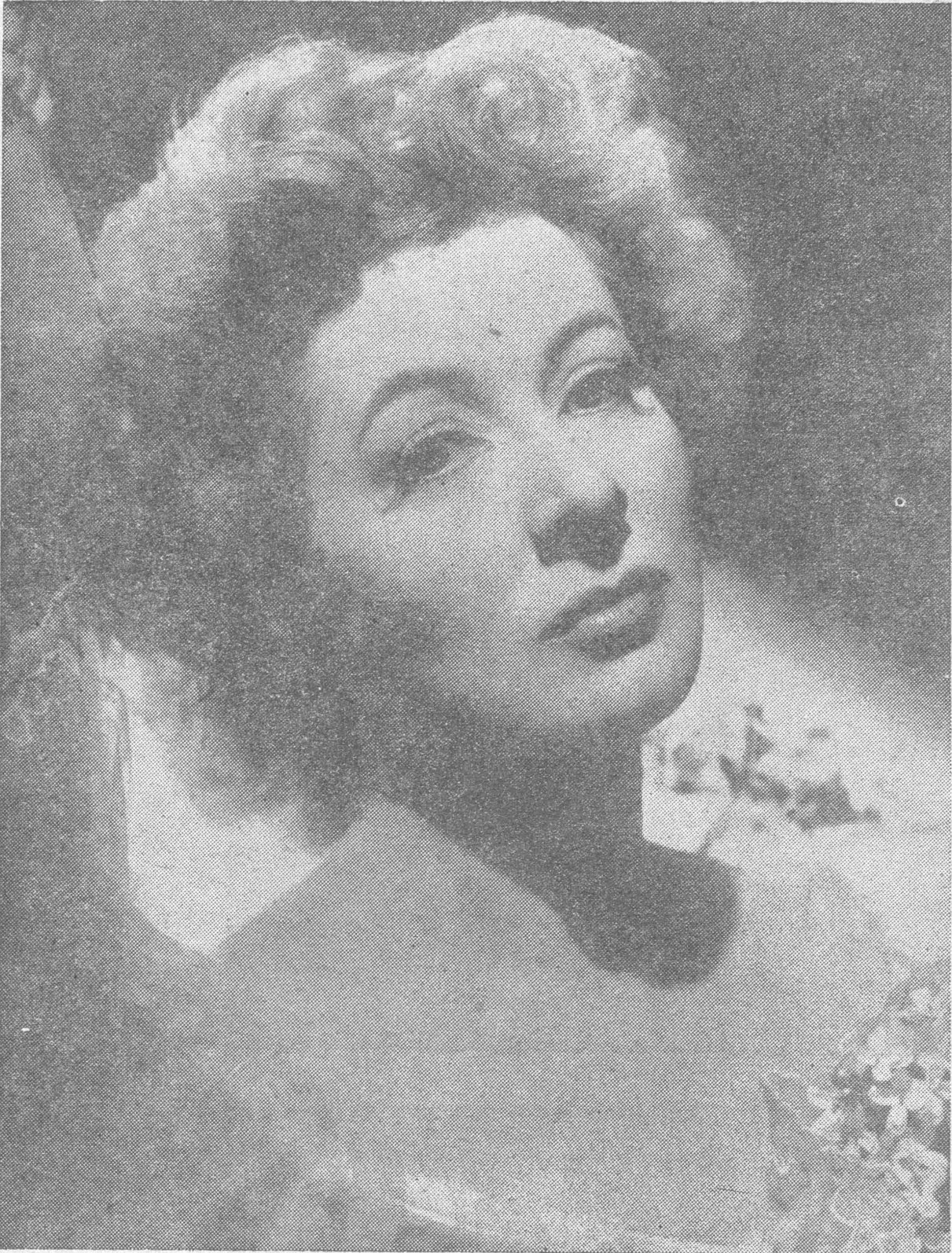
Greer Garson is distinguished by the fact that fame has not affected her and money has not spoiled her character. In her acting she tries to bring out for people the best she can of emotions and feelings, even when the story in which she appears has no particular plot or artistic force.
It is certain that the directors in Hollywood have recognized these qualities, and so they have not advertised Greer Garson as "the glamorous actress" or under other such alluring names — and this may be the reason that her standing has kept rising in people's eyes.
Greer Garson came to London in 1936, and her success in
playing the part of the American girl in the play "The Golden Arrow" was so great that the critics denied her Scottish and Irish origin and took her for an American girl.
So she went on acting play after play, appearing with Seymour Hicks in "Vintage Wine" and with Nicholas Hannen in "Accent on Youth" and in "Mademoiselle," until one night in 1937, when Louis B. Mayer, one of the owners of the Metro-Goldwyn-Mayer company, saw her and decided that she was fit to be a movie star.
Greer Garson had previously refused to work in British films, but she found it hard to refuse Hollywood. So at the end of 1937 she traveled to America, and there she did nothing at all for six whole months.
She went back to England and "slipped into the part of Kitty," as she herself tells it — Kitty being a part in "Goodbye, Mr. Chips," in which Robert Donat played the leading role. She succeeded in this part so well that Hollywood called her back again.
She played her first film with Robert Taylor in "Remember?", and the part of Elizabeth in "Pride and Prejudice," then leapt to the front rank in the part of "Mrs. Miniver" with Walter Pidgeon.
Finally she scored a surpassing success with Ronald Colman in "The Return of the Captive," for her acting attained a great degree of artistic splendor. "Madame Curie," too, revealed new sides of her genius as an actress.
And Greer Garson,
by Hollywood's own testimony, has never sacrificed her art for the sake of a passing effect; rather, she has given everything she has played a splendid artistic expression. The best description of her is that she is kind of heart and of a brilliant intelligence that has qualified her to be one of Hollywood's first ladies.