Our esteemed colleague Mr. Ilya Shaghouri spent a few weeks in Cairo, during which he had the honor of calling upon Her Ladyship the venerable leader Mrs. Huda Shaarawi. In her palace he made the acquaintance of Dr. Rydh, president of the International Women's Union, and had with her the engaging conversation that follows, which we reproduce from his distinguished Damascus newspaper "al-Balad."
I had no previous appointment with her, for her days in Cairo were numbered — scarcely enough for visiting the women's institutions and observing how far the renaissance of the Egyptian woman has advanced, and the extent of her share in humanitarian projects and in the national movement.
She was the guest of the leader of the women's movement in the Arab East, Mrs. Huda Hanem Shaarawi, in her sumptuous palace. She had come to Egypt with one of the members of the International Women's Union, intending to become acquainted with the women's unions in the countries of the Middle East and to see the work of their ladies.
This lady is Dr. Rydh, president of the International Women's Union; she is Swedish, and of a well-known family.
I said I had no previous appointment with her, for my presence that evening in the palace of Huda Shaarawi was chance. I had come to ask after the accomplished woman of letters Miss Hawa Idris, and she seized the favorable opportunity and presented me to Dr. Rydh — a lady of fifty years, tall of stature, of broad culture. No sooner had she learned that I was a son of Damascus, and a journalist, than she opened to me her complaint of the unforeseen circumstances that had beset her journey and would deprive her of a visit to Damascus, though it had been settled that she should visit it and meet with the Syrian Women's Union.
I said: And what are these unfore
seen circumstances? She answered me with a certain vehemence mingled with a pained smile:
You may ask your government; it has the answer.
I then learned from her long account that her companion on the journey, who is the treasurer of the International Women's Union, is a Jewish lady called Mrs. Seelar, to whom the Syrian legation in London had granted a visa for entry into Syria. Upon her arrival in Cairo, Mrs. Seelar was told that the visa she held was considered void, and that the Cairo consulate was not charged with granting her a new one. Contacts passed between Cairo, Damascus, and Beirut to solve this problem, but to no avail — a thing which roused Mrs. Seelar's indignation, so that she fell to criticizing these proceedings and compelled her colleague Dr. Rydh to cancel her journey to Syria and Lebanon. The Syrian Women's Union had meanwhile taken note of the president's approaching arrival and made ready to receive her.
As for the reasons for this measure that was taken, they go back to the fact that Mrs. Seelar is a Zionist, and had previously defended the Zionist movement in Palestine at a number of international congresses. And since Syria at the present time forbids the entry of Jews into its territory, in execution of the resolution of the Council of the League, the Syrian legation in Cairo was charged with informing Mrs. Seelar of this.
And in solidarity with her in her anger, Dr. Rydh canceled her visit to Damascus and set about preparing to travel directly to Iraq, then Iran, then Turkey, then Greece.
This conversation between myself and the president of the International Women's Union took place in one of the salons of the palace of Mrs. Huda Shaarawi, and I could not but share Dr. Rydh's regret at not visiting Syria — though I begged her to leave her
colleague in Greece and to come and visit Damascus before her return to London. Then we passed into the dining room; the hour had reached half past eight in the evening. I had a previous appointment with one of my Egyptian journalist colleagues, so I had to content myself with a brief talk with the president of the International Union.
She first recounted to us the details of her journey, then spoke to us of the beauty of her country, Sweden, where the sun does not set for six whole months... She passed on in her talk to the mission for which she is touring the capitals of the Middle East, saying that the intention is directed toward holding regional congresses, in view of the impossibility of traveling great distances to hold an international congress; and that during this journey she is sounding the opinions of the presidents of the unions in the countries of the East, so as to fix the place of the regional congress and its date. When I asked her whether Damascus was a candidate to be the seat of the coming congress, she answered with much courtesy and grace:
And who among us does not wish it?... But the decision rests with
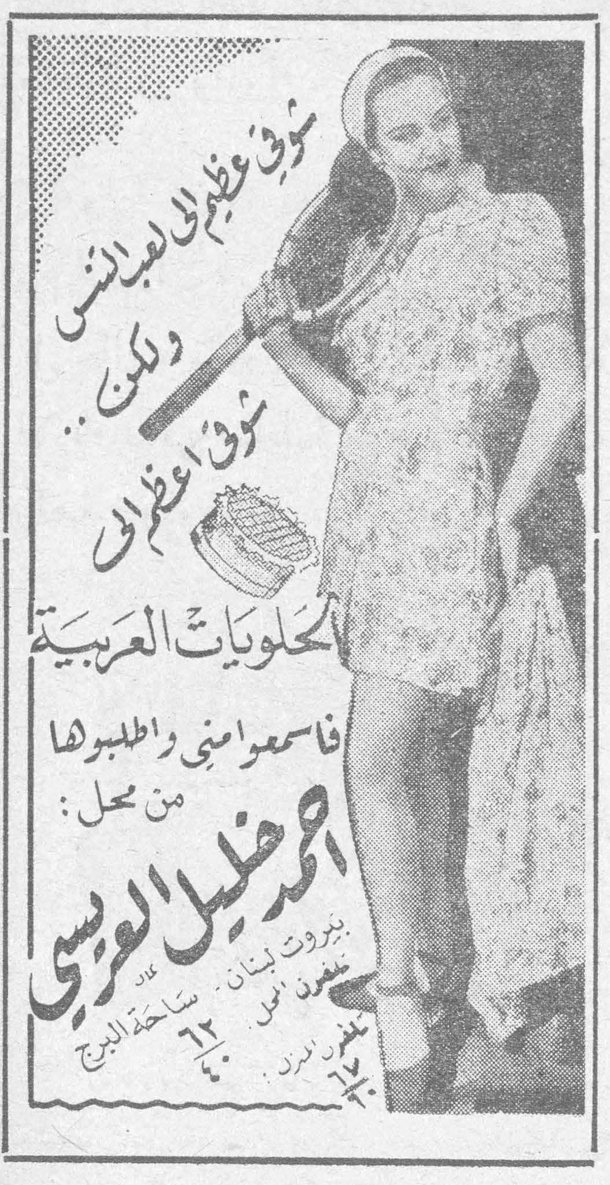
Ahmad Khalil al-Oraysi — Arab Sweets
Distributor of the Empress's perfumes — but... the distributor of my perfumes
is Arab sweets: so hear my voice and order them from the shop of:
Ahmad Khalil al-Oraysi
Beirut, Lebanon
22 Nazlat al-Burj Street