
How profitable it is for a person, young or old, to read the lives of self-made men. And in the life of "Milton Hershey," the chocolate king of the world, there is a
living example that spurs us to imitate him in overcoming the difficulties of life.
"There is no limit to a man's age in his relation to work" — a sentence uttered by Milton Hershey, founder of the chocolate factories in Pennsylvania, when he was eighty-five years of age; and he added to it, saying: "It is enough for this war to have demolished one creed in the world, namely, that a man must stop working once he has passed fifty or sixty. Here I am, past eighty-five, and I feel no incapacity for doing what my country requires of me. There are the factories, the workshops, and the companies of every kind, filled with the men and women who have taken over the various jobs in place of the young men at war; and the increase of production at their hands supports what I say and proves the falseness of the said creed."
This is the opinion of a man of wealth and a great philanthropist; rare indeed are those who have followed his example among those upon whom the millions have piled up.
Milton Hershey grew up a poor farm boy whom
circumstances opposed for many years; he overcame them by his patience, the strength of his will, his determination, his steadfastness, and his refusal to surrender to despair.
Hershey's forefathers emigrated from Switzerland to Pennsylvania in 1719, where they acquired a small farm named Derry. On this farm Hershey was born about the year 1854, and he was schooled in the simple village school. When he was seven years old his family was forced to sell the farm and move to another town on account of a civil war. At fourteen his father sent him to a printing house to learn printing, but he did not care for the trade and rid himself of it by a ruse after a time, and entered a shop to learn the making of sweets — and this time he succeeded. When he reached twenty, having mastered his craft, he said to himself: "As long as I can earn these sums for others, then I can earn many times as much for myself." So he left his job and went to Philadelphia, where he opened a small shop thanks to what he had saved of his wages and to his uncle's help, and for six years he made sweets for children, at the end of which he saw that his success was limited owing to the smallness of his capital. So he left the shop and went to Chicago, where he worked
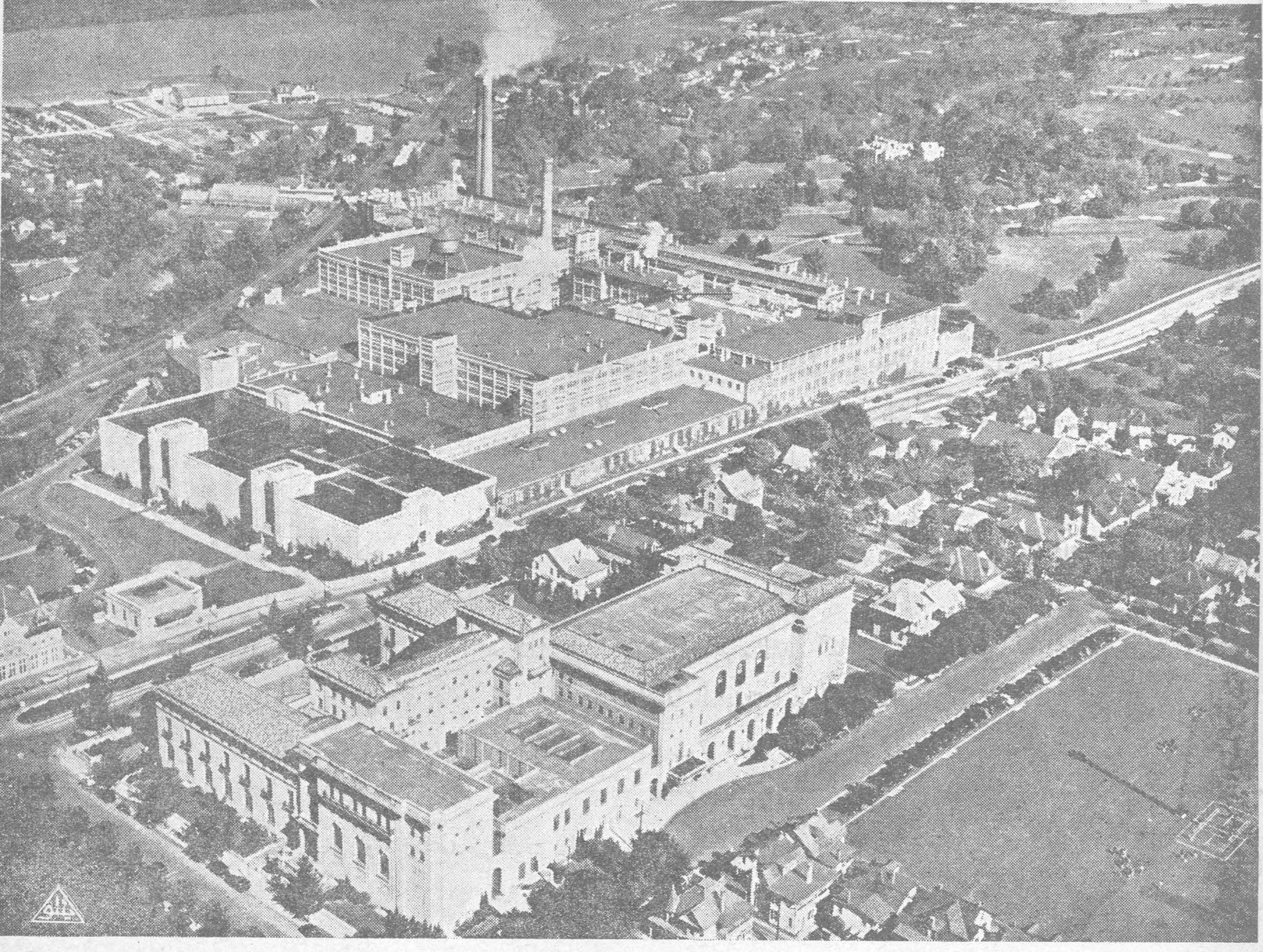
This view shows a large part of the Hershey factories