The famous inventor and great mathematician Muhammad Hasan Kamel al-Sabbah is counted in the front rank of the men of science who worked, and expended prodigious mental effort, to realize the dream that many had dreamed: the transmission of images of persons and things through the ether across vast distances — the method that scientists have agreed to call television. Perhaps it is well to say, on this occasion, that the method conceived by the mighty mind of our inventor, the late Muhammad Hasan Kamel al-Sabbah of Jabal Amel, during his time as chief of engineers of the General Electric Company in New York State, was the best method ever devised for television — this on the testimony of the great men of science throughout the inhabited world. And who knows? The television apparatus now in use in America, Britain,
and elsewhere may well be built on al-Sabbah's method and not on that of other scientists. To verify this matter and clear up its obscurities, one of the specialists in this art from among the sons of this country — if we have specialists — would have to undertake a precise study and a thorough scientific inquiry, which neither I nor others who know but little about television are able to carry out. There is no room to examine the question here except by way of a reminder and a rousing of ambitions.
As for television, its nature may be defined and described in a sentence or two as follows. Imagine that you wish to speak to a friend or a relative far away from you. If he has a telephone, you go to your own telephone, or to some other, and ask the exchange to connect you with the telephone of the person you wish to address. Your request is soon answered, and the
two of you converse with ease. This method of conversing, however, has several drawbacks, chief among them: the slowness of the connection, since you must often wait several minutes before you can speak to your friend; and the impossibility of your speaking by telephone in secrecy. Among the drawbacks of the ordinary telephone, too, is that you cannot see your companion, since you hear only his voice — and what difficulties that entails is plain enough.
But television has come to make good these deficiencies. It has become possible for you to speak to
a person and see him
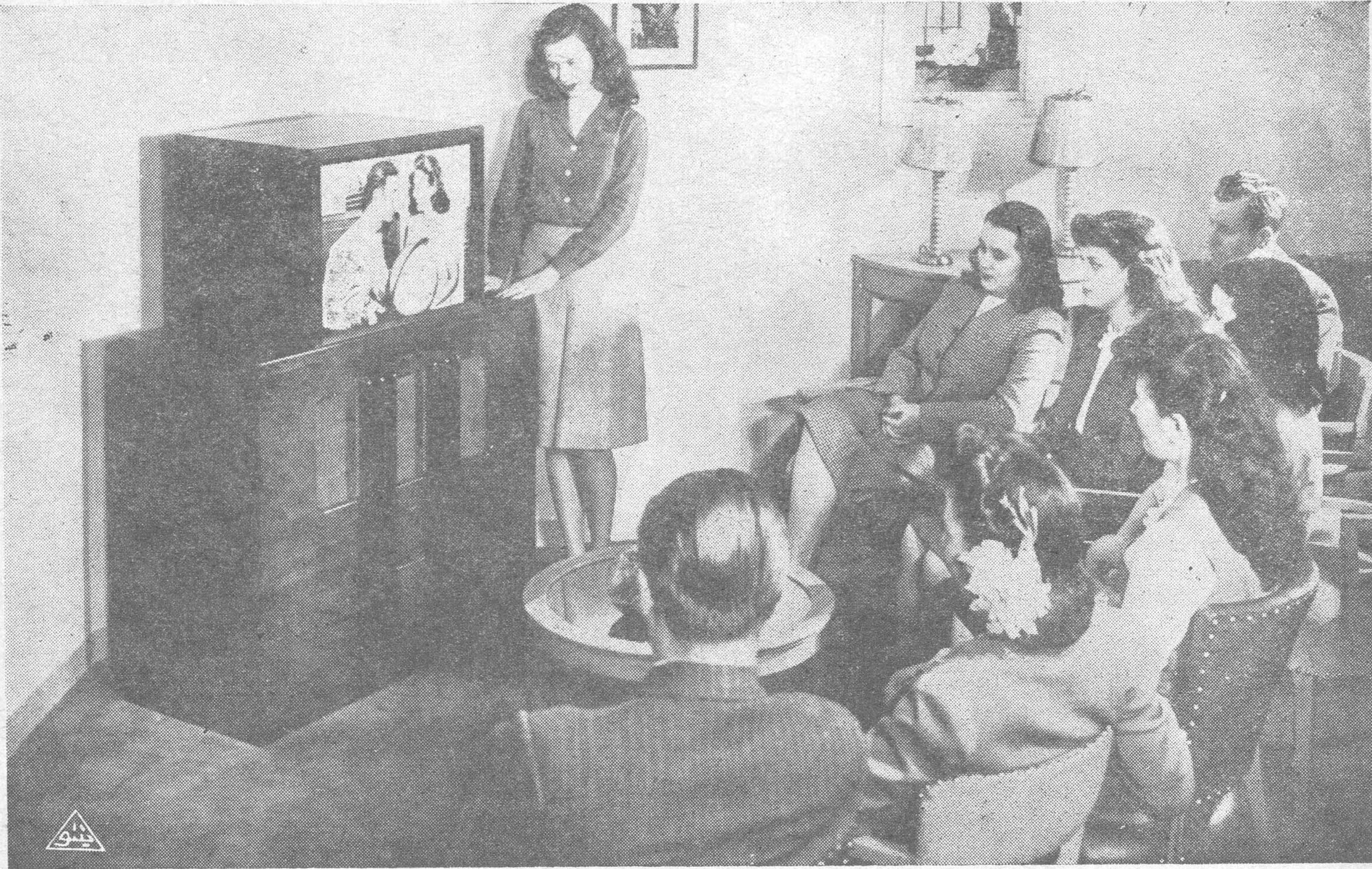
Madam, before long you will be able to have in your home every means of enjoyment — among them the television set