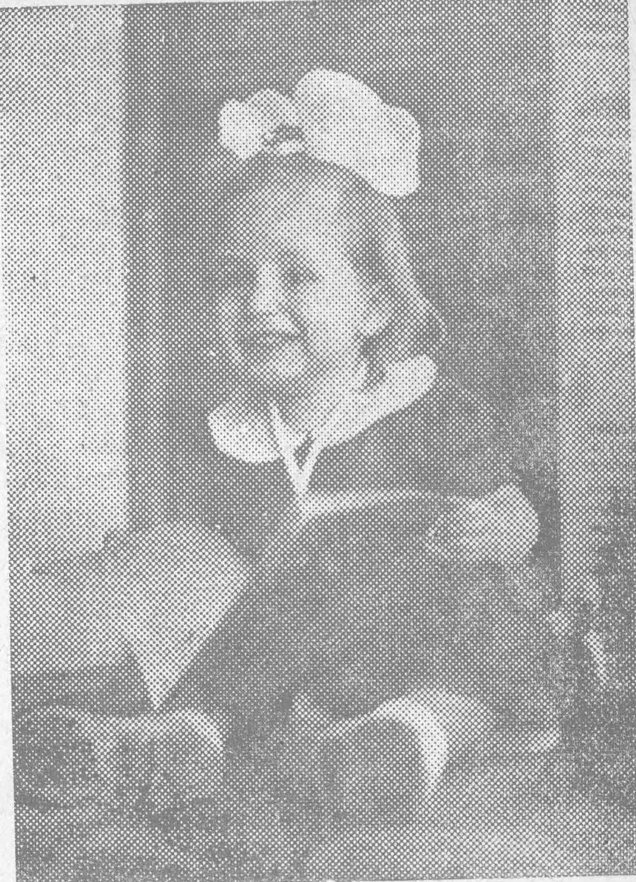
May Albert Rihani
al-Rihaniyyat, The Kings of the Arabs, The Lily of the Ghor, Khalid, and Inside the Harem, and witness how Ameen defied the procession of time, measured against what the Arab mind had opened itself to in those days.
And while you are thus, behold Albert — Ameen's brother — interrupts you to recount the projects newly under way at his hands. He is working on the printing of the manuscript works Ameen left behind, chief among them The Heart of Lebanon, The Case of May, and Letters that no money could price. He is working, likewise, to direct the attention of the responsible men of power and standing in Lebanon toward concern for Freikeh — this famous village — that they may join it to civilization by a road on which the modern donkeys shod in rubber can travel, establish a school in it, and extend to it the lines of light, water, and telephone. And it astonishes you to learn that most of these projects have been achieved, though after arduous effort. Then you listen eagerly as he tells you how he will make of Freikeh a summer resort for writers and artists, and so carry on the literary mission that Ameen began.
I stayed in Freikeh that night.
And when morning broke, the car carried us down to Beirut. No sooner had we reached it, at eight o'clock, than my companion Mr. Albert said to me: What do you say to a visit to Salma Sayegh? I was delighted with the idea. A few moments later we were knocking at the home of her kinsman by marriage, the poet Salah Labaki — and we had become three. The third was Miss Ibtihaj Kaddoura, president of the Lebanese Arab Women's Federation. We had met her on her way, likewise, to see her great colleague. And when the door was opened to us — never in all my life have I witnessed a meeting to surpass the meeting of those two great ladies. While tears of joy and longing streamed from their eyes, my own tears choked in the corners of my eyes. As for my companion Albert, he was exultant: Shall deliverance come at woman's hand, after man has begrudged it to us?
And what should I convey to the readers of The Woman's Voice of the talk that followed? Perhaps the finest part of it is the very part our great woman of letters forbade me to convey to anyone. Let my readers be content to know that the talk touched on Palestine, and the literary movement in Brazil, and the women's movement in Lebanon, and the feeling of the Lebanese communities abroad toward this 'era' of independence, and the false rumors being woven around Mr. al-Sawda, Lebanon's Minister Plenipotentiary, and other such matters as ought and ought not to be, for the sake of the renaissance of Lebanon and its dear neighbors.
At last we rose to take our leave. Our great writer shook my hand with warmth; and as though she had understood what was passing through my mind, she said: I shall give myself over to rest in the mountains a little, and then turn to writing and composition. And I shall favor The Woman's Voice with a series of talks on subjects that concern our women and please them.
And on the way back, I walked beside my companion, in a strange world — I do not recall that I had ever felt my own existence so before.
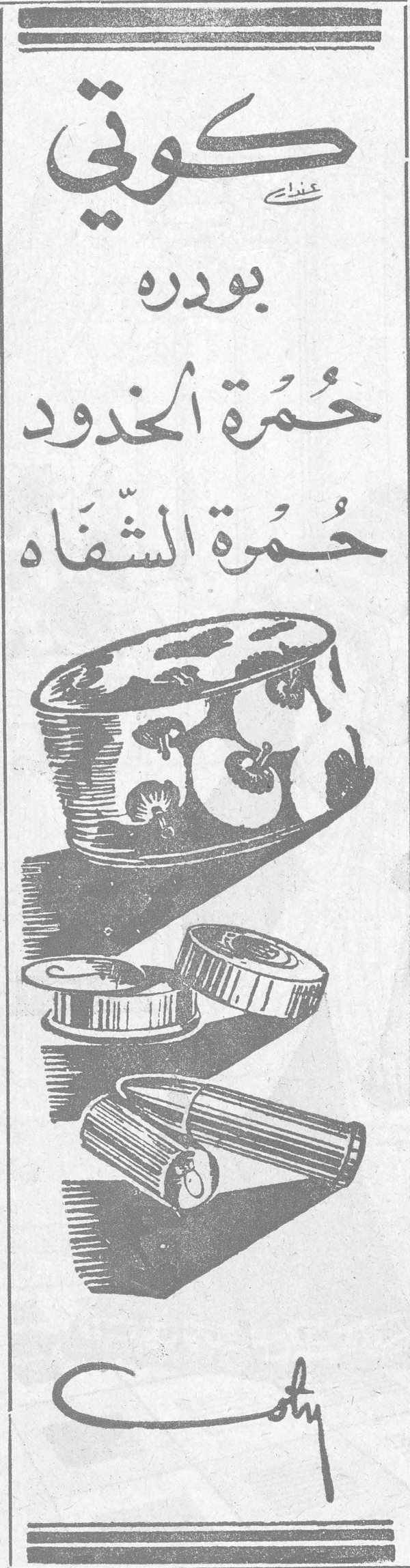
Coty — Powder and Rouge
Coty
Powder
Rouge for the cheeks
Rouge for the lips