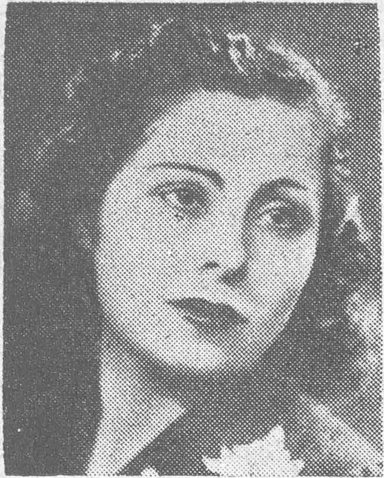
Miss Zahia Kaddoura
I knew Miss Zahia Kaddoura as a student at the American University of Beirut, joining the hours of her days to her nights in grueling, exhausting work, bent over the study of books of sources and history — those books which none can endure save one whom God has blessed with long patience and adorned with the virtue of
sound learning. Nor did Miss Kaddoura's ambition stop at obtaining the bachelor's degree in Arab history from the aforementioned university; she traveled to Egypt to continue her scholarly work at Fuad I University, to return to us with a precious thesis: Aisha, Mother of the Believers.
It is not within my power to go deeply into
this valuable book in these few lines, but I cannot help congratulating Miss Kaddoura on the great effort that appears plainly and clearly in her work.
In a scholarly manner she has treated Arab life before Islam and after it, passing through the Arabian Peninsula and presenting its political, social, economic, literary, and religious life. She then took up the life of the Arab woman before Islam and compared it with her life under Islam, until she reached Aisha, studying that radiant face in Islamic history in a way that made it clearer still and more brilliantly luminous; she left no thought that might occur to a critic's mind without raising it or treating it with a precision and a learning that move us to congratulate the author from the depths of the heart.
Nothing could be better than to cite the words of Professor Dr. Hasan Ibrahim Hasan, professor of Islamic history and head of the history department at Fuad I University — the words with which he prefaced the book. Dr. Hasan said: "... And what increases our delight is that this study should be the ripe fruit of a Lebanese Arab young lady who has combined the two cultures, the Arabic and the Western, and yet — for all that — takes pride in her Arabness and her traditions, and shares in reviving the Arab renaissance, which we, the community of Arabs, are laboring hard to bring back to life, until it returns to what it was in its glorious golden age.
"And what increases our delight further is that Miss Zahia should be the first Lebanese Arab woman to have earned this degree in Islamic history from the Faculty of Arts at Fuad I University; she is therefore counted in the vanguard of the Arab women who have won this lofty academic degree."
And if we may add one word to the words of Dr. Hasan Hasan, it is this: Lebanon is proud, wholly proud, to have among its people the likes of Miss Zahia Kaddoura to carry out its scholarly mission in the service of the entire Arab world. On, then, to the doctorate, God willing.. Muhsin
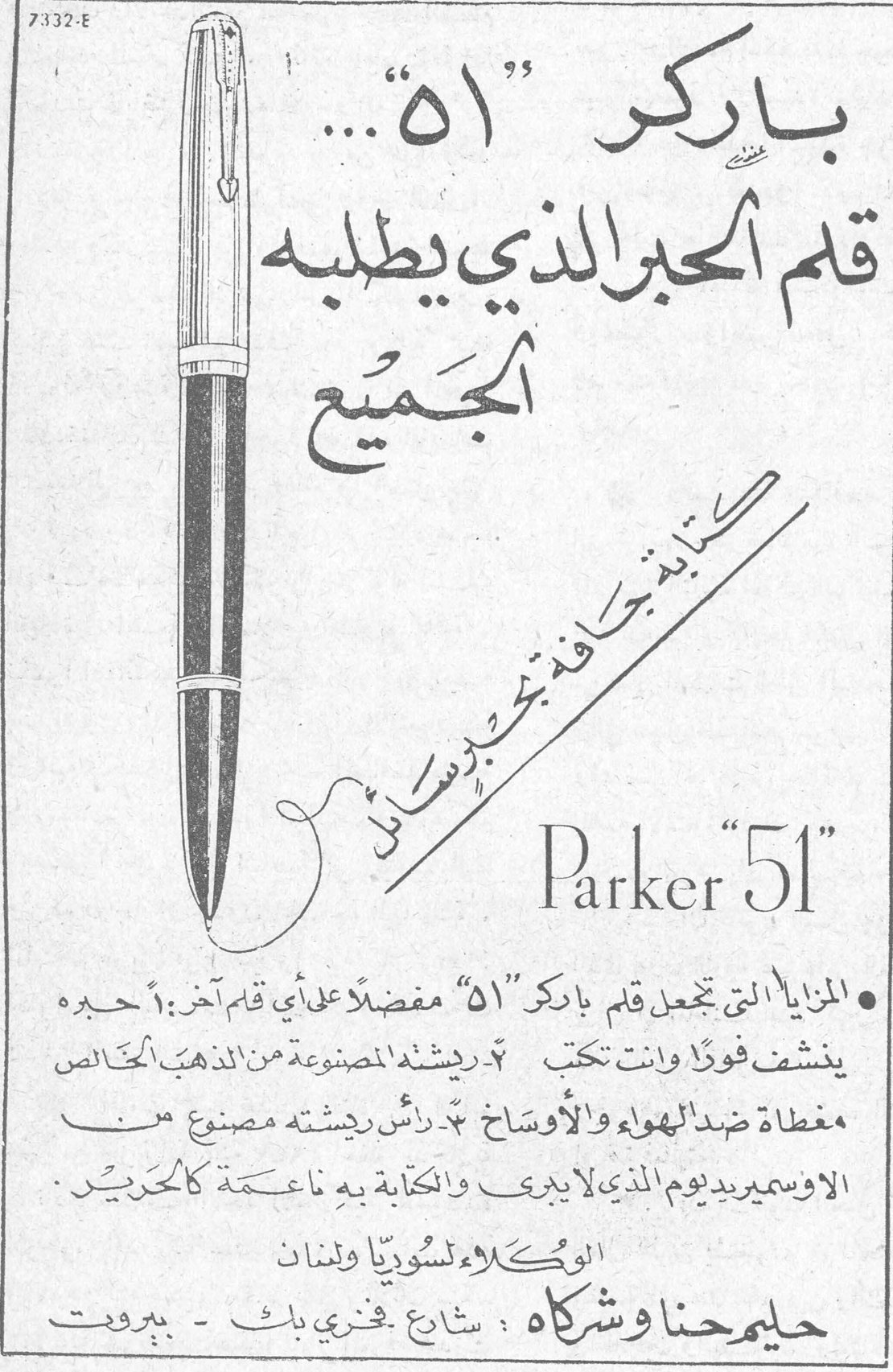
Parker “51”...
The fountain pen everyone asks for
Dry writing with wet ink
Parker “51”
• The advantages that make the Parker “51” pen preferred above any other pen: 1 — Its ink dries instantly as you write. 2 — Its nib, made of pure gold, is covered against air and dirt. 3 — The point of its nib is made of osmiridium, which does not wear down, and writing with it is smooth as silk.
Agents for Syria and Lebanon
Halim Hanna & Co.: Fakhri Bey Street — Beirut