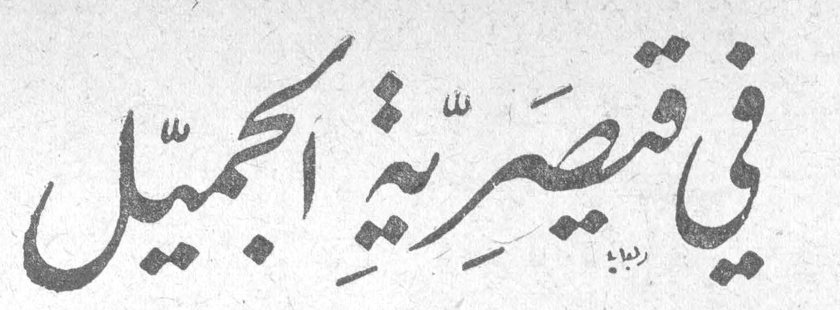
Cesar Gemayel has given his country house on the outskirts of Bikfaya the name "al-Qaysariyya." And if some names do not match the things they name, the Qaysariyya, without any doubt, is not of their number in the
least degree.
And how should it not be a Qaysariyya — this serene, tranquil building, crouched on a Lebanese summit which the dust-gray mist treats gently, wrapping it in nothing but a soft, fluttering wrap, such as to cut every tie between it and the earth and hang it in the heights of the firmament, a well-formed star.
Yes! How should it not be, when, over and above this beauty, it was built for art. For you — if it is given you to enter it as it was given me — cast yourself into the presence of art, before canvases leaning against the walls with the nonchalance of one well pleased with himself — canvases into which Gemayel has poured his soul and his personality in colors and shades rich in expression: in thought, feeling, and imagination. And how pleasant it is to look at them, and to look long — not because they are of boundless splendor, but because they creep toward your heart softly and tenderly, spreading love and warmth through its expanses.
And yet... despite the presence of these two, beauty and art, the Qaysariyya's Caesar suffices it. You may not be taken by what Cesar Gemayel embodies of his personality in colors and shades; you may not admire it; you may even suppose it lower than what it ought to be and could be. But you are taken, without any doubt, by the personality of Cesar Gemayel, and you admire it; indeed you would suppose it hewn out of the loftiness of Lebanon and its gentle pride. I cannot recall ever sitting with Cesar Gemayel without imagining that I was sitting with Lebanon in flesh and blood: a towering figure; a head on whose height the hair sits enthroned in resolve and dominion; a face whose features disclose the wide worlds locked in their owner's depths — generous in giving and in taking, melancholy in the midst of mirth, contented despite the anxieties of the present, confident of tomorrow, straining to embrace its destiny there with a believer's faith in the grace of truth.
To this Qaysariyya, then, we climbed one morning. We were four; let it suffice me to mention among them the artist Saliba Douaihy.
And the conversation makes its rounds, and no matter under the sun escapes it. And we find ourselves agreeing that the present situation in Lebanon is a wretched one. And it is wretched, likewise, at every crossing-point on the face of the earth. Where, then, is humanity heading? Modern man is the victim of a violent struggle between an old era that rebels against passing away and a new era whose glad tidings knock with stubborn insistence. Whoever supposes the subject of this struggle to be so shallow as to be confined to political, economic, and social systems has strayed far indeed. What we are witnessing between communism and capitalism is only the outward manifestation of a deeper struggle whose subject is liberty — that liberty besides which nothing shall be a subject worthy of humanity's struggle, a struggle of life or death.
For the sake of liberty, then — man's liberty to live and to die as he wills — you witness this struggle now under way in Palestine, in Egypt, in Lebanon and Syria, in India, in western and eastern Europe, in Africa, and in America south and north. It is a struggle that will not lay down its burdens until liberty sits on her throne in a kingdom where love reigns.
Yes, we are wretched — wretched as Lebanese, and wretched as citizens of this great, troubled world. And the source of this wretchedness of ours, as Lebanese, is that we lost our roots in history, so that at the dawn of our renaissance we set about searching for a heritage to live and to build upon — for what our existence requires of the virtues of thought and life: is it the heritage descended from stocks deep-rooted in the landmarks of history, or the Arab-Islamic heritage rising upon the traces of them all?... And so it came about that our morals went to ruin and our virtues sank, after the manner of those who have no defined history or coherent, living heritage; and so