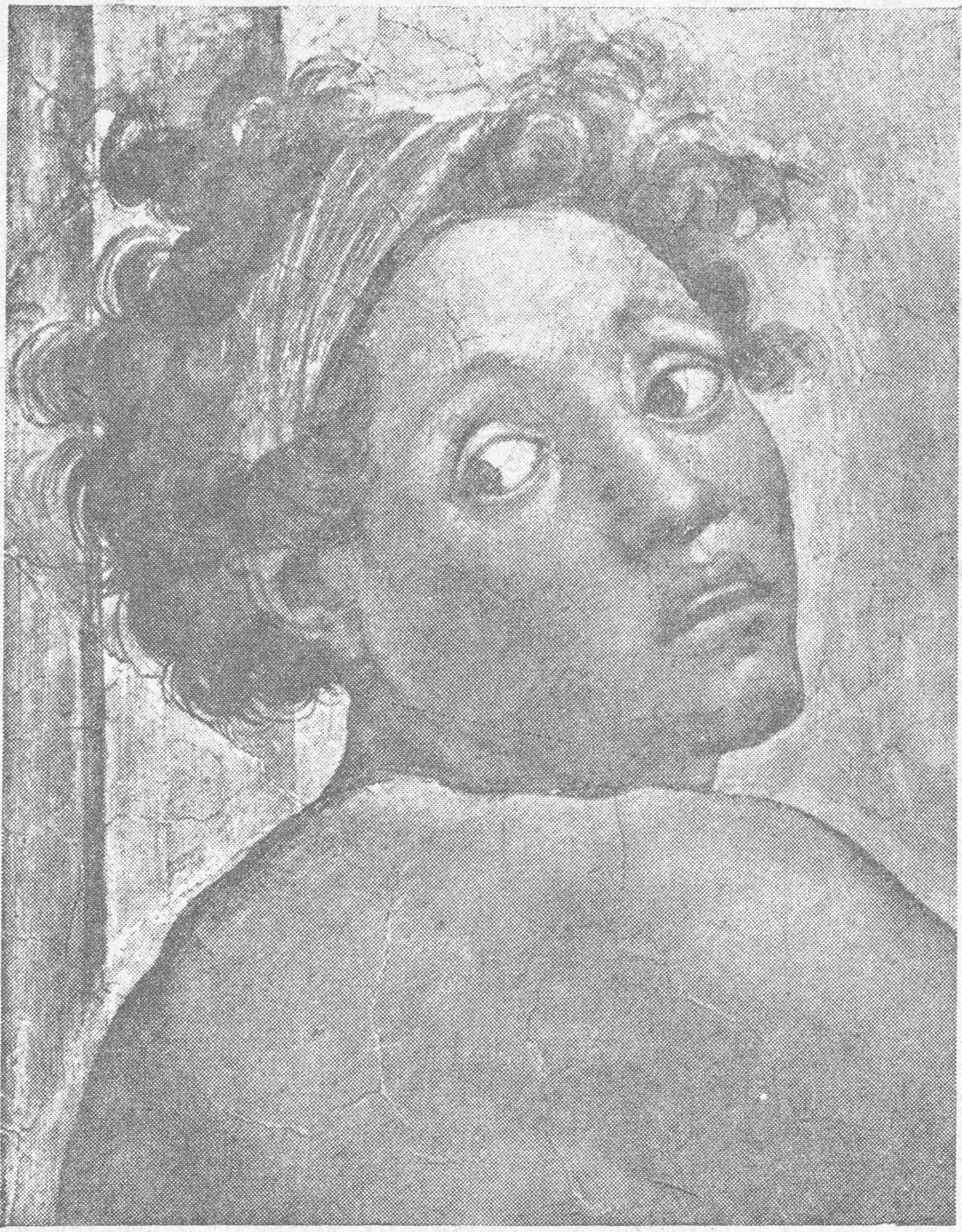
A head from the brush of the artist Michelangelo
Let us shatter the chains of time and undo its fetters and go free; let us suppose the age to be one of the ages gone by — let it be the fifteenth century.
In that century the Pope was the ruler of the old world, in the West, and its absolute prince, governing as he pleased and how he pleased, his rule running over all who followed him, with no difference between master and subject, king and slave.
And this authority of his was far beyond the reach of the tongues of rebels and malcontents, beyond the reach of any man's eyes.
One day of days the Pope heard that a singular artist, the like of whom life rarely bestows, was
living in Florence — that goodly town, now tranquil, now in revolt — and the herald of glory cried out within him, and the fingers of immortality played upon his skin, and he desired him to come. So he came, and entered Rome the capital, and its people caught sight of him and asked: Who is this!?
And they were told:
— Michelangelo Buonarroti.
The Pope welcomed this young man of strange dress, with his broken nose and his bushy beard, walking in his portico without fear, angry at every man, resentful of everything. He put out his hands, and when he came level with His Holiness he bowed according to the prevailing custom, then straightened up again and
conversed with him face to face in a voice of measured tones and steady ring; and the arms and hands, with their many motions, showed that his talk was the talk of imagination, holding within it a special project for the raising of a huge and matchless monument.
After an hour or thereabouts the man of religion turned to the man of art, saying:
— And how much do you ask as payment for this work of yours?
— A hundred thousand "scudi."
— And if we made it two hundred thousand... would you agree?
Come... begin the work.
— It is a rare generosity on
the Church's part, without a doubt.
Michelangelo went out cutting the marble as he wished and carving it into statues as he pleased, working night and day without rest or siesta; and at the week's end he would make for the Pope's treasury and enter upon him without asking leave, collect his wage, and find in the coolness of the coins' touch something that softened the edge of his weariness and soothed his exhausted nerves — until, when enchanting Aurora mounted her golden chariot at the dawn of the next day, the young man stirred in his bed, then rose brimming with vigor and strength, on his lips the smile of a man who believes in himself, who loves life not out of infatuation with it but because it is a stretch of time that opens to him the field of creation and invention.