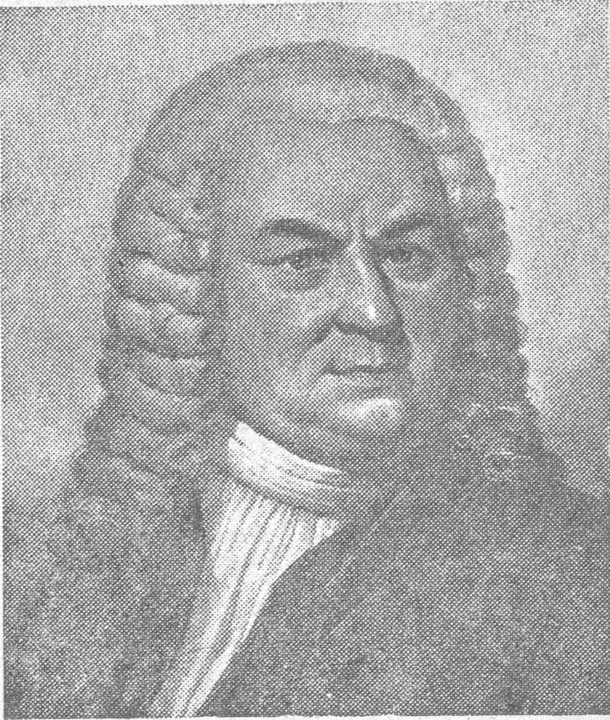
A man who grasped, by the inspiration of his native instinct, the hidden things of music and its obscurities, and who went on pouring forth magical hymns and melodies, until a rapture takes hold of the listener — a rapture arising by way of the optimism that reigns over his melodies.
How long Bach wrestled with fate, tasting its sweet and its bitter; and from his wide experience he drew opinions, maxims, and sound theories which every man repeats, wishing as he savors them that he had grasped them before this hour. This solidarity with Bach's personality is owed to his state of inspiration when he composes his enchanting melodies. His melodies are so unified that their parts admit of no division. With their phrases they rise to that lofty inspired state which we have tried again and again to approach. All that his soul utters and his lips murmur — words and passages — gives birth to a continuous stream into which flows the current of his vibration and trembling. And behold, we are stirred by what stirred Bach three hundred years ago: we rejoice at his success, we grieve at his failure, and our
soul sways forever, as his soul wills, between desire and dread, hope and despair. Such is the effect of that mighty splendor which reigns over the whole of Bach's composition, above mental and material factors, and carries us into its pure atmosphere. He is, as was said of al-Mutanabbi, one who “speaks with the tongues of events and expresses the thoughts of every man.” And above all this, his musical corpus is comprehensive and universal.
Bach created his works in the middle of the eighteenth century — that century in which Germany was influenced by France's musical culture through “Gluck,” who spent a stretch of time in French lands and afterward carried to the climes of Germany the pioneering French message, which the Germans transformed into immortal music. And yet those works stand apart from the general literary current that swept the whole age; for extravagant imagination and excessive sensibility had become the reigning fashion and the basic rule in Germany, while France at that time was marked by the reining-in of imagination and the stagnation of thought. German letters in that period were characterized by the writing of personal books expressing private feelings without any regard for general truths or for the stamp of common humanity. We could support our statements with a valuable account of all his compositions; but we know that every group of his compositions demands, for its analysis and presentation, at least a separate article. We must, however — if only for the moment — follow the spirit of haste that prevails in these times, and content ourselves with fleeting glimpses.
The melodies of the “Mass” show us Bach's soul yearning to soar toward the Creator. The listener to the fourth section — the one suited to the moment of the “Credo” in the divine sacrifice — imagines, as the many sorrowful melodies rise, that they whisper to man his unworthiness of Christ's death upon the wood of shame. As he continues on his way in composing his Mass, he frees himself little by little from this sorrowful atmosphere and carries us into a loftier and more resplendent one, where flashes the gleam of hope in a life happier than the one we live, and of surrender to the Creator's will. As for his style, the meanings are sweet and graceful, the writing clear, rich in phrases and in ornamented notation that lifts the curtain from a sea brimming with music in Bach's noble soul. His melodies — as Georges Duhamel said in a lecture on Bach delivered in Paris in 1937 — were created to glorify their Creator, such is their purity of conscience and clarity of faith; and they possess something of that magical melody which carries away the innermost hearts.
Then comes the tragedy of “The Passion according to Saint Matthew,” which falls into two clear parts: the first ends at the arrest of Christ, and the second begins with the session before Caiaphas and continues to the tomb of Christ. Bach composed this tragedy in 1728 in Leipzig. In it we see a clear and manifest expression of all that the soul of the Son of Man stored up throughout His passage upon the earth: the lofty virtues and the warm, surging ardor for the salvation of mankind.
As for his toccatas, they are a magical wonder of musical construction into which the composer poured the essence of his heart, his lofty aims, his burning thought, and his singular intelligence. His compositions for the organ are the utmost of musical beauty and artistic harmony, which together make of them