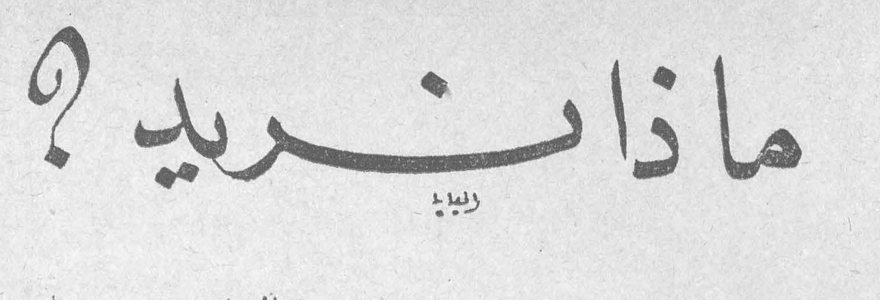
Knowledge is a mental act, positive, aggressive, marked by a conscious egoism and a justified pride drawn from a sound, deep feeling of precedence and superiority. And whoever grasps the truth of a piece of knowledge cannot but love it, strive toward it, and will it. Knowledge, in the end, precedes the will, and the will inevitably comes after it.
I say this with the thought in mind that we, in this country, so often will what we do not know, or do not will what we know, or do not know what we will. Our willing what we do not know drives us to commit a logical error: making the will precede knowledge or, at the least, stand apart from it. On the other hand, our willing what we do not know sinks us to the level of the mob, rushing after the unknown in a blind, emotional rush. How often have we cried out for unity without knowing, deeply and truly, the pillars of that unity? Or pursued nationalism without having any clear, pure idea of its essence? Or joined under the banner of an idea, grown zealous for it, and solved our problems by its light, with no full awareness of it in our minds and no plain understanding of its grounds and of the sources of its formation? And finally, in a single word, how often have we willed what — had we truly known it — we would not have willed, but rather, if we were sincere, would have rejected decisively.
And often we do not will what we know, either because we have lost our efficacy and our vitality, so that surrender to dreams and illusions has grown pleasant to us, or because we are traitors unfaithful to knowledge, and cowards who fear the uprising of ignorance against us. In the first case we furnish the proof of our deficient humanity; in the second we pass upon ourselves the judgment that we are unfit for life and liberty. If in our country, even in this twentieth century, there is no existence for intellectual life and intellectual liberty, it is only because we do not cut our way to them over the skulls of martyrs and victims, as the West did before us five centuries ago. We want life and liberty not on the basis of the little that we know — because we fear and turn coward — but on the basis of the much that we do not know — because we thereby avoid the uprising of ignorance against us, embodied in the mob and in worn-out inherited traditions.
And finally, we often do not know what we want with a true, clear knowledge. That is why you see us wandering in the darkness of perplexity and emptiness. And if we do know a little of what we want, our knowledge of it does not pass beyond the bounds of generalization. We know, for instance, that we want reform; but reform is an empty generalization, and our willing it is worth nothing unless we know what the sound foundations are on which we ought to build this reform we mean to achieve. Are they foundations drawn from our history alone? Or from our history and the history of other civilized nations? Or from neither the one nor the other, but from the wellspring of the positive world civilization standing today? And then, is the reform we want, built on sound foundations whatever they may be, a political reform, or an economic one, or scientific, or moral? And do we truly need reform, or a revolution — a moral and intellectual revolution before all else, one to carry us from the Middle Ages into the twentieth century — that is, five centuries forward?
We do not, in truth, know what we want. That is the secret of our remaining in the darkness, burrowing our dens like moles and taking shelter in them, safe from the clamor of the light and from the loud heat of the sun. Knowledge, in the end, is a will that works and builds in pain and sacrifice. So instead of knowing what we want, we take refuge, like the mob, in willing what we do not know, and we hold back, in treachery and fear and cowardice, from willing even the little that we know.
Issue 11 — Year 3 — November 1947