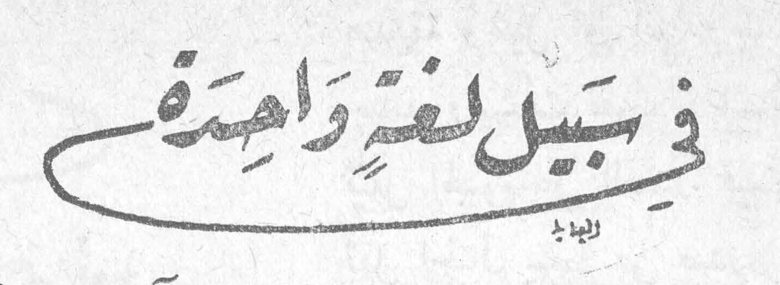
Anyone who looks at the future of the Arabic language with a view not narrow of horizon sees that if this language is to live, it must pass through a series of developments and reforms that are indispensable if it is to become a modern language keeping pace with the other modern languages.
I shall sum up these reforms as follows.
1 — Enlarging its vocabulary and profiting from the various methods of borrowing, coinage, and derivation to enrich it with modern terminology.
2 — Reforming the Arabic script so that it becomes easier to print and to read. Some attempts have been made in this direction, the most recent being that of the Lebanese artist Nasri Khattar, which consists in making a change in the shape of the letters so that they are written separately, in print and in handwriting. But his project, for all its merits, is still incomplete, because it does not take up a fundamental problem of the script — the problem of fixing the vowel marks (the damma, the fatha, and the kasra), at least those that fall in the middle of the word, and of devising letters to take their place, as in French and English. It is no secret that the neglect of these vowel sounds, in printing and in writing, makes accurate reading difficult, indeed at times impossible.
3 — Enlarging the Arabic alphabet. Our alphabet has twenty-eight letters as against twenty-five in the Latin languages; yet our language lacks certain letters needed for writing the foreign proper names current in history, geography, and the press, whose origin no one can make out once we have written them in Arabic. As for the consonants such as G, P, V, these they have managed to indicate by special marks over the fa', the ba', and the kaf. But that is a temporary expedient and an unpractical method; better than it would be to establish letters corresponding to them, and other letters corresponding to the vowels, especially O, U, E. It might even be possible to take these over as they are, with some modification, if we wrote the letters separately after the manner of Nasri Khattar, or in the Western manner.
4 — Simplifying the rules of grammar. This is an old refrain, and much has been said about it; the modern grammar books have taken small, scattered steps toward it, and the need is still pressing for a simplification of wide scope, carried out by concerted scholarly efforts on the part of all the Arab countries.
5 — Reforming the spoken language and drawing the literary and the colloquial closer together. This is the
subject I wish to touch on in some detail, because it lies within the reach of teachers, and every educated person can take a hand in it. This kind of reform takes several forms. One of them is simplifying the literary language, making it easier, and adjusting its phrasing in a way that suits the modern taste. The second is widening the movement of exchange between the two languages, the literary and the spoken: there are words we suppose to be colloquial which are literary and stand in the dictionaries, such as 'ayyat, futa, maraq, rah, hatt, and it is necessary to use them in the literary language; and there are other colloquial words which the literary language can absorb, for their aptness and suitability, such as mushkil, muntazah, di'aya, madyun, tamma, hawuz, kabbut, hazuqa, etc.; and other expressions and idioms besides, which ought to be brought into the very body of the language. The third is raising the level of the spoken language so that it becomes less deformed and less coarse. And finally, reforming pronunciation and enunciation, and easing the weight of the local accents that are conspicuously heavy and plainly grating.
The thing we must keep before our eyes — if we are among those who care about the language — is that Arabic can neither grow nor spread, nor can its students master it, so long as this vast gulf remains between the language of writing and the language of talk; and this language cannot stand firm before modern developments unless it becomes a language of speech and conversation. The teacher of the language is obliged to accustom his students to use a simplified literary Arabic as far as possible, and obliged also to attempt the refinement of the spoken language, as follows:
1 — By purging it of jarring foreign expressions: replacing "automobile" with sayyara, "merci" with ashkurak, waraq bol with tabi' and tawabi', "cordon" with siwak, "cartable" with mahfaza, bosta with barid, "dossier" with milaff, and so on. And at the same time we try, as far as we are able, to coin new words that render the meaning of the foreign ones, as one student coined the phrase jami' awraq to match "Lefax."
2 — By purging this language of every expression and usage that affronts taste and departs from the norm to no purpose — for example: the use of joz for zawj, haqiq for hanaq or ghadab, 'aqad for qa'ad, ma'laqa for mil'aqa, qalaq for araq, khasal for ghasal, safad for sadaf, zaqaf for saffaq, ijr for rijl, bayyi and khayyi for abi and akhi.