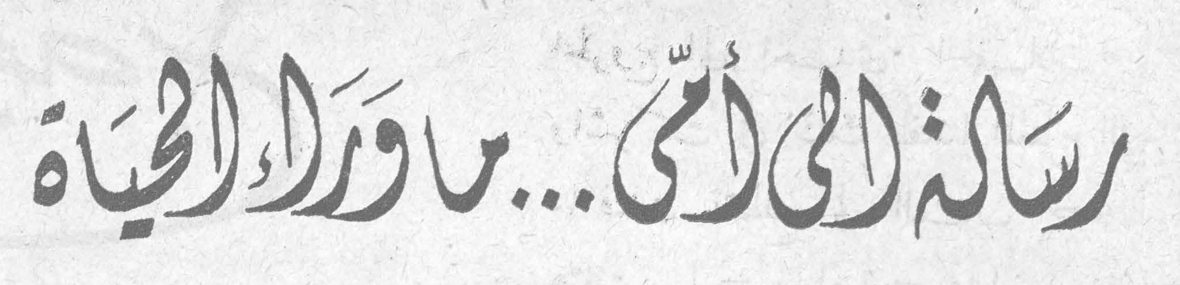
Mother:
Yesterday I withdrew into myself, reviewing certain pictures in its depths and certain feelings, when all at once your serene face filled my soul and my feelings, and I wished to speak to you, and to commune with your spirit.
But what talk can I offer you, what communion! What affair of my affairs, or sorrow of my sorrows, or secret of my secrets, or tremor of my heart's
tremors, or gleam of my features, or line of my brow, have you not touched with your fingertips, not encircled with your feeling? Can I turn east or west, or take a step forward or backward, without your being with me? Are you not in the eye of the providence that keeps watch over me? Are you not in my fancy and my imagination and my dreams — nay, are you not the blazing ray in which my thoughts and my inspiration bathe? You, my mother, are the perpetual wakefulness in my being. I lie down and rest; but you, from the time I was formed a babe in your womb until eternity carries me off from you — if it can find a way to do so — know neither rest nor stillness nor slumber, because I am the eternal cross you created that you might crucify yourself upon it, until the day when I — or you — lose all sense of material or spiritual life! ...
Woman, mother, is half the universe, but she is the heart of life. She is generosity and the generous. Forever given to sowing and planting and building. She sows and waters, but she does not reap. She plants and prunes, but she does not gather the fruit. She builds and adorns and furnishes, but she does not dwell.
I have followed your traces from the time you became a living being, from the time you began to know your own face, and life began to know its face in it. I saw you a daughter and a sister. Then you walked a few steps along dim windings — despite the beauty of the earth and the radiance of the air and the music of space — and you became a wife. And before long you became a mother ...
In this still, quiet hour I have wished to study you, to unfold your history, to portray your heart, to draw you in lines and colors, a great canvas, that I might be able to say to my imagination and my mind and my heart: I have returned to my mother a drop of her sea, a ray of her sun, and a rose from her field! ...
Your beloved face has vanished from my eyes, and my eyes have no power of sight, nor my memory of printing and picturing, so that no material trace remains to me — only a trace where once there was the thing itself. It may occur to you to ask: why does he write, and to whom, and how does he imagine and feel?
You have the right to ask, and I have the right to remind you that every mother, in every time and place, is my mother. My blood and my spirit, all that I feel and all that I sense, are you — without denying my father's merit. And if I strain my imagination and my heart to reach your all-embracing forebears, in every corner of the universe and beyond it, then this is a message I deliver; and as I write it to you, I write it to all mothers, to all women, to woman, in the unknown wilds of the earth and in its landmarks — the woman who went before man, or the woman who still feels that he is her master. And in writing to you I write to every creature, to everyone possessed of conscience, that perhaps this communion between me and your spirit may become a message to society, and after it society's message to civilization — the civilization of man, who wants to rise into the ranks of the gods! ...
A little girl you were in the days when you carried the cares of your father and mother and your small brothers. Yes — no sooner had you reached your sixth year than responsibility was laid upon your shoulders. You felt that your father and mother were the cause of your existence, more than your elder brother or your younger brother did, so you hastened to create joy out of nothing — teasing, playing, chattering — to lighten the heaviness of the air upon your father's shoulders, and to coax life gently, in the fervor of your good, tender, serviceable childhood. And scarcely had you climbed a little way up the ladder of growth than your responsibilities swelled. Your mother and father would leave the house upon your shoulders, and you grumbled a little — and what little you grumbled was only by stealth and in whispers — because your keenness of feeling and your daughterly love made you the ram of the burnt offering: yours the responsibility, yours the care, and in you "the breadth of character."
And as a sister — how much of yourself you gave to your younger brother or sister, indeed to everyone younger than you among the children of the quarter, the neighbors, the relatives, and the acquaintances. You are the companion who gives and does not take, who loses and does not gain. You are forever staking your capital, be it great or small, for the sake of others — but for the sake of their good, first and last.
And now you have begun to understand. You now have ambitions and desires. You too are a human being