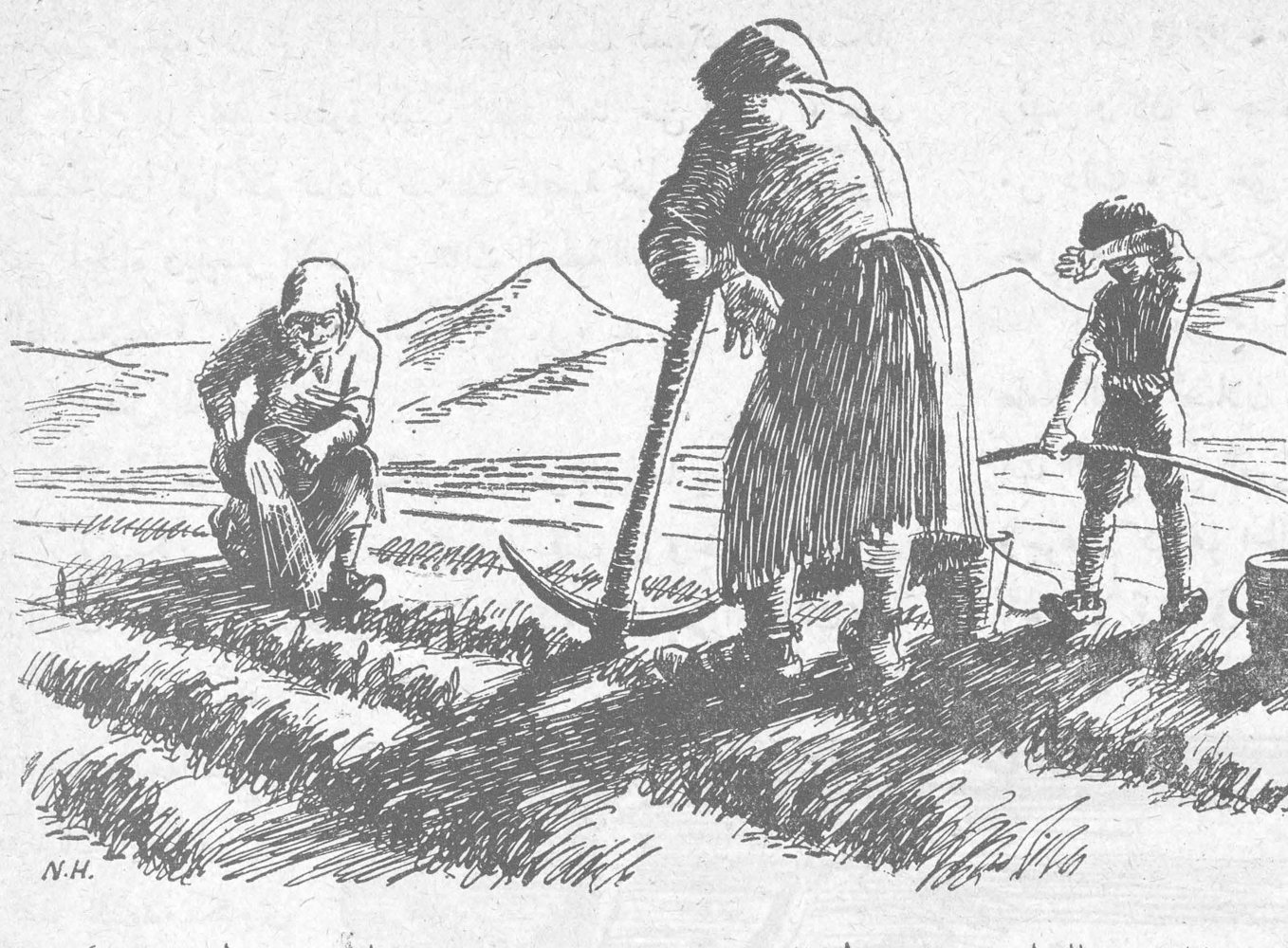
sticks taller than themselves, they drove lean cows to the herd that used to pass by the edges of the village; and together, too, they would pelt the frogs in the canal with clods.
And when they had grown somewhat older, they were accustomed to go with their mothers to the market to sell ghee and yogurt. They would go together to fetch wood from the mountains, a journey covered in seven hours on donkey-back; indeed they would sell this wood each in the other's presence, and if they managed to sell it for a few piasters above the market price to some official from another region unversed in prices, they would buy from the same cloth two lengths, from which they made themselves two matching shirts.
As youths they would go to the wedding feasts together and watch the women dance. And, as is the case with all the men of central Anatolia, the friendship between these two men was a silent friendship, empty of phrases; but its outward signs showed, from the dawn of their youth, in their habit of walking side by side, the hand of the one in the hand of the other.
As they advanced in age, the gravity that marks those who drudge to wring their daily sustenance from the earth made their relations still further removed from outward show. And when it fell to their lot to bear the responsibilities of a family, they met less often than before. Zaghar Mehmed had married; as for Mehmed of Dedemköy, his father had died, leaving him to support his mother, his elder sister, and a younger brother of eighteen springs.
It would sometimes happen that the two old friends met at the approach of night beside the wall of the mosque, where they would sit watching the flocks returning to the village; and they would remain for close upon half an
hour in silence, exchanging not a single word; then the one would look at the other, and nothing would come over their faces but a smile; then they would leave their seats and return to their houses.
At last, so as to add to the working hands in the house, Mehmed of Dedemköy and his brother Mustafa married on one and the same day, and two brides who had not yet seen their twentieth year came to live under the roof of the one house built of mudbrick.
And so life ran on in its course, as it had run for centuries past, in the shape of a quiet struggle to wring a bare pittance of food from a grudging earth.
And in the thick of the thought of food, which claimed for itself all else, friendship and outings began to fold away, little by little, into the folds of oblivion, sinking gradually behind its veils, until with the passage of time they were erased even from memory.
One day Zaghar Mehmed went to water his field from the canal and found the channel empty of water, with nothing in it but a layer of yellow silt. Then he raised his head and began to look along the canal; then he looked toward the field of Mehmed of Dedemköy, whose field lay a little above his own, and found that
they had built a dam across the water and were busy watering their land.
Then Zaghar sent his six-year-old son over to them, and the child set off running barefoot over the dried cow dung until he reached the field of Mehmed of Dedemköy and called out to them: "Father says you must let the water go."
Mehmed did not answer; the child waited a moment, then turned back, running, to his own field.
After that the two Mehmeds stood watching each other across a distance of no more than a hundred and fifty yards.
That look disclosed many things; but the first and most important thing that came of it was that from that day there broke out between them a quarrel that admitted of no settling. The look held no hatred, for nothing had passed between them to cause it. There was in that look only the specter of a quarrel whose source was land and water — a specter that draws blackness over the thoughts of men. Nay, perhaps the look held something of sorrow as well — a sorrow born of their knowing that an exchange of mortal blows was inevitable: how else could life go on, and how else could that meager piece of chalky land be kept; how else could a