handful of grain be got out of this divided field.
For apart from that, there was nothing between the two men to cause hatred. Zaghar Mehmed could not stand against the two brothers, and so peace was his first object; but he knew that it was impossible, that the water would not suffice to satisfy the need of both sides, and that for this reason, too, Mehmed of Dedemköy would not answer his message.
And yet Zaghar Mehmed waited. He kept going to his field and watching the water channel and the dry yellow silt in its bed, then turning his gaze for a long while toward Mehmed as he moved about his field. He waited, and looked up at the sky. He searched for clouds. And still he went on waiting.
As for the ears of grain — the thin ears — they
shrank gradually until they stood no more than a span in height.
After that the sun gave up all its other offices and concentrated its rays upon that small spot in the steppe country, drying up that small green patch. And under the rays of the sun those delicate little blades fell to quivering like the tongue of a dog worn out by the heat.
Those ears never grew beyond a span in height — those small, wretched ears. But the ears in the field of Mehmed of Dedemköy grew until they reached to the knee. All this while the sun kept its rays concentrated upon the field of Zaghar Mehmed, where the color of the ears, no more than a span tall, began to turn toward yellow.
In Çumra there was an office for supervising the distribution of the water; the office had a chief, and
it had collectors of water taxes and other officials besides; and in spite of all that, not so much as a single drop of the canal's waters passed beyond the field of Mehmed of Dedemköy.
Zaghar Mehmed saw that his wife and his mother of sixty years, who worked in the field bent double the whole day long, and likewise his son of six years — he saw pallor spread over all their faces, as it had with the ears of grain whose color had turned to yellow while they were still but a span tall. And Zaghar thought, and waited. And there is none who knows the depths of what passes in the mind of a peasant of the steppe, nor what it is he waits for.
...
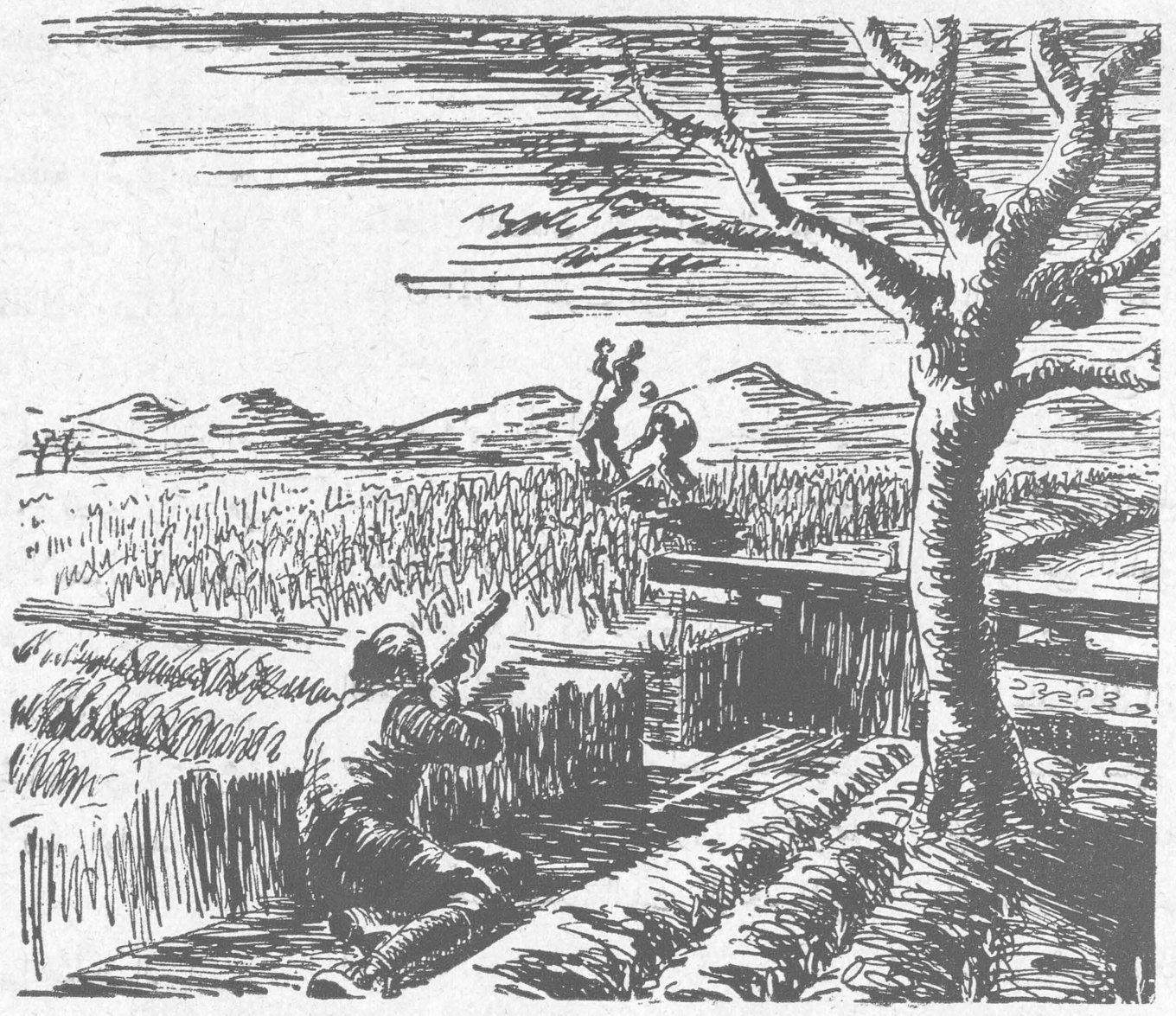
Early one morning Zaghar took his rifle and set
out for the field, and lay flat in the dry channel until he saw Mehmed of Dedemköy and his brother; then he fired five shots.
And there is nothing easier than dying and killing in those barren fields.
Zaghar Mehmed asked his wife, who came hurrying up, to open the channel of the canal and to water the field, and told her that from that day on they would let no one hold back the waters of the canal, for not one of the men of the upper field remained.
And while his wife was on her way to the dam built across the canal to remove it, he called after her, charging her that the boy's gifts must not go to waste, and asking her to bring him from time to time to visit him in prison, and not to treat his old mother badly.