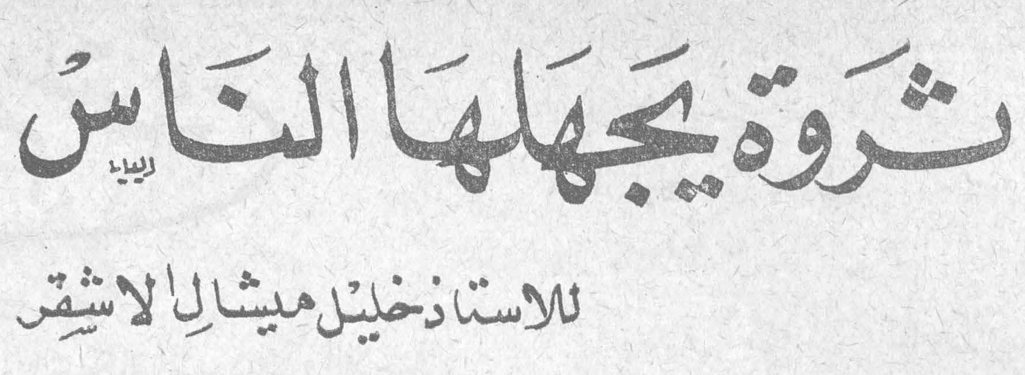
Riches.
The majestic sight of the mountains — this sight, manifold in its unity and firm in its repose — cannot but awaken the creative powers latent in the depths of man.
Never have I felt such awe as when I found myself face to face with the splendid sight of the mountains in one corner of this beloved country. At first glance this scene appears to you like a drawing whose secondary lines are not yet complete — rather, a drawing come from the brush of a creative artist who was in a state of rapture, and who took up the brush to draw what his soul pictured of the unfinished phantoms of the mountains, and what it sensed in these mountains of loftiness, mysticism, and divinity. Yet no sooner do you fix your gaze on this same scene than you notice that the artist was not in a trance but in full possession of his senses, drawing to express the silent struggle in the depths of his soul between the forces crawling toward the lowlands, which pull him to take the path of the material world, and the blazing forces climbing toward the heights, toward the world of mysticism and of union with the greatest Creator, who is God.
These lofty rocky peaks, here and there, rising forever toward the heights like the points of spears, represent exactly those ascents ablaze with the fire of faith which the believing mystic creates, desiring to meet his Lord a believer, good, pure of hand and heart and conscience.
And these deep valleys, parting in the depths, represent the disparity between man's base desires and his lofty, perfect desires. This valley is forever the valley of tears to which Gibran and the prophets pointed; it is the valley that runs dry in summer, when longing for the perfect good sets its breast aflame, and that floods in winter, when the sweeping inclinations overwhelm the lofty inclinations within it — floods so as to go forever down to the sea and vanish, neither giving benefit nor receiving it; rather it does harm in its flooding, and how many times has it torn up the secure willow and the tranquil walnut tree,
that their trunks might vanish in the greater flood, which is the sea.
The difference between it and the pure spring that bursts from the breast of the mountain, past which the earth and the people move, overflowing with goodness and generosity — the maiden carries her jar to it and fills it with the clear water of life; the shepherd shelters beside it, the sheep around him thirsting for the beloved draught; and the peasant bends over it after his toil, stretching out to it his two pure hands, wearied by the blessed mattock and the good pruning shears in the rich vineyard...
The difference between this silent spring and the clamorous flooding of the valley is very great indeed: it is the difference between the small good and the great evil. For evil is not excused by its greatness, while good is not harmed by its smallness; great and small are relative, and hence it is right to recall the well-known saying: “How many a lowly one has risen, and how many a great one has been brought low”...
The unknown wealth, then, is the one we discover in the sights of our mountains and our valleys, and in what they inspire of perfect goodness and lofty love. And not one of us will be rich, in the deep sense of the word, unless his soul overflows with goodness and love.
I call upon those immersed in their worldly life, drowning in the sweeping flood, to forsake the din and withdraw to the artistic corners of this country, to live in silent harmony with immortal nature. Then their eyes will open upon the true wealth; then they will know what richness this immortal richness is, and what wealth it is that brings us near to God, while in our conscience the voice of repentance whispers, and in our heart the echoes of true faith answer one another. I call upon mothers to take their children on daily outings to the valley, the mountain, and the slope, so that these immortal images may be stamped on the mind of the growing child, and a secret communion take place between him and nature — one that will awaken later in the form of love, goodness, and forbearance.
Material wealth alone cannot give
man rest and peace of mind. He finds no rest until love of the good and forbearance take shape in his depths, so that a man comes to work for his brother as he works for himself, and comes to dread evil and flee from it. This, upon my life, is the richness that man lacks.
This wealth is not in the bowels of the earth, nor in the vaults of heaven; it lies within reach of the hand, the eye falls upon it a thousand times every day, and people do not see it, because over their eyes is a film that hides from them the abodes of goodness and the abodes of richness in this beloved country.
By wealth people mean what the fist can close upon of this perishable coin — money passed from hand to hand without enriching mind or heart or conscience. For that reason it is a dead wealth, bearing in its essence nothing but deadly sloth and sickly idleness; for the more of it gathers in its owners' hands, the more their resolve weakens, and they retire from fruitful work and from the long, useful striving demanded by the nature of life, which aspires always to steady advance and to full, harmonious growth.
This wealth drags man down to the abysses of servitude and abasement. And what servitude is darker than one that strips man's mind of invention and creation, strips man's activity of vitality and growth, and strips his soul of loftiness and perfection — all for a fistful of money that profits nothing but the intestines, and holds no place on the path of perfection that might lend it any essential or intellectual value, however small.
When man gave material wealth its present value, he was in a state of material “hunger.” And his spiritual and ideal capacities — those that drive him to seek absolute perfection and absolute beauty in absolute goodness and absolute spiritual richness — these capacities, I say, were in a state of cramp and slumber. And should they awaken to this material floundering into which man has fallen today, they will not be slow to create a violent revolution in man's whole frame, nor slow to stir up man's view of life and of the world around him, and thence of himself.
The wealth I mean is the wealth that lies hidden in the values of the things around us — above all this wealth that lies hidden in the powers of nature standing before our eyes at every step along the paths of this mountain