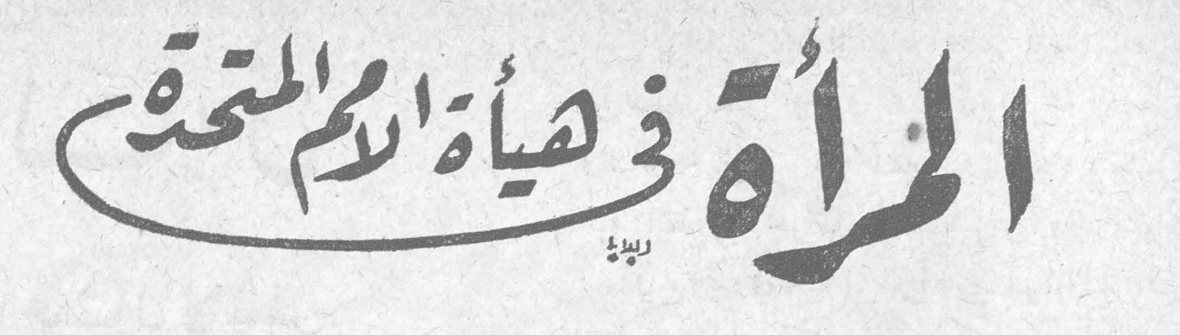
In the United Nations there are 450 delegates, among whom are only ten women, distinguished by their abundant activity, their enthusiasm, and their devotion to the principles of man and the rights of woman; they do all in their power to realize the idea of social and political equality between the sexes.
Fifty-five nations take part in the United Nations, yet among them are some that deny women the right to vote. These nations are: Afghanistan, Belgium, Bolivia, Colombia, Costa Rica, Egypt, Ethiopia, Haiti, Honduras, Iran, Lebanon, Mexico, Nicaragua, Saudi Arabia, Syria, and Venezuela. As for Canada, woman is deprived of the right to vote in the province of Quebec. Chile and Greece grant her this right in municipal elections only.
Here follow some of the prominent women figures in the United Nations.
Eleanor Roosevelt
Eleanor Roosevelt, wife of the late President Franklin Roosevelt, is one of the strongest women personalities in the world. Her breadth of knowledge and her experience of affairs have won her the respect of her women and men colleagues on the committees of the United Nations. Last January Mrs. Roosevelt was elected chairman of the Commission on Human Rights of the United Nations; her election took place amid a storm of the greatest enthusiasm — and no wonder, for all her life she was a faithful companion to her husband, the great democrat.
Eleanor Roosevelt was in the forefront of those concerned with the problem of the displaced
and the refugees, and she had the leading share in the formation of the International Refugee Organization.
She would constantly call upon the members for more deeds and less talk. Once, speaking to them of woman's right, she said: “The United Nations is the voice of the world, and woman must be a part of it.”
Aase Lionaes — Norway
Mrs. Lionaes studied at the University of Oslo, then entered the London School of Economics and joined the association of Norwegian workers to work in the underground resistance. When the Gestapo was about to arrest her, she fled to Sweden. After the liberation she returned and was elected head of the women's movement in the Norwegian Labor Party.
It may be recalled that the Norwegian woman has the same political rights as the man; Mrs. Lionaes is now fighting to equalize woman's wage with man's.
Mrs. Lionaes is a mother, with a daughter six years of age.
Bodil Begtrup
Mrs. Bodil Begtrup graduated from the University of Copenhagen and headed the United Nations subcommittee charged with studying the status of woman. She presented a proposal urging the states belonging to the United Nations to give woman the right of political equality with man.
Mrs. Begtrup was president of the National Council of Danish Women in Denmark's delegation to the League of Nations, in the year 1938.
Although the law makes woman and man equal in Denmark, Danish women show no great activity in political life there.
Marie-Hélène Lefaucheux
Madame Lefaucheux had never concerned herself with politics in her life. Hence we have seen her embrace socialist views although she is the wife of one of the great men of industry, and then resolve to resist the Germans.
When she is described as a heroine, Madame Hélène denies that she is one. She says: the true heroes have been laid in the earth. She is adviser to the French delegation on territorial affairs. The Resistance nominated her to be a member of the municipality of Paris. She opposes women's organizations and does not acknowledge their importance in the struggle to obtain woman's rights.
Vijaya Lakshmi Pandit
Vijaya Lakshmi Pandit was recently appointed India's ambassador in Moscow; until very lately she was head of the Indian delegation to the United Nations. She is a friend of every oppressed people, whoever they may be.
She goes forth defending the rights of man and the rights of persecuted minorities, and she delivers her speeches with eloquence and warmth.
It was this same surpassing eloquence that moved Jan Christiaan Smuts, prime minister of South Africa, in the Security Council —
to strike out his address, in one of the sessions, of the Indian