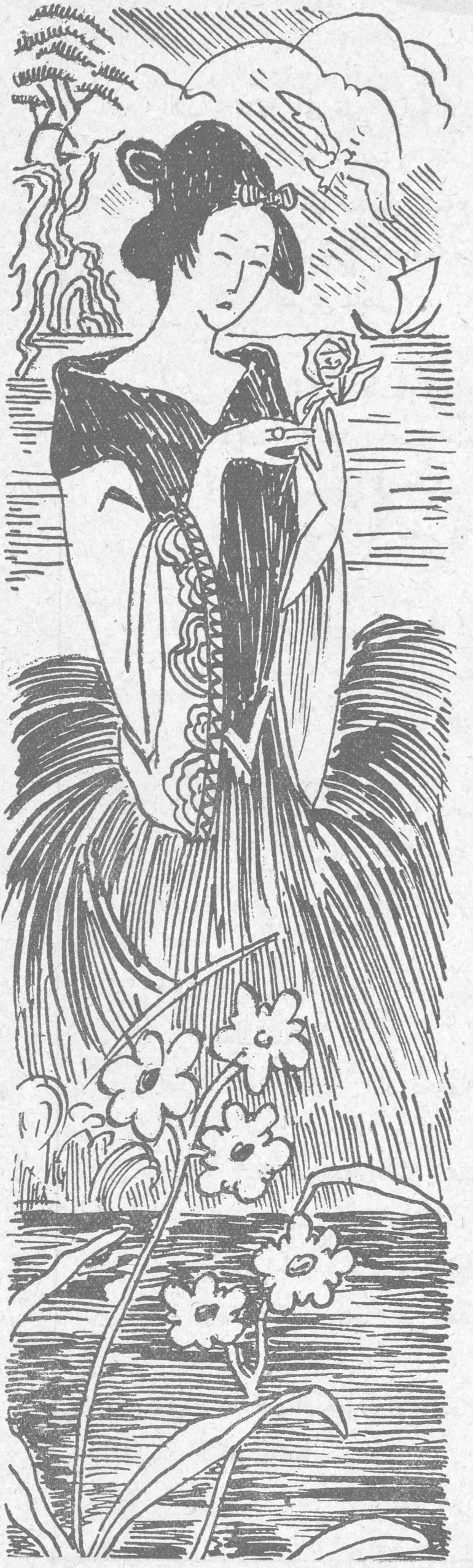

Sociologists, American and English, are taking an interest in studying the position of the Japanese woman from the social standpoint. These scholars have begun writing long articles about women's life in Japan, and they ask: do the Allied Powers intend to reform the life of a great class of the women of the Land of the Rising Sun?
One of them wrote a long article in which he said:
In fact, the woman in Japan remains to this day mere chattel owned by her husband or her father; and the best she can expect of life is this: will she be treated as a beloved, tame animal, or as one of the house's precious and charming curios? Yet many women are looked upon as mere animals for hauling and labor — indeed, worse than that.
Strangely, educated Japanese see nothing out of the ordinary in women being treated as slaves are treated, and in their being denied the slightest opportunity by which they might give vent to the will and desire in their breasts. The women of Japan, who number forty million, have no legal rights whatever. And the English influence which their cultural organizations employ toward the bettering of their lot is far less than the influence employed by the bodies concerned with preventing cruelty to animals in Britain and America...
It is a natural and familiar thing among educated Japanese to see the girls of their country sold by fathers, brothers, or uncles to the body called the 'geisha,' on the white market, or hired out to practice prostitution.
The price of a girl offered for sale ranges between one thousand and ten thousand 'yen' — that is, the equivalent of 17
or 70 pounds. The income she brings in after her sale is divided among herself, her family, and those who bought her.
The law authorizes the 'geisha' body to buy whatever girls it pleases, whatever their age; but girls are forbidden to enter one of the 'geisha' houses before reaching sixteen years of age, and they are likewise forbidden to practice prostitution before the age of eighteen.
The girls put by most of their earnings so as to be able to win their freedom before they reach thirty; until that date they are considered the property of the 'geisha' body, which disposes of them as it pleases.
The girls feel nothing of happiness, for they are never given the chance to see any other color of life than this one. And it has never happened that anyone asked one of them about the inclinations, desires, and hopes stirring within her.
The Japanese peasant uses his wife for hauling exactly as he uses an animal. It has been observed that Japanese women, when they have finished their daily tasks, crouch silently against the walls of the dining rooms until their men have finished eating; then they come forward to the tables to devour the scraps their masters see fit to leave them — contented and satisfied.
It may seem to some that these statements are far from the truth and greatly exaggerated; for how are we to explain this great backwardness in Japan's social life, if it is compared with the great progress on the political and economic sides?...
But whoever has visited Japan knows that these facts are but a little out of much! And perhaps this is among the strangest phenomena of that land filled with wonders.