The throb of your breast is other than it was yesterday — the day when brows were rubbed in the dust, brows that had wearied of diadems, finding them thorns, and yearned toward the roses, and set a parting
between your temples... And this pallor in your face is a crescent in the history of the moon...
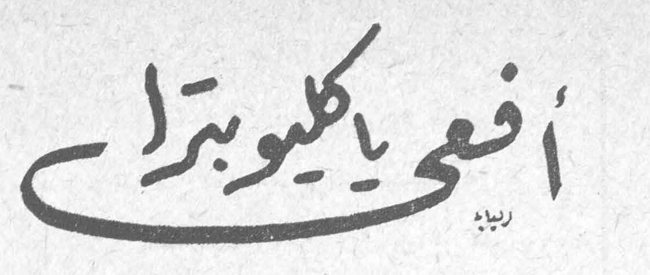
An asp, Cleopatra — and at your breast?
It writhes, it writhes... In the heaven of your body are a thousand serpents, each deadlier than the one that lies in wait at the spring of honey and milk; it writhes.
A serpent denied your first mother Paradise, and a serpent has denied you the paradise you were living. But you are ever the conqueror: and see, your little companions have gone forth to avenge you; there they go, taking vengeance upon us, serpent for serpent.
And what is your acquaintance with love, Cleopatra?
Alas for this shore — a whip of flame; upon it you grew, and in its folds you had your dealings: ask Alexandria, and Rome, and Tarsus, and Actium, and Jerusalem... And you knew love before lovers had grasped it. Early was your acquaintance with love; early, your acquaintance with blood.
And what is love, Cleopatra?
A giant, and a fathomless vault, and a young girl displaying a body... a woman's body; and the giant takes fright, and the ravening beast throws himself upon the little foot and kisses it — yet with no abjectness. And a smile: that is love — and the meeting of two lips... Weep no more, O lover, in your bed, and learn from the little loving girl.
And horses' hooves drummed in every quarter, and in their neighing was the name of Rome, the eternal city; and a mocking laugh rang out, its echo heard in the Capitol:
"I came, I saw, I conquered!" Ha, ha! Behold the hero, O Rome, husband of all your women: he leaves his armies and his charges and sets about a new conquest.
Who is the conqueror now, Caesar? Will you not say: "I came, I saw, I conquered"?
Yes — it is Aphrodite raised up anew: did she not come forth from a bundle and stand before you, while you gaped in astonishment, just as Aphrodite burst from the foam of the blue sea? And is she not of the very stock of the gods? No blame on you if you were
conquered: did you ever taste in Gaul, O victor, what you taste now, fettered in chains?
Where is Calpurnia? Where are your other wives? Has not this Eastern goddess the right to mock the Capitol?
To Rome, then — and set her up as ruler over the center of the earth, mother of your son and your successor.
And if you die, fear no barrenness in the heart of your beloved.
Like the sweet lake toward which the streams rush headlong, tossing and clamorous in their descent from on high: she gathers them into a heaven of gentleness, and draws their waters — and in the taking there is bounty — then casts them forth again: a perpetual, unceasing process.
Ha! Were none of her lovers known but Caesar and Antony, but her brother and the giant? And who has counted the stars? And who turns to look at the brooks once he has known the rivers?
And Antony came to her — a new river.
A scornful smile on his lips: for he knew well the stings of sorcery. Cleopatra? Beauty? Enchantment? Aphrodite? He is Antony — force, might, Mars of iron... And it never dawned on him that his ancestor Mars stood disarmed before Aphrodite. He would show her who he was and who she was.
And she showed him who she was and who he was...
And he summoned her to Tarsus, to come cringing before him. And she went to Tarsus — and why hold back? Her love never in its life knew coyness. And her galley moored upon the coquettish shore. And it was she who summoned him: no refusal — but no going up, either. And the light dazzled him: where is your loftiness, Antony, and where your yellow smile? Did the crimson melt them both?
There is Rome, and her conquests: of no account, a civil war and the sundering of a state; and what matter? A hideous defeat, and suicide — and a name