over the canvas... She thought his life would never go beyond that amusement and play, and she did not know it was the beginning of the struggle and the first of the preparation. His life stayed as it was until his twenty-ninth year, when he began to exhibit his canvases with his friends the Impressionist artists. For until that time he was still drawing from the bank money enough to keep a comfortable house and a fine, spacious studio.
At thirty-two Paul Gauguin realized that there was nothing in the banks to draw him to them, and no pleasure or delight in that work of his; and
he realized, too, that painting is an art worthy of a man's vowing to it his self and his life. So he forsook the banks and gave himself up to his passion, repeating his saying: "From now on I shall paint a picture every day."
And it is nothing strange or wonderful if I tell you that his private life began to decline rapidly — indeed more than that. He moved with his wife and children to Denmark, where the wife began to work to feed her children and her husband and drive hunger and famine from them. But Paul had not the strength to remain so; he resolved to depart for Paris with his eldest son. He reached it — and behold, the child fell ill; he nursed him and went on painting. He was forced to sink lower in his manner of living, and moved to an inn outside Paris which the artists of the past century had made their headquarters, leaving his son behind him. In that inn Gauguin took his place among the artists and created his own school. Afterward he was driven out to the islands of Martinique, then returned once more to Paris... yes, to Paris again... or rather to those who "live in Paris in dissipation"... to the Moulin Rouge and Montmartre... to Cézanne and Van Gogh and Georges Seurat and Toulouse-Lautrec... to Zola
and Émile Bernard... to the nineteenth century entire, concentrated in a single glass of absinthe...
Yes, the nineteenth century, which shattered the shackles with a single blow, by a single band, around a single table... and in the embrace of one and the same abject poverty!
Mankind has never known a company of men stronger of will, tougher of fiber, and firmer of soul than these...
But the band was not to stay in Paris while the world stretched out in all its spaces; the sun is a blazing torch moving slowly everywhere, and the artist in the nineteenth century was a blazing torch too — so it is no
wonder and no marvel that he followed the sun and walked in the light.
So Seurat died, and Zola grew rich, and Van Gogh departed for Arles, and Cézanne withdrew into the hills and fields of Aix-la-Chapelle, and Toulouse-Lautrec stayed on in the Moulin Rouge and its haunts — and Paris grew desolate, and Montmartre stood empty.
There reached him from Arles an invitation from his favorite friend Vincent van Gogh, and he went there, where he passed with "the red-haired madman" a time divided between painting and quarreling and...
In Arles there is a hot sun, its color the color of lemons, its light a yellow that splits the head and shatters the nerves; if you would make its acquaintance, go back to Van Gogh.
And in Arles there are women, of whom Paul Gauguin will tell you...
And there are other things in it... and Rachel... and the tale of Rachel is difficult; its telling is forbidden here. But I will tell you that she cost Van Gogh his reason — or rather helped him lose it — so that he began to
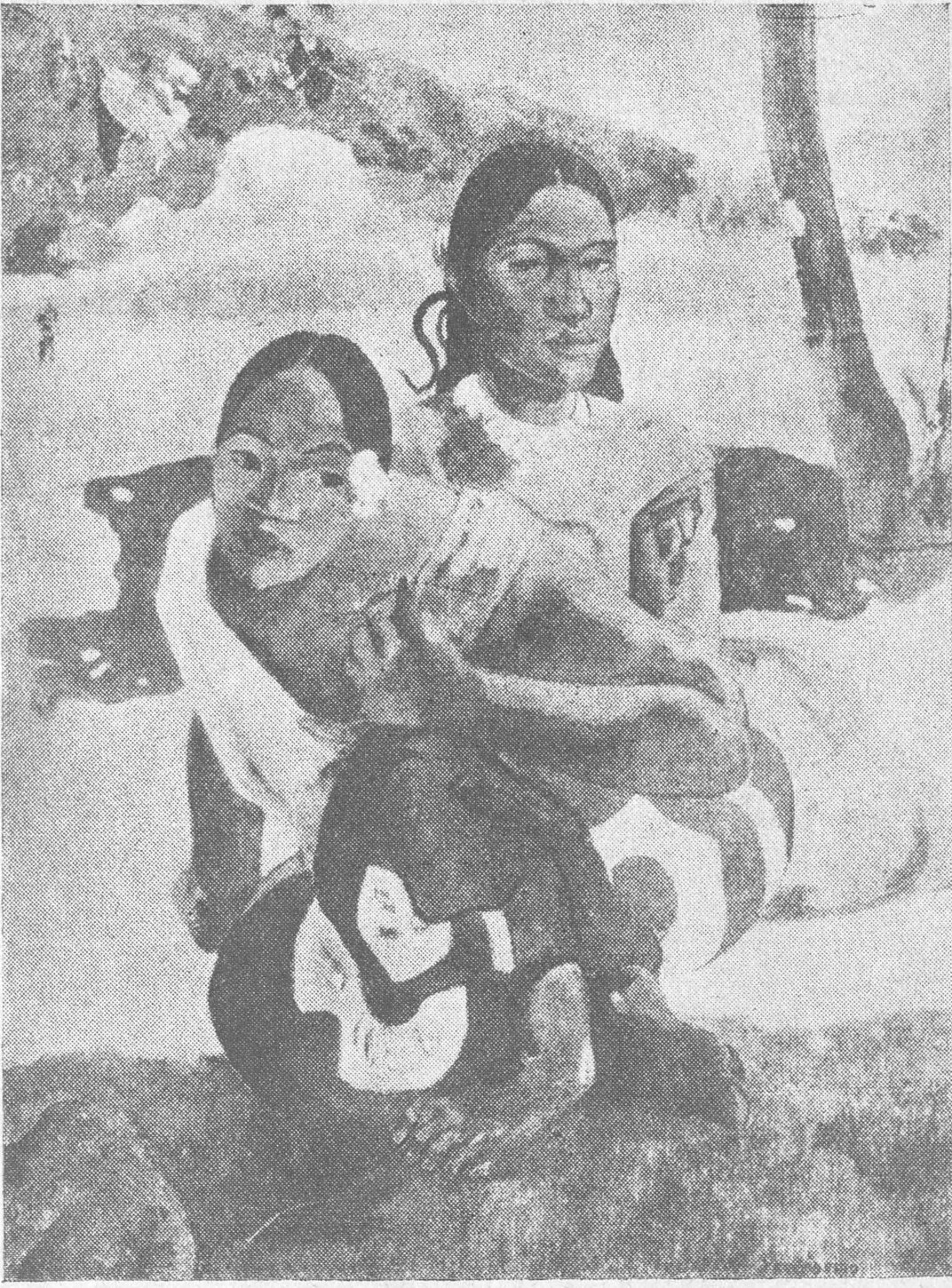
Women of "Haiti," from the brush of Gauguin