But the news never reached Abu Said's big ears, for he does not mingle with mankind. He believes in nothing but the field — and let him die of hunger who does not worship the earth. His creed: "Who does not sow does not eat his fill." As for Umm Said, she learned her son's news from the jar-carrier — nicknamed in the village "the Post" for her chattering — and she sat down to weep.
Two days before Christmas she said to her husband: Give me leave to go look for Milad. And before he could say no, she rushed on, her eyes fastened on his face: For your life, give me leave. How can Christmas pass with the boy away from home?
Abu Said scowled, and she said, brokenly: For your life, say to me: go.
— Go, and Godspeed, Umm Said. But sew up your dress; it has been half a year in the chest. And your shoes?
She answered: The dress we'll sew tonight, and I'll borrow Umm Habib's shoes.
He forced a laugh and said: Sew at your leisure. He'll be better brought up if we let him keep the feast in Beirut.
— No, no, no, no!
— All right... you're in the right. Run, catch up with him.
And fearing Abu Said might take back his leave, she sewed nothing; she borrowed everything, down to the shoes and the stockings — and on Christmas Eve she was in Beirut.
No door of livelihood had opened for Milad in Beirut. Boys like him are locusts crawling over the city: this one kills, that one begs, another picks pockets. Milad tried all of it and had no luck; portering and begging did not stop his hunger, and he withered until he had all but dried up. His clothes grew filthy and tore, till people shrank from him in disgust and he would slink off out of the way... Then the poor wretch heard that on Christmas Eve people give alms, and give of their best, and he girded himself for the battle. But the frogs of his belly were croaking, and his legs would not carry him. He remembered his father's saying: "Straw is the nails of the knees," and he sighed for one lick of food, and walked through the souk like misery made flesh. He saw the little Christmas trees set up at the doors of the shops and laughed at them — but they reminded him of their winter evenings at home, and he groaned. Then he walked on with a beaten eye, hunting for the loaf — and the loaf is a whole engine of labors for a worn-out wretch like Milad to come by. He turned and saw the turkeys laid out and hung up by their beaks, and took them for chickens, and cried out as he walked: "God's blessings! That's chicken!"
The whisper of spoons and the ringing of glasses, here and there, worked upon
him, and he remembered his mother's breakfast on Christmas morning the year before, and sighed, and crawled on with resolve, making for Burj Square. The north wind drove its freezing cold at him; he shivered and chattered, and remembered the raids he used to make on the wine jar, and sighed for one sip. And when the rounds had worn him out, he flattened himself near the Cathedral of St. George, and stretched out his hand for the first time, and cried:
— Alms, kind gentlefolk! I throw myself upon you. Hungry!
The people passed, and not one stopped for him. A few half-piasters were tossed to him, but they would not buy a loaf; his crying grew hotter, and their number grew a little, and he put them into his ragged felt cap. He cried out and counted, and when he found he had the price of two loaves he praised God. And he remembered the Gospel verse that says: Seek, and ye shall find; knock, and it shall be opened unto you — so he went back to his pleading and his moaning. He warmed to it, and worked so hard at playing the beggar that he mastered the whole eloquence of that art; but it profited him nothing, for the crowd at the springs of the "Nativity grotto" had thinned. So Milad held his tongue and set about a final reckoning of what was in the cap: supper was secured, and there remained something to wet his throat with come morning. So he put his trust in God and stood up. And hardly had he straightened when a street ruffian of his own age butted him, snatched the cap, and flew.
Milad let out a fearful shriek and made to chase him; but hunger turned his head, and he dropped in a heap where he stood.
A woman had been watching, from the opposite pavement, this struggle of two desperate alley boys over the loaf, and she rushed toward the fallen one, tripping over the hems of a dress longer than herself, hobbling and bunching her steps as though her shoes pinched; and she would have gone down in the middle of the road had she not braced herself. After a thousand pains she reached the spot where the beaten boy lay heaped, and stood over him, her eyes welling with tears; then they rolled down hot, all but scorching her cheeks. And after a moment's musing — who knows what memories came crowding in upon that woman's fancy — she found herself stirred to charity, little as the money in her pocket was; then her hand went out to the boy, and she said to him, half knowing, half unknowing: Get up, my son; come with me; I will give you your supper.
Milad tore his eyes open and cried: Mother!
Aley, December 5, 1947
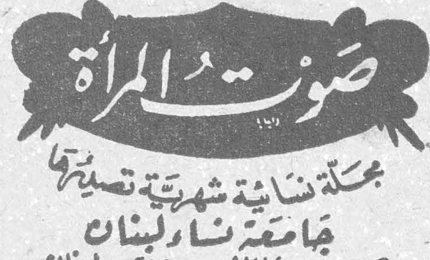
A monthly women's magazine published by the Lebanese Women's League
P.O. Box 1284 — Beirut — Lebanon
Responsible director: Heneni Tarcha
The supervisory committee: Afifi Majdalani,
Ibtihaj Kaddoura,
Rida Jureidini,
Lily Badre
Managed and published by
Dar al-Kitab
General editorial director: Youssef al-Khal
General business director: Fuad H. Badr
Administration: Beirut, Phoenicia Street — the Saab Building.
Address: Dar al-Kitab, P.O. Box 1284, Beirut — Lebanon
Subscription: in Syria and Lebanon, 15 liras;
in the Arab world, one and a half pounds;
abroad, ten dollars.
This amount is payable in advance, either by postal money order or by bank check made out to "Dar al-Kitab," or through our general agents.
The subscription rate for official departments and institutions is 25 L.L. in the Arab world, and 50 L.L. abroad.
Advertisements: by arrangement with the administration. The administration has a special advertising branch which photographs the advertisement and produces it artistically, in keeping with the level attained by the modern art of advertising.