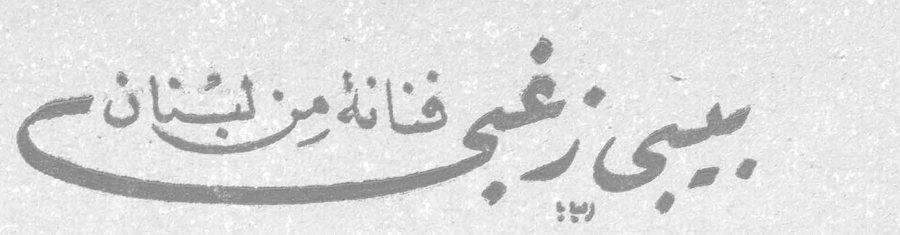
When I was told that a Lebanese woman from Argentina was to exhibit her canvases to the children of her first homeland, I felt my imagination bolt suddenly toward the women artists whose works history has recorded: I remembered Madame Vigée-Lebrun, and I remembered Rosa Bonheur, and I remembered Berthe Morisot and Mary Cassatt and Marie Laurencin. But I did not once remember — nor did there cross my imagination the memory of — a single one of the men artists who have filled the books of history with their names and crammed the museums and exhibitions with their works. I did not know the reason for that omission, but I tried to grasp it, and I found that my neglect of them was unintentional; for I believe, consciously or unconsciously, that the gap between men artists and women artists is too wide for a woman to cross with ease, so as to link her name with theirs and her works with theirs, or to summon one of them to my imagination.
Then it happened that Omar Onsi invited us; so I met her and made her acquaintance, and I found that despite the twenty-five years she has spent far from the East she still keeps her Eastern nature in her talk, her habits, her hopes, and her opinions... as though she had come down with all this from one of the villages perched on the shoulders of Lebanon's hills, and had not brought it across the vast ocean.
*
Mrs. Bibi Zoghbi is Lebanese by birth, Lebanese in constitution, Lebanese in mind and soul.
Like all the girls of Lebanon, she was born in Lebanon, of Lebanese parents; yet she did not live the life of her fellows, but created for herself, and by herself, a life of her own...
She was born in a small village on the quiet northern shore, a village whose name perhaps only a small handful of Lebanese now remember; she told me its name was "Sahel Alma."
She remained in Lebanon receiving her first schooling until she reached fifteen. Of her childhood she remembers nothing at all — except one sweet picture, blurred at the same time, which she carried away with her, like the shadow of a dim phantom, of Lebanon and its people, of its society and the customs of its sons.
Like many Lebanese, Mrs. Zoghbi set out for Argentina and made of it a second homeland; she grew up in its regions and was reared among its people, and she loved it and loved them, and her spirit loved their flowers; and she felt art creeping slowly into her nerves. She looked about her and found her hand fell short — yet she did not take fright, and did not retreat... A short time passed in which she found herself and knew her goal; she took up her brush in her right hand and her palette in her left; and a few years went by, and behold, Bibi Zoghbi was an artist in whom Argentina took pride before the sons of "Sahel Alma" knew her...
*
Her artistic culture rested on her own effort more than on lessons received from masters of painting. That shows plainly in her canvases, for she has been able to cut a path all her own — even though now and again we find slight traces showing us that she walks with the kit of certain earlier artists such as Gauguin and Rousseau... I do not mean by this that she was influenced by them or borrowed from them — she herself denies it, and says she did not know them until someone told her of the resemblance between them... I mean rather that with her inner being and her artistic gifts she understood nature and grasped it, independent and alone, as those two understood and grasped it before her.
Mrs. Zoghbi's first exhibition was in Argentina in 1934, and the approval and patronage she won there encouraged her to persevere and press on; so she made for Paris, where she held her second exhibition in 1935, and she spent some time in the city of the Louvre, gathering memories she treasures and loves. Then she returned to South America and toured its countries, painting and exhibiting her pictures, until the war broke out; then she withdrew into Argentina until last summer, when she gathered her canvases and crossed once more to the city of the Louvre. Last June (1947) the artist opened her second exhibition in Paris and gained from it what she had hoped to gain; and she sold enough of her canvases to venture a grave financial gamble — for she gathered up her remaining canvases and brought them to Beirut, to show us the fruit of her delicate, tranquil brush, although some people told her she would sell nothing in Lebanon, and would find none of