epithet of “the deserter who flees his camp and gives himself up to the enemy.” What he broadcast in America may be summed up as follows:
“The Kremlin, knowing that war is bound to come, divides the struggle into three stages: 1. The occupation of all Europe in three weeks. 2. The occupation of half of Africa and of the Middle East in three months. 3. Mastery over a part of Asia within three years, with the help of the Communists of China and of the Chinese and Dutch Indies — and, in the end, agreement with America on the dividing of the world.”
And Madame Tabouis says that the broadcasting of these secrets drove the Americans — who labor unceasingly at perfecting the invention of pilotless aircraft, atomic bombs, and killing microbes — to hasten the discovery of the secret rays which, though they remind us of the tales of H. G. Wells, are the only way by which America can help her allies in the West! She believes, further, that the failed London conference brought us nothing new, for it merely gave “an official stamp to a situation already existing and known to those taking part in it”; that any solution and any state of affairs is better than a casual agreement lined with fundamental disagreement; and that the coming war will not be declared for two years! As for what came after the London conference, she told us that it dashed every hope — above all the resolution for the partition of Palestine, which “will remain in the records of history a perfect picture of the greatest political error committed by postwar policy.” And she spoke to us of her hope that the Americans would find a way to delay its execution, and even to fight the voted resolution with certain reservations!
* *
And Madame Tabouis sat down, having delivered her lecture
standing — contrary to the custom that French lecturers have followed. She sat down amid sharp, long applause, aroused — along with her sympathy for Palestine — by her elegant bearing, her wide knowledge, her concise sentence, and her strange intimacy with every jot and tittle of world politics.
The president of the Cénacle announced that the lecturer was ready to answer questions from the audience, and this allowed us to touch the Lebanese consciousness — wary, comprehending, and skeptical.
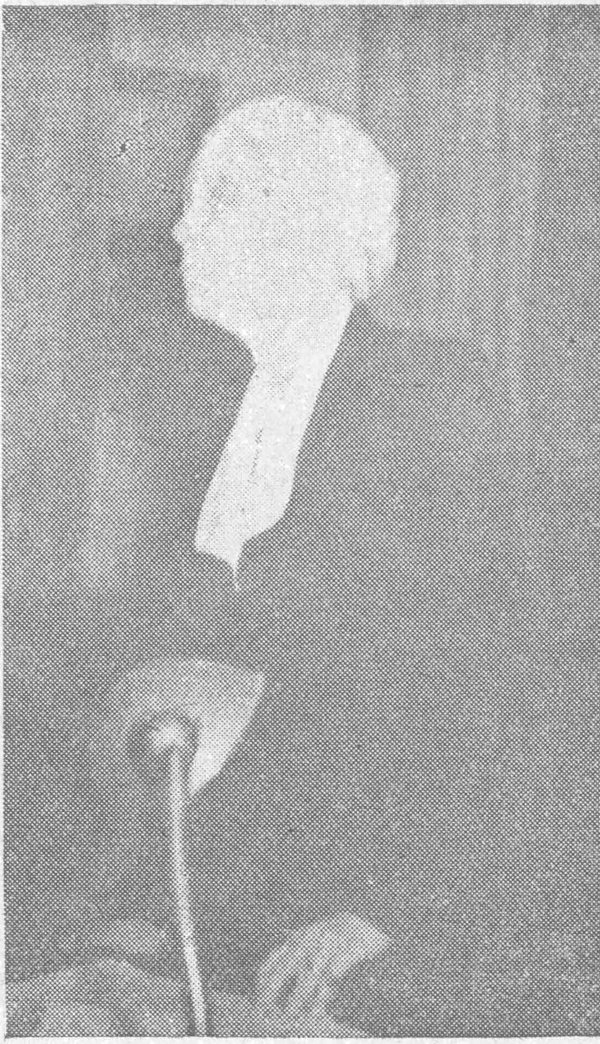
Madame Geneviève Tabouis lecturing at the Cénacle
Among the questioners were ladies. And among what was said:
You have spoken to us of the great quarrel between the Americans and the Soviets, but you have told us nothing of the position of the mistress of the seas.
She answered, after a tactful circling in which little of the conclusion's frankness could be commended, that England is
America's ally and will remain her ally.
And someone sprang up to say:
What drove the statesmen of France — men of prudence and of fine feeling — and he all but said: and among them a great stateswoman of the very measure we have just seen — to stand on the side of partition?
She answered, calling the amusing jest to her aid in order to win the round: “It was the Frenchmen's delicate sense that partition would never come to pass that drove them to go along and to vote with the resolution.” Then Madame Tabouis turned about, returned to her sincerity and her gravity, and intimated to us that the French are in need of everything — of food and of clothing... It is the dollar!!
The most mischievous of the questioners was the gentleman who said: How do you explain the Anglo-Americans' fear of Communism — all this fear — and then Russia's positive stand for partition? The execution of partition will bring the hand of the Soviets into this Near East. How are we to explain that?
The writer of these lines believes that this profound question received no frank answer, despite the lecturer's skill and her radiant intelligence...
A glance chanced my way, and I saw the face of the intelligent Mrs. Alice, wife of President Alfred Nakkash, smiling at me a smile of far-reaching meaning; and it occurred to me to say to Madame Tabouis: — You have spoken to us at length of the Four Great Ones, and of the Big Forty; will you not speak to us of the small? Will you not describe to us — you who have traveled the inhabited world — the feelings of the peoples of the small countries, like Belgium and Holland and Albania and Greece?... Will you not tell us something of the fearful, trembling mothers bent over the cradles, and of the fledgling boys who in two years