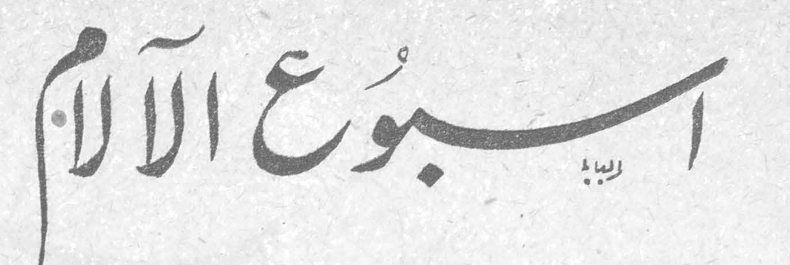
Holy Week is truly a funeral: the church mourns, and puts on no adornment until Saturday evening (the Saturday of Light), in rejoicing at the resurrection of (the Bridegroom) triumphant. So if the villager has named it (the Sorrowful Friday), he has spoken truly.
The village is hushed and reverent, and grief fills every house. They give no greeting of “happy be your day,” nor wish one another good evening; their salutation is “Glorified be the Son of the Lord, Jesus,” and its answer, “Peace be to Our Lady Mary the Virgin.” The church is like a beehive—people coming and people going. The walls heave sighs, the apse groans, the dome wails with broken strength. Prayers every day; and as for the fast, do not ask. None breaks it but the freethinker, and none eats meat, eggs, or laban but the scant of faith..
***
In those days... Father Timothaos came to the sanctuary before sunset and tolled the bell in mourning. Then he drew from his bosom his rosary, to pray to Him who rides upon the East and the West. He began pacing the church court with majesty and gravity, as though walking on eggs, sighing now and then and looking at his rosary to see how far he had come. The Thursday evening prayer is long, and the people were slow in coming.
Strange of aspect is the priest—had Darwin known him, he would have needed no other proof. His eyebrows squat beneath a jutting forehead like a tilted ledge above two nostrils set in carved rock, between which stretches a flat, cleft nose; and beneath this fountain, two mustaches like ram's horns, under which dangles a beard so long that were it not black as a raven's wing you would take it for a broom.
Glory to the Creator! He gave him ugliness without reckoning; and, as though He wished to make of him a portent, He struck him with smallpox, which greatly lessened his dignity. And his great affliction was that his eyes did not match: one eye carob-brown, the other blue—the beholder would take it for a blue bead against the evil eye. For this the nickname (Blayq) prevailed over his given name, Boutros, before he was anointed with the holy oil a priest of God; then his fatness added to his ugliness, so that since his
consecration to the Creator he is squat, thick, black, and glistening.
The priest was merry in his youth, fluttering about, never settling anywhere, with no business but hopping around the village; you heard nothing but “Blayq's gone, Blayq's here.” The child of his father's old age—a boy whose father died, and a mother does not bring up.
As for the elders of the village, they would shake their heads, marveling how Blayq had gone and another had come.
And an old woman said to the one sitting beside her: “God, God—how you once were, Umm Qablan, and what you have become!” Her son had heeded her, and became priest of the parish. And so it proved: her house prospered, and she was at rest from the blast of the oven and the tannur. She used to eat from her spindle and her carding—and she became a princess.
As for Father Jirjis, who had become helpless and decrepit, he sat among his children, listening. He moves his lips and his coal-black beard and says nothing. He remembers his old glory, the days when the parish had a single shepherd, and he mutters; at last he wrinkled up his nose all at once and said with sharpness and mockery: “Fie upon the days we have come to! Since when do they consecrate to the Lord the refuse of mankind, like our brother-in-God... This, a priest? This is a good-for-nothing.”
His sons tried to hush him, but he raised his voice to spite them and cried twice: “This is a good-for-nothing! This is a good-for-nothing!”
As for the young men, Father Timothaos's companions, they withdrew and formed a ring on the open ground under the ban tree, talking and winking at one another, now nibbling their laughter down, now snapping it short. Uneasiness showed on Father Timothaos's face, and he kept bearing down in his walk toward them, hoping to catch a scrap of their talk. The priest fears the tongue of one of them: Zakariya. And Zakariya is a young man past thirty, tall and lean of frame, his skin pale and sallow. He took the vow of celibacy at twenty-five, put on the black striped qunbaz, stuck the inkwell in his sash after the manner of the shidyaqs of that age, and gave his fair beard free rein—though he kept trimming it, so that it never grew long. His comrades
made sport of his short beard at first, but he bore with them and beat them.
The shidyaq is a man of praiseworthy qualities: he casts down his eyes if his neighbor-girl comes in sight; he keeps the commandments of God and the Church; he never missed a mass or a procession. He is the church's mainstay—its qandaq—and the priest's deacon, so as to earn the reward. He has not broken his fast of a Saturday since he came of age and reason, and has eaten neither meat nor eggs nor laban on Wednesday and Friday; and in Lent he shuns oil besides. It is all one to him whether the Patriarch permits it or not: he is his own patriarch. A devotee of the Virgin Mary—should (the Lady's scapular) slip from his neck, he would sleep no quiet sleep that night. And were it not for his mockery and his sporting with people, none would doubt his sanctity. For this trifling with the afflicted is a great sin that brings a man down to hell; and a man abides its aftermath, punishing himself in spite of himself: God brings forth in the offspring of the mocker the defects of those he mocked..
Zakariya was forever making game of his friend the priest, and it went to his head.. Not a girl in the village escaped his teasing or an evening at her house, and often he would knock at several doors in a single night; and wherever he alighted, the house filled with uproar and laughter.
He had all but married Tabitha, daughter of Daher Hanna; but he obeyed his mother and made a eunuch of himself after the death of the village priest, studied theology and Syriac, and after two years became a venerable priest.
***
The dead man is his Father's only son, and the night was moonlit, tempting people out of doors; so the people came, even the aged and infirm, to attend the playing of the tragedy of the Redeemer. Everyone's dress was black, as though the village had turned into a monastery. Many will not straighten their garments, in abasement of themselves; and some of the old men wear their cloaks inside out, as though the departed were their cousin in the flesh. All cross themselves when they come face to face with the church. Some kiss the cheek of the door, others the corner of the sanctuary; and whoever takes the short way touches the wall and crosses himself. Greeting goes to the priest first, then to the company; and His Reverence answers by a stir of his beard. They gather in circles, and their talk is like the rustling of the harvest—their carpets the grass, their chairs the stones.
And Miss Tabitha came, having curled her hair as was her custom. Some thought her impudence monstrous—Zakariya above all—and