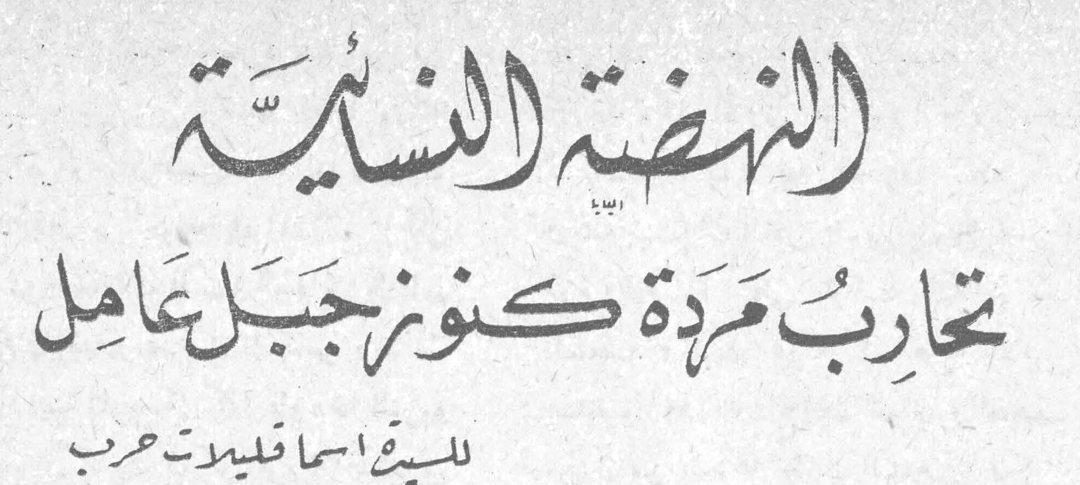
If you asked any Amr among men for a definition of the word "treasure," his answer would most likely be that a treasure is a hoarded collection of rare precious stones or costly metal, found buried in the bowels of the earth or lost in remote corners of the universe, arduous of approach and hard to attain.
Imagination may well have its share in the thinking of this Amr of ours, carrying you from this comprehensive definition to what may have escaped your knowledge: that treasures have genies of the jinn to guard them, that their secrets are held hostage to certain charms or talismans, and that... and that...
All things his thinking may lack in scientific rigor, without being robbed thereby of the splendor of imagination and the sweetness of legend.
And were I to contest this Amr in his definition, I would tell him that treasures are not obliged to lie buried beneath the layers of the soil, or lost in some unknown reaches of this vast universe. How many a spot on earth, abounding in bounties, do we pass by without perceiving what we might reap from it with a little labor and toil! And how many sources of good in the minerals, plants, and living things around us are we kept from by our greed for the mirage of this worldly life — that mirage which never ceases to draw us toward it until it brings us to a deep abyss where, had our friend Amr come to it in pursuit of his treasure, he would have found nothing but pitch darkness, the darkness of the grave, and a bitter cold, the cold of the end at which every striving and every headlong rush must halt...
And were we to search this trusty land for some of those hidden treasures of which we speak, we would find one of them the size of a tremendous mountain, crouching like a mighty lion fettered in iron, keeping to its place and gazing
at the horizon with a look of anguish and regret... That mountain is Mount "Amel," which we might more truthfully name the wretched mountain, or the deprived mountain...
It is not for me to expatiate upon the injustice and iniquity of which this dear part of the homeland complains; to prove it I need only call upon whoever has two eyes to look with those two eyes, for what is to be seen there of the varieties of misery and deprivation is many times more than any description or account could contain.
What I aim at in this place, rather, is to speak of the noble services rendered by a group of our most excellent women who make up "Al-Nahda An-Nisaiyah." They have striven, in a manner deserving of thanks, with all the means and resources at their command, to serve that suffering Ameli portion of this dear homeland. In some of its villages they have founded a chain of schools for the instruction and upbringing of young girls, thereby achieving a new and blessed step toward finding the "charm" that can destroy another of the genies — the genies of ignorance and misery who stand as a stumbling block in the way of Jabal Amel's opening to the light, and of its sharing in the service of the country with its treasures, which are doubtless many, and abounding in good for whoever takes the trouble to search for them.
I was lately given the opportunity to join the revered president of the "Nahda," Mrs. Evelyne Bustros, and its excellent mem
bers — Mrs. Heneni Tarcha, Mrs. Adelaide Rishani, Mrs. Asma Issa, and Mrs. Janette Tadros — on one of their tours of inspection in the villages of Jabal Amel, and I saw such signs of those excellent ladies' success as delight the eye of everyone who loves this homeland and serves it faithfully.
Wonder took hold of me when I saw the dignified Mrs. Evelyne Bustros and her excellent companions endure, for long hours, every kind of hardship in traveling roads whose stones outnumber their dust, and whose ruts outnumber both stones and dust together. The excellent president did well in directing the conversation during this arduous journey: she chose Palestine, and spoke of it to us with overflowing feeling and sweeping patriotism, before which every trace of the journey's hardships vanished — the stones of the road and its ruts put to shame — while the banner of wounded Palestine, and the banner of vengeance for dear Jabal Amel against the genies of ignorance and wretchedness, fluttered smiling in the air.
In an out-of-the-way place beyond Hasbaya, in the quiet village of "Mimess," certain eyes beheld for the first time in their lives pictures moving in the darkness, cast by machines that had been carried to Mimess in a silver-colored automobile accompanying the car of the ladies of the "Nahda."
The people of Mimess greatly admired the practical counsels those beautiful moving pictures brought them, meant to guide them toward what is best for