Lebanon has scored a new moral victory, to be added to the chain of its glories and its prides — a victory that entitles it to rest assured of its place in the world, to strengthen its faith in its mission, and to take pride in the brilliance of its sons and their singular genius.
The nations agreed unanimously to raise the Honorable Dr. Charles Malik, Lebanon's Minister Plenipotentiary in Washington and Lebanon's delegate to the Economic and Social Council, to the presidency of the greatest economic, social, and intellectual institution history has known.
This Council is considered the world's foremost authority in matters of economics, society, and culture. Its aims and powers were defined in the Charter of the United Nations at the San Francisco conference, and since that date it has been redoubling its activity and widening its fields of work, until today it supervises upwards of twenty world organizations and committees that treat the greatest problems facing the present-day world.
As for its aims, they are to bring about the conditions suited to achieving peace and to secure welfare for all peoples, on the basis of respect for the principle of equality of rights and the principle of the freedom of peoples to determine their own destiny. It therefore strives to raise the standard of living and secure employ
ment, to provide the conditions suited to economic and social progress, to take up the economic and cultural questions that come before the various nations, and to uphold respect for the rights of man and their safeguarding, without any distinction of race, nationality, language, or religion.
It is composed of eighteen states, elected by the General Assembly of the United Nations for a term of three years, one third of them being renewed each year. Among the proofs of the activity shown by Lebanon's representative on the Council since his election to it is that his election was renewed for another three years; no state won this renewal besides Lebanon save the United States of America, represented by Mrs. Roosevelt.
The states represented today on the Economic and Social Council are the United States, the Soviet Union, Britain, France, Canada, India, Czechoslovakia, Norway,
Holland, and Turkey, to which are added Lebanon and six other states from among the states of Latin America and the British Dominions.
The Council supervises the following institutions and directs their studies and their work: the Labor Organization, the Food and Agriculture Organization, the Educational and Cultural Organization (UNESCO), the Civil Aviation Organization, the International Monetary Fund, the International Bank, the World Union for Wireless Communications, the Universal Postal Union, the World Health Organization, the International Refugee Organization, and the International Trade Organization.
Each of these great institutions abides, in its studies and its work, by the directions laid down by the Economic and Social Council, and submits to it periodic reports on the activity it puts forth and the results it has reached. We mention in particular the International Monetary Fund, whose charter was drawn up at Bretton Woods, and which concerns itself with monetary matters and strives to develop and safeguard them; the Trade and Employment Organization, which met in London and
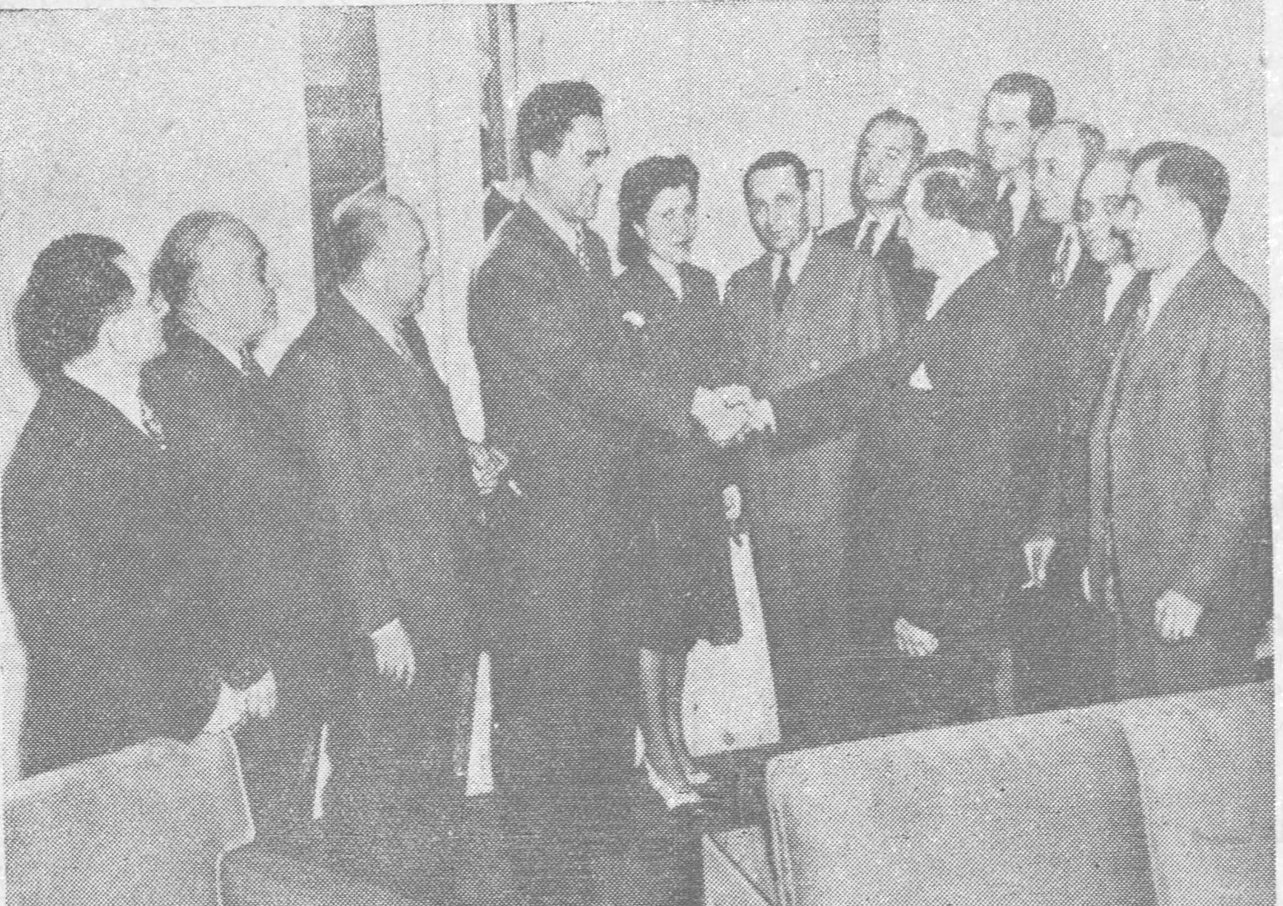
A delegation of notables of the Lebanese emigrants in the United States on their first visit to congratulate Dr. Malik on his coming among them as Lebanon's first Minister Plenipotentiary in Washington