
He lived, died, and was immortalized a martyr of art. He roamed the climes of France, Switzerland, and England, sacrificing and striving in the cause of the creed of his age — that man who lived in Paris, Weimar, Bayreuth, Budapest, and Rome, and who drew from the various tendencies of these artistic climates a special tendency of his own, by which he was marked and which he proclaimed in every one of his musical pieces. For he united the French idea, the German influence, the Latin culture, and the Catholic creed. He was influenced by Goethe's mystical literature and joined the ends of German literature and Latin literature, so that balance shone forth in his creed in its most splendid and beautiful qualities.
"Liszt" lived in an age in which the cultural and artistic morale of the people had been killed, for the class of the nobility alone was adorned with refined taste and penetrating thought. So he began calling for the people to be given their literary and artistic rights,
and joining together the various philosophical schools so as to bring them nearer to the understanding of the people, then still in darkness. He first presented the great artists to the people, publishing and interpreting their compositions without any concern for what he himself produced, thinking that if he sought to benefit the people by means of his own art he might come near to selfishness. So he made famous "Schubert" and "Schumann" and "Berlioz" and "Mendelssohn" and "Chopin"; then at the end of his life he took up solving the problem of Russian music, such as the music of "Mussorgsky," and presented the music of "Brahms," from which was drawn the music of "Smetana, Franck" and "Saint-Saëns," in which he came later to be taken as a kind of father of "the musical family." He grew, matured, and was reared upon this principle: everything is permitted in art if the law of beauty is established in it.
In Liszt's music there is loftiness and thought, for in the measure that a man detaches himself, his thought rises in loftiness and his principles ascend — since selfishness touches thought and leads it always toward interest, and interest and art are two elements that do not come near one another.
Liszt's genius came as a completion of the movement of the great French Revolution, and he demanded the rights of humanity, especially in the rhapsody, joining the revolution of thought and the revolution of music. He was the first to introduce into the art of performance those powerful accents that belong to a violent clash in the soul of the performer and of the composer possessed
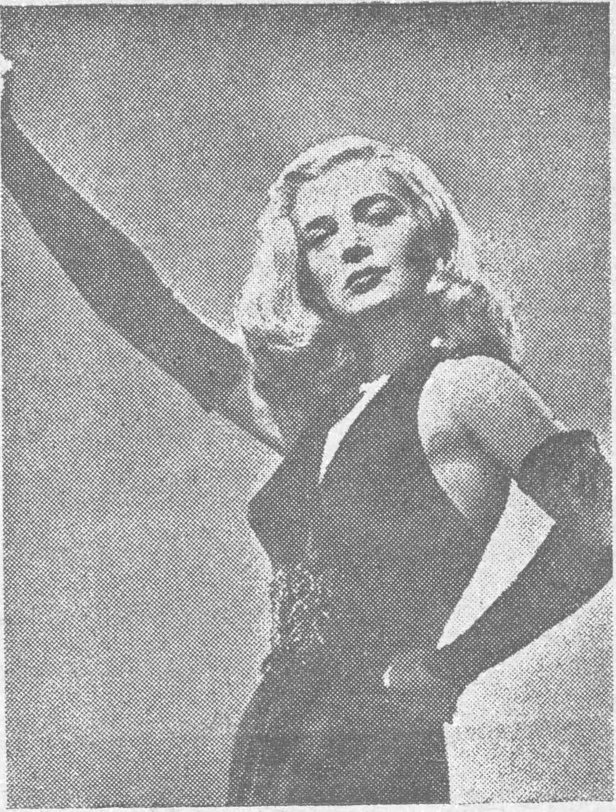
Lizabeth Scott
when he looks for a wife to share his hopes and his pains, settling his choice on a girl like Diana Lynn or Dorothy McGuire, in whom there is such femininity, delicacy, and sweetness as makes a man feel, when he is near her, that he is big and strong, and that she needs to take refuge in him and shelter with him. This feeling between man and woman is the foundation of their drawing together and the cause of harmony between them. And so the delicate, gentle type of woman will keep her value and her worth so long as man is man, glorying in his strength and his sway, and so long as woman is woman, armed with her femininity and her weakness!
So if, dear girl, you are one of those who wish to become charmers, desired ones, you must first study yourself and your temperament and decide what type of woman you are. And when this truth becomes clear to you, dress your personality in the garment that suits it, and adopt the movements that accord with your type, so that your conduct comes naturally, far from affectation. For every imitated, unnatural beauty is cast off, empty of all charm, and its owner fails utterly.
Diana Lynn