The Arab Cultural Club in Beirut invited the Lebanese artist Mr. Saliba Douaihy to deliver a talk on the subject of "Decorative Art among the Arabs." "The Woman's Voice" is pleased to reproduce the introduction of this valuable talk, which contains a fleeting glance at the position of art in Lebanon.
The signs of painting by hand did not take shape in Lebanon until the last years of the past century, and its dawn did not break forth clearly until Daoud Corm, Habib Srour, Khalil Saleeby, and Philippe Mourani saw the light. These are the men who laid the cornerstone in the edifice of Lebanese art.
And today, when the modern artistic renaissance has begun — over the last ten years — to raise a well-wrought structure upon the solid masonry founded by the men of art in the past, producing and showing its production in exhibitions, the number of connoisseurs in Lebanon increases day after day.
It is very difficult for a man to reach, in a short time, a high degree in the understanding of the arts. And if we see the great mass of the European people tasting, understanding, and appreciating the artistic picture, it is because the people of Europe are the descendants of generations that labored in travail with the arts and gave birth to an art which, across the generations, passed through alternating periods of decline and ascent, until, perfected by geniuses, it became a pure and immortal art.
There is no doubt that the majority of the Lebanese people has begun to taste the artistic picture and to thirst for its understanding; but rarely does it find anyone to analyze its merits for it in a scientific analysis, stripped of every passion and free of every motive.
How far we are from understand
ing the artistic picture with a correct, scientific understanding! How incapable we are of applying the standards of beauty to an artistic picture! And how often our artistic judgments are driven by a personal whim and by a sentiment that has no kinship with art — so that the trite picture becomes a splendid masterpiece, and the splendid masterpiece a trite picture...
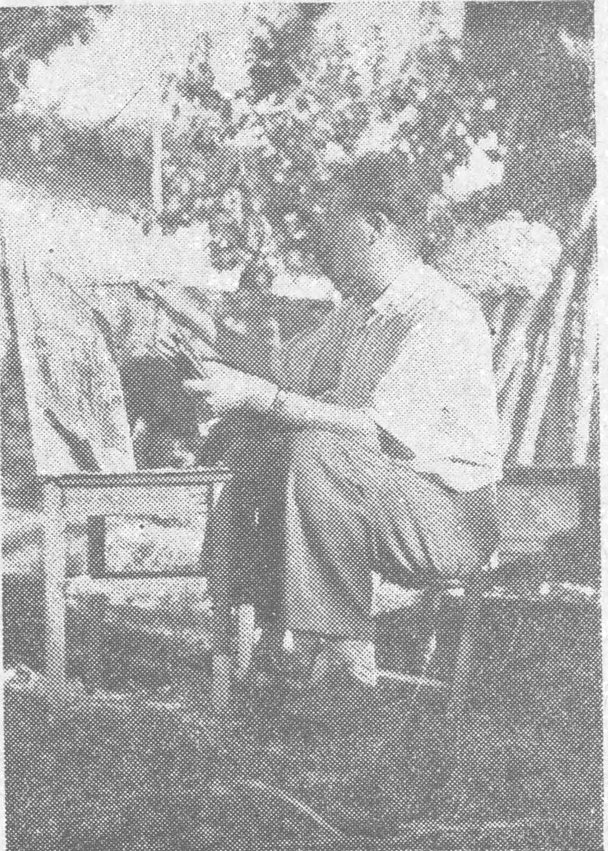
The artist Saliba Douaihy
Lebanon today is in need of an expert art critic, sincere in his criticism, who understands the meanings of drawing in the picture, in its strength and in its weakness: the abundance of repetition in showing volume by drawing, and the scarcity of drawing by volume, and its showing in a manner in which the drawing can scarcely be made out; the placing of color that
bespeaks drawing, and drawing that bespeaks color. The critic must show the painter's mastery in one form or another — a subject seen from above, or seen level, or from below — and we must imagine the subject as figures swimming in space. Are not those figures that Michelangelo painted, swimming in space in the Sistine Chapel, among the immortal wonders of painting?
Not everyone who mounts a horse counts as a horseman, and not everyone who writes about art counts as a critic and an authority. Sound artistic criticism is a gift before it is an acquisition; then its possessor must tend it by practice and by exercise in the arts of drawing — that is, by learning the principles of drawing, the mixing of colors, and the quality of artistic workmanship that sets an artistic piece in a place of importance. Then the critic must frequent the museums and the studios of the artists, giving full attention to how a piece is begun and how it is finished, so as to learn where the warm strokes fall and where the cold, the distribution of the touches, the passage from the shadows to what lies between them, and the colors and the lights — for it is in bringing out the shadows upon the picture that the artist's ability is revealed. Whoever would analyze the artistic piece must know all the foregoing; and greater than that, the critic must make plain the fine meanings conveyed