of powers. Yes, he sacrificed his life and his glory for the sake of his contemporaries among the musicians, and no gratitude was kept for him, so he withdrew into himself, portraying for us the hopes of the people and their ambition, and especially the imbalance of their thinking.
He wrote in his memoirs in 1778: "The sane man among people is half mad." And this is what led him to a state of pessimism, interspersed at times with thoughts or scatterings of hope in the renewal of the people's retrograde mentality.
His musical conduct is the conduct of one faithful to his art. He fought for the art of "Wagner" more than "Wagner" himself did, when he could have taken him as a rival; instead he rendered him material and moral services with a strange generosity.
This is Liszt the man, and we have analyzed him before analyzing his musical pieces, because we are usually directed to honoring the production without any sound knowledge of the source of the producer — as though the creed were more complete than its believer. For a man may produce without offering to the people all the vital resources he stores up. It would therefore have been more fitting to devote ourselves to the study of the composers before our study of the music, and this is what led us to analyze Liszt as a man before studying him as a great artistic genius.
Liszt the artist knocked at many doors of instrumental music, among them: the rhapsody, the sonata, and the concerto, and then symphonic music, in which he excelled in the Faust-Symphonie, and then the Préludes. In the "Préludes" he portrayed violent revolutionary ideas which he loosed upon his listeners in a splendid mold of grace, joining sweetness and violence.
As for the "Faust-Symphonie," in it Goethe's idea appeared in the prime of its development. He was
the first to go deep into the study of Goethe and to portray his creed in plaintive melodies that delight the ears — Gounod did not follow his path. He portrayed for us human thought in its perpetual contradiction, and how divine glory, and man's rising toward it, deliver him from this contradiction. For man in the symphony always inclines to contradict what he has said, as if he does not acknowledge the existence of a laboratory in the mind that tests creeds before releasing them as ideas upon the listeners. In this symphony Liszt may be said to embrace the pure mystical doctrine, the doctrine
of Goethe, throughout the fourth decade of his life. Then he hastens to compose for the piano alone, inasmuch as he was the unrivaled performer of his age. He composed the rhapsody, a charming piece that portrays for us the life of the Hungarian people, their principles, and their ambition. The famous rhapsodies demonstrated in Liszt's soul a wellspring overflowing with artistic gifts and musical methods. As for the sonata, Liszt did not succeed greatly, because he introduced into it personal idioms at a time when it was a classical mold into which musicians poured the essence of their thought and their unbridled feeling.
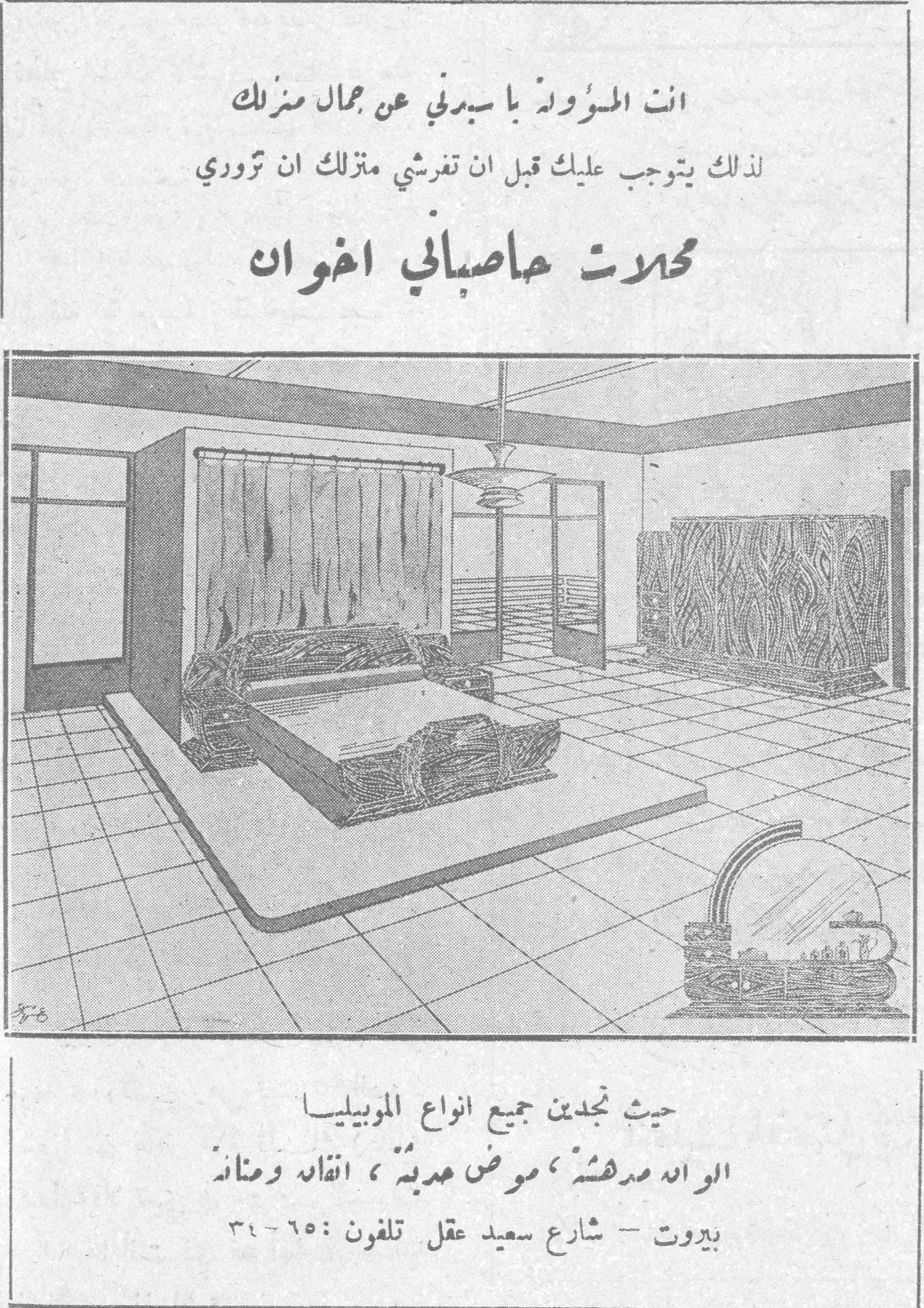
The Hasbani Brothers Stores
You, madam, are responsible for the beauty of your home
Therefore, before you furnish your home, you must visit
The Hasbani Brothers Stores
where you will find every kind of furniture
Astonishing colors, the latest fashions, fine workmanship and durability
Beirut — Said Akl Street — Telephone 650-34