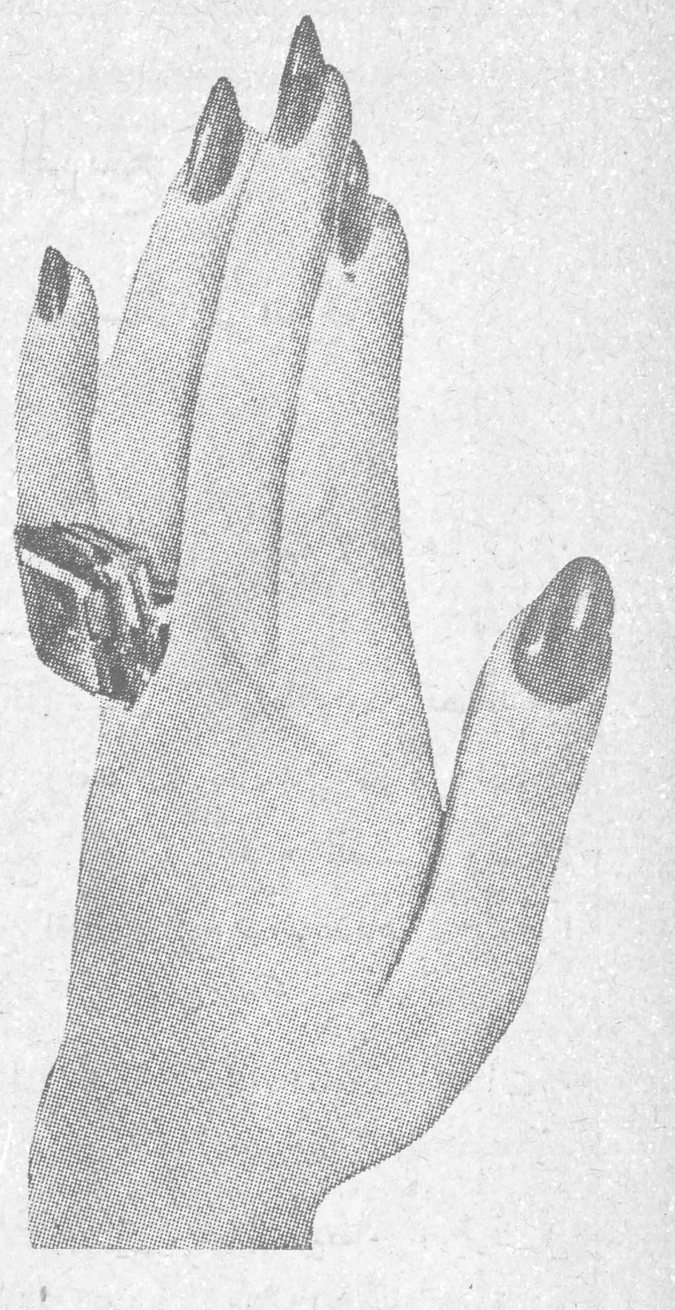
Beautiful nails that have known the touch of polishing and tinting are counted a precious ornament in which a woman takes pride, just as she prides herself on a beautiful, winning face and a sound, glowing complexion. But have you considered, madam, the way in which you may obtain smooth, strong, long nails? The answer to this question—as in every case that concerns beauty—is good health. Strong, lustrous nails, beautiful flowing hair, a clear complexion, and teeth of pearly appearance are all so many signs of established health and overflowing vitality. And the reverse is true: from rough, thin nails that break easily a physician may deduce some hidden cause of a latent illness.
The nail, generally speaking, is highly sensitive, and its most sensitive part is the root. It is quickly affected by injuries from without, just as it is quickly affected by the diseases that strike the body. This
root is always covered by a thick layer of skin, of which nothing shows but a small crescent-shaped portion, usually counted an ornament that lends the nail a certain beauty. Most of the injuries to this part come, as a rule, from want of caution in using the manicure implements, above all the orange-wood stick. There is also a condition that afflicts the nail and disfigures its appearance, commonly called adherent skin: it occurs when the skin covering the nail's root sticks to the nail itself, so that the nail, as it grows, drags the skin along with it. This condition is commonest among ladies whose hands tend to dryness, whether from much exposure to the weather or from an excess of heavy housework. The treatment for it is to separate this part from the nail with care and push it back with the implement made for the purpose—the one whose tip ends in a rounded piece of rubber. But beware, madam, of cutting this skin with scissors, lest inflammation set in. And if you find that the skin in question adheres stubbornly to the nail, use the following preparation to soften it; it is applied by means of the orange-wood stick after a wisp of cotton has been wound about its tip:
Borax — 4 grams Glycerin — 4 grams Distilled water — 72 grams
And since we are speaking of the orange-wood stick—careless use of which so often ends in injury to the growth of the nail—it is well to follow this method:
1. Wind a piece of cotton around
the stick and moisten it with oxygenated water; then press with it, gently, along the edges of the skin surrounding the nail, until the oxygen reaches as far as possible between the nails and the skin around them.
2. When you have finished all the fingers, pass with the stick to the underside of the nails and remove with it the dirt lodged between the nail and the fingertip, taking care to change the piece of cotton whenever it becomes soiled. And take note, madam, to dry the nails as you go along, so that the oxygen left upon them does not turn them white.
The file is another of the implements used in the manicure, and you must see to it that it is used before the nails are washed or polished, since washing softens the nail, and it is then easily split while the file is being used. The way to use this implement is to hold it between the thumb on one side and the remaining fingers of the hand on the other, the thumb beneath the file and the other fingers above it. The edge of the file is then placed under the nail at the inner corner, so that it lies almost parallel with it, and drawn with a light, continuous stroke until you reach the middle of the nail, where you stop the stroke; then move the file to the opposite side and make the same stroke in the contrary direction until you come to the point where the first stroke ended. These two strokes
are repeated until the nail is perfectly smooth,