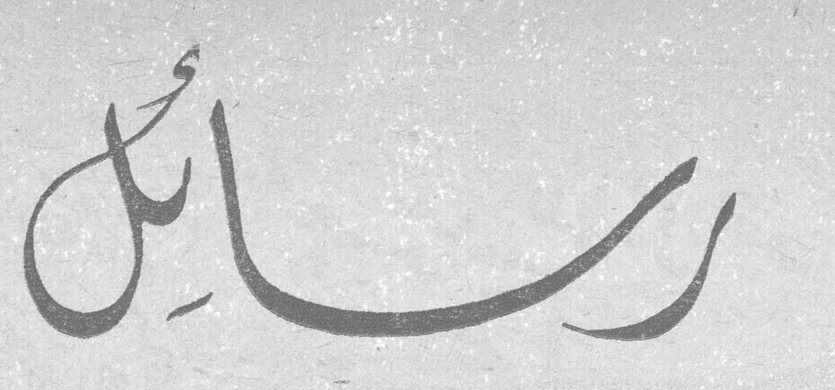

On this page appear the letters of our readers, women and men; we have set aside another page for news. The Woman's Voice is always pleased to remain in contact with its readers, so that these spiritual bonds between the magazine and its supporters may endure. So write to us, Madam, whatever you wish.
Among the finest and strongest letters in The Woman's Voice's mail this month is the letter of the literary Miss Fayza Abdul Majeed, author of the article published in this issue; she is a well-known woman of letters in the sister country, Palestine.
In this letter the writer Fayza Abdul Majeed gives a splendid picture of the Palestinian woman's struggle for the great cause for which all the Arabs are working today:
"How sorry I am for my delay in writing to The Woman's Voice! But since my piece on 'the Glorious Nativity' I have written absolutely nothing outside the scope of the national struggle, for it drains the greater part of my time and my efforts — so much so that a great veteran writer took pity when he perceived the extent of this self-effacement in work, as he read what I write in our daily papers in the name of the Union several times a week, to give voice to the stirrings of the Arab woman in Palestine and to publish a picture of her sacred fight at this decisive stage.
The writer advised me that another woman writer should join me, to take some of the burden from me so that I might be free for other important matters. But is there anything more sublime than the fight between liberation and bondage, between death and life?!
Nablus is now taking its great share of the struggle, and together with its district — 'Tulkarm and Jenin' — they form 'the dangerous triangle,' as the English call it; they have shied away from it, and it now surges with the fighting companies and their arms. And the Arab woman is now working at the man's side — according to her particular gifts. You will see that the Women's Union has established a complete hospital in which its members themselves attend to the wounded fighters — and it has filled to overflowing. Then, how precious is freedom, and how great the faithfulness of the Arab sisters...
Besides this, the Union carries on
the work of all the committees it has formed — for first aid, for nursing, for sewing for the fighters, and for social affairs, for the relief of the families of the martyrs and of the destitute — with the greatest of efforts... As for morale, it is strong, splendid, and exalted in every single person in Palestine, drawn from true creed and from history — and 'creed and history' are the whole of civilization, in the phrase of 'Le Bon.' In short, we are in a struggle into which all forces and all efforts have been marshaled.
I return to the subject I am now submitting, the 'Brontë' sisters. It is a distillation I have gathered from many of the biographies written about the gifted sisters, and from several chapters of various books of literature. Truly, by God, I have labored much over it. Nothing spurred me to undertake it but that it is a living picture of the fight against despair and failure, worthy of the attention of us who have known harshness in the pursuit of the ideal. As for my style, which the Ustad commended in a previous letter, it is what strengthens me, along with this general encouragement — is it not this that pours reinforcement upon us on our striving way?!
So thank you, Ustad; and I have nothing to say of this except that 'none know the merit of the people of merit save those who themselves have merit' — and such, by God, are your ways. How great was your word about 'Huda,' and how tender your musings on Zinah... Give us more of these splendors, if you would be so kind..."
(Signed)
In our mail is a letter from Mrs. Iqbal Izzeddine Zouq, president of the Women's Charitable Society of Tripoli, to which she has attached some passages from the speech of Dr. Raif Abi al-Lama', delivered at the society's party last January:
Dear worthy and respected sir,
Greetings. Your kind letter reached me while I was away from Tripoli. In it you apologize for having been unable to publish the article which Mrs. Fili sent about the party of the Women's Charitable Society of Tripoli on January 25, 1948. I have accepted your apology, with thanks for the expressions of courtesy and delicacy of speech contained in your letter.
Thank you, then, for your constant interest in the women's renaissance in al-Fayha', and especially in our society, which appreciates your efforts to
raise the affairs of the Eastern woman and the progress of the magazine that comes out in her name.
Here are some passages from the speech of Dr. Abi al-Lama':
Ladies and gentlemen,
When Miss Ibtihaj Kaddoura, president of the Women's Union in
Lebanon, invited me and asked me, in the name of the Women's Charitable Society, to say a word at this flourishing party, I hesitated a great deal — not out of any distance from this blessed society, nor out of coyness or affectation, but because I live in a deep and gloomy silence, which some count in me as pride and some as despair — God knows, and you know not. But she — clever and skillful as she is, sociable and gentle — discovered my weak point and struck the sensitive chord in my heart. She spoke to me of the noble purpose for which this distinguished elite of the ladies of al-Fayha' is working, and of the lofty goal to which it aspires: the founding of a home for the orphan girl on whom fate has borne down hard, whom it has wronged by depriving her — while she is yet a child — of a mother's tenderness and a father's affection.
And I, ladies and gentlemen, by my nature love the poor and feel with the orphan, for I myself was raised an orphan. I lost my father when I was ten years old, so that he — God's mercies upon him — could not guide me along the path of growth and knowledge, nor light before me the rugged roads of life with their many dark obstacles.
And I lost my mother when I was but three years old, so I do not know her, nor can I picture her fair, radiant face; and whenever I hear one of my friends call to his mother, pain cuts into my heart and a tear trembles in my eye, because I do not remember ever once in my life having said the sweet words: O Mother.
And I love the orphan and the poor man, because the sons of orphanhood and the children of poverty, if God grants them someone to take them by the arm and open the road before them, so that they walk through their lives with diligence, sincerity, and energy, leaning on themselves, generally become the best of men and the finest of women. How often, in my solitude, have I repeated these two verses:
Do not say: this is a poor orphan, who has no fortune in life to make him happy. Perhaps in the poor man there is a Christ; perhaps in the orphan a Muhammad.