Miss Mona Haik is one of the most profound young women of this country in thought and culture. She holds the higher degree in law, though she does not practice at the bar, for she believes that woman sustains life for something loftier than the bar and medicine... And The Woman's Voice is very proud to present this strong voice among its strong and distinguished voices, on a subject which is indeed among the most delicate and sensitive of subjects.
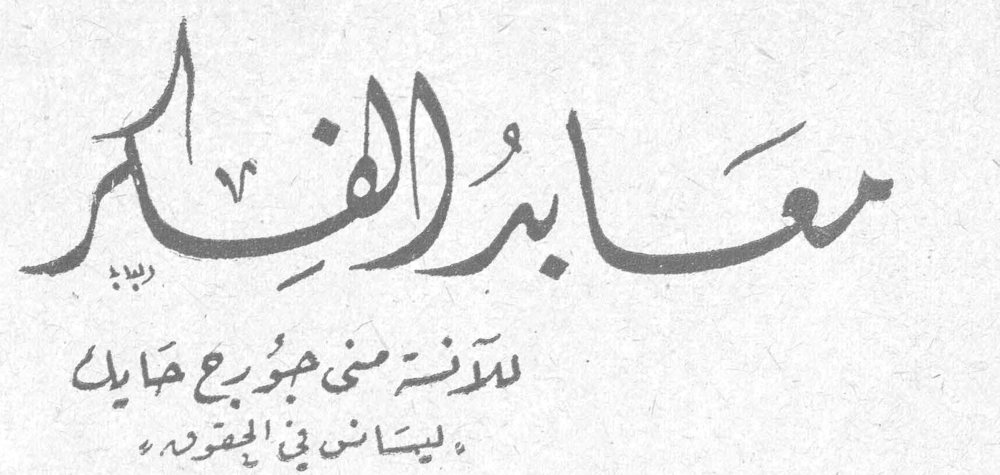
I have found nothing in the world whose small size is so out of proportion to its great work as the book. A few sheets of paper that the grasp of a hand can hold — and they contain an entire world.
Through it we have inherited the thoughts of the ages, the civilization of the peoples, and the culture of the scholars and men of letters among the ancients. In it are the sayings of the prophets; in it the tablets of learning and letters; in it the traditions of the forefathers; in it man's longing to know the eternal truth. The philosophers in their retreats and towers, the thinkers in their cold cells, the poets in their valleys of fancy, shroud their souls in the worn pages of books. The book is a spirit bearing the trace and the image of man in his intellectual and material work. It carries to us the thoughts of the heroes of the peoples, from Confucius to Socrates and Plato, to Ali ibn Abi Talib, al-Ghazali, and Jalal al-Din al-Rumi, to Copernicus and Pasteur.
What is the book we may take as our friend?
Pasteur said, addressing the young: spend your hours in the calm, tranquil atmosphere that reigns in libraries and laboratories. For these are the temples of human thought and of the human spirit.
Yes! We shall spend most of our hours in libraries — but which books shall we choose? I believe that the great and cultivated [...]
The first is the classic book — the book that has been read and studied for many centuries, and those who study it believe that it will go on being studied for a long time in the future as well. There is in it something permanent and immortal of human nature. Peoples have beliefs and fixed ideas, absolute in their eyes, by which they steer their lives and without which they cannot face the future. And these ideas are born in the classic books, in the books of the leaders of the world's thought. There are books that have exerted a profound and mighty influence on the history of the human soul. For genuine feelings and strong ideas are the same in the human creature, whether he lived in the remotest centuries and in the noondays of the equator, or in this age of ours on the flanks of the pole.
Or do you suppose the black Negro mother in the heart of Africa loves her Negro child less than the Beiruti mother loves her beautiful fair-haired baby? Do we not feel, even today, when we read the farewell of 'Hector' to 'Andromache' in Homer's Iliad, the greatness and majesty of Hector, and the gentleness of Andromache,
her grace, her love for her husband and her only son, as though the event had happened among us and in our own circle? And so it is with Molière's 'Miser,' which was performed for six unbroken months — not in seventeenth-century France, but in 1938, on the stages of Tokyo.
And beside these classic works, which set down the genuine stirrings of the human soul and thereby rise above time and place, stand works that pass from outward historical events to an understanding of their causes and consequences, sifting the past, comprehending the present, and divining the future. These are those sweeping views of historical, social, and human affairs, such as the works of Bossuet, Pascal, and Montesquieu — not to speak of the works of the Greek philosophers and the great figures of world literature, such as Dante, Cervantes, Shakespeare, Goethe, and Tagore.
These works man will study so long as he remains man, and he will revere them because they express the truth; and one becomes wiser and better guided upon making their acquaintance.
Books such as these instill in us a spirit of humility, for we understand that there exists an independent truth which does not hang upon our own essence — an absolute, detached truth which others have seized upon, and known, and tried to explain to us for the benefit of mankind. Yet we must, with the help of their interpretation and their books, test it ourselves too, and understand it. And this is what drives us out of our torpor and brings us forth toward something better and finer. Likewise we look upon what the leaders of thought have created, from whatever lands they came, and we see the point of view of others; thus we understand them and understand their claims, and peace prevails in the world. And there is no peace among peoples without mutual understanding.
And how can we come to understand one another by any better way than the way of books and culture? The