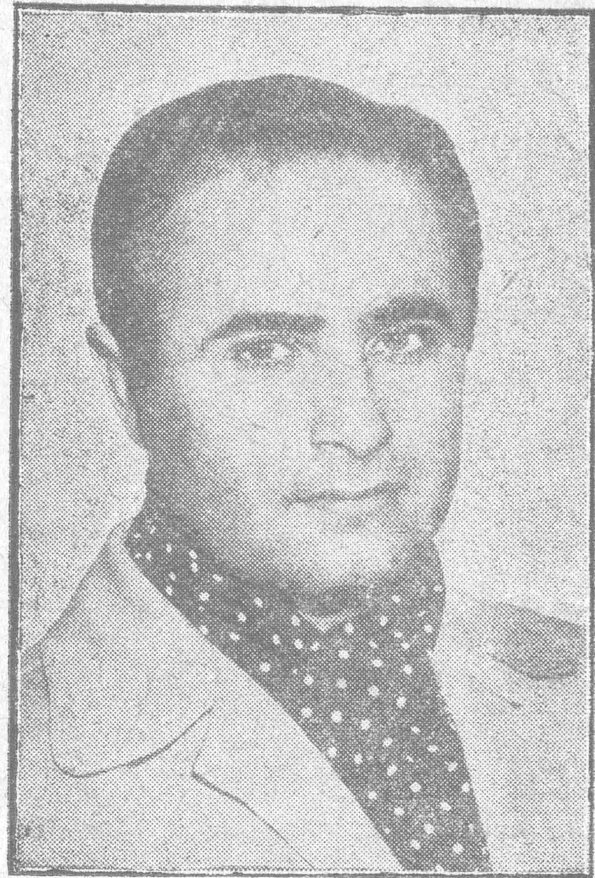
The artist Farid Kahhaleh
The machine has begun to rival the brush. For a time, art rose against the machine in a sweeping revolt, because the machine, as art says, cannot achieve beautiful, lofty expression; it is but a deaf machine, capturing things as they are — and things as they are, without imagination and without beautiful expression, remain inert and dry to the soul and to the eye...
But photography has for some time now begun to occupy its distinguished place in art; and the deaf machine has set about rivaling, to a certain degree, the artist's creative brush and his soaring imagination.
Photography is composed of two essential elements: the element of the machine, and then expression and invention. Expression and invention are the artist's style and his personal stamp, and they are the two elements with which the machine would rival the brush... In these specimens we have seen by the photographer Farid Kahhaleh there is a most successful attempt
to bring out those immortal artistic horizons which the machine was formerly powerless to express.
There is in them much life and much freedom of movement, and this artist has succeeded in capturing them and making of them living pieces lacking nothing of faithful expression, or of distinguished imagination...
In Mr. Kahhaleh's pictures you see the mark of the gifted artist who knows how to refine his pictures, and how to create the beautiful atmosphere within them, so that as you look at them you forget that they are the work of a machine — a machine with an eye that sees, but no imagination that creates.
The artist Kahhaleh was an engineer before he took up photography as a profession; but the artist in him overcame the engineer. This came about through his reading of the works of William Mortensen, the famous American photographer; he threw himself into the study of this artist, and then circumstances allowed him to study under him...
Last year the artist Kahhaleh returned to his homeland in the company of the Arab Emir Saud, and he exhibited some of his specimens in the great West Hall of the American University of Beirut, where they met with great appreciation.
"The Woman's Voice" will present magnificent specimens by this artist in its coming issues.
appear, floating in the fluid, even in the earliest stages of the disease. A simple surgical operation can then be performed which guarantees the rooting out of the disease before its roots branch and spread — and by this means a woman makes her life safe from her enemy and killer!...
The first results of this discovery appeared in the year 1943, when the presence of cancer particles was proven in the fluid drawn from the womb of a woman afflicted with this disease, even at its very first formation. Science proved a great victory and recorded a new conquest in the wide world of medicine. Tests were then made on a large number of healthy women, and the doctors marveled how in many of them cancer particles appeared in the fluid drawn from their wombs; the disease was tracked down in its first stages, and those women were completely cured. The strange thing is that when this simple test was offered to a body of women numbering over three thousand, the microscopic cancer particles were found in many who were enjoying full health — and many of them were under the age of forty, which is considered the threshold at which cancer begins to appear in women. The importance of this discovery lies in its simplicity, its speed, and its cheapness; for it has become possible for every woman to undergo this test yearly, as a precaution, to make sure of detecting the cancer particles in its first months or weeks, when the disease is the size of a pin's head, still floating on the membrane of the womb, its roots not yet fixed — roots that spread out after the first year of its formation.
The second benefit of this discovery is that it makes it easier to learn the cause of this disease, which remains to this day an obscure secret in the world of medicine; for when the disease is discovered in its first stages, learning its cause and tracing it become less difficult than they are now.