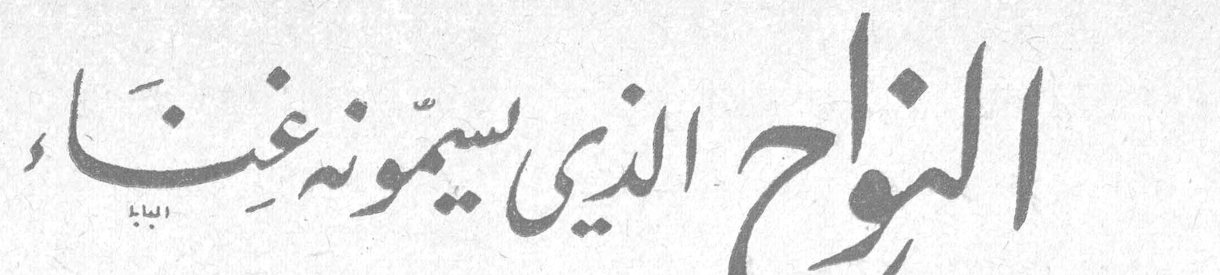
Every time I hear from the broadcasting station this wailing they call singing, I marvel at the wondrous patience that distinguishes the inhabitants of this country, and at their capacity for listening to the same monotonous, threadbare tune repeated in their ears — the very same for tens, nay hundreds, of years.
This attitude of theirs means either that they have grown used to making light of things, to indifference, and to a criticism confined to talk; or that the musical sense is weak in the souls of many of them; or, again, that they have grown so familiar with ugliness that they have come to love it and cling to it, in the words of al-Mutanabbi:
I was created constant: were I to return to youth, I would leave my gray hairs behind, sore of heart and weeping.
Singing is not, among us, the only manifestation of this inclination to chew over the old and hold fast to the traditional, familiar tune, for no reason except that our ears have grown used to it and found it palatable despite its ugliness.
Some time ago I attended an oratorical gathering in which speakers from among the school students competed. I heard all of them repeat this same monotonous tune we know from singing: a kind of droning sing-song and intoning in which the speaker's personality is extinguished. Rising and falling — shouting and agitation — theatrics and warbling that plant weariness in the soul; and the listeners admired it, because it is the tune agreed upon by convention. Nor do I doubt that the judges awarded the prize to whoever perfected the tune better than the rest, and soared in the atmosphere of imitation, of falling and rising tones.
But why should we blame schoolboys? Have you not attended an oratorical gathering at which well-known men and writers spoke? Have you not heard the orators on the broadcasting stations and elsewhere competing in "chanting" their speeches? Have you not noticed in them this intoning and pomposity, which is the farthest thing of all from nature, from art, and from personality?
The first attribute of art — and of literature, which is an inseparable part of it — is that it is personal, that it expresses the inner self of its maker, that it is a piece of the artist's soul and a morsel of his very heart. And I do not know how a literary piece can be art — can be personal — if its author delivers it in this impersonal fashion. How can he be personal in his composition and devoid of personality in his delivery? This oratorical affectation is proof of the weakness of his personality in both cases.
The language may be, to some extent, responsible for this deplorable state of things. For until now we have not succeeded in making it a language of conversation, a language of communion between spirit and spirit. Classical Arabic is still far from us, still pillowed on her throne among the clouds; and still, when we wish to use her, we dress her in cloaks and long robes after the manner of "Buffon," and put on a personality not our own, and inflate our words and intone our phrases, and go back a thousand years, to the age of Quss ibn Sa'ida and Abd al-Hamid ibn Yahya. I do not mean here to belittle these two men of letters: each played his part and represented his age and his personality most excellently. But we do not.
God rest Rousseau, who called upon his people to return to nature — to their own souls — as if he saw that excess of civilization and of art was the root of the affliction. As for us, we must return to our own souls in our speech, banishing embellishment and flattery from it; and to nature in our speeches and our songs, banishing chanting and imitation from them. But our disease is not an excess of civilization; it is that we understand art upside down — as affectation and the extinction of personality.