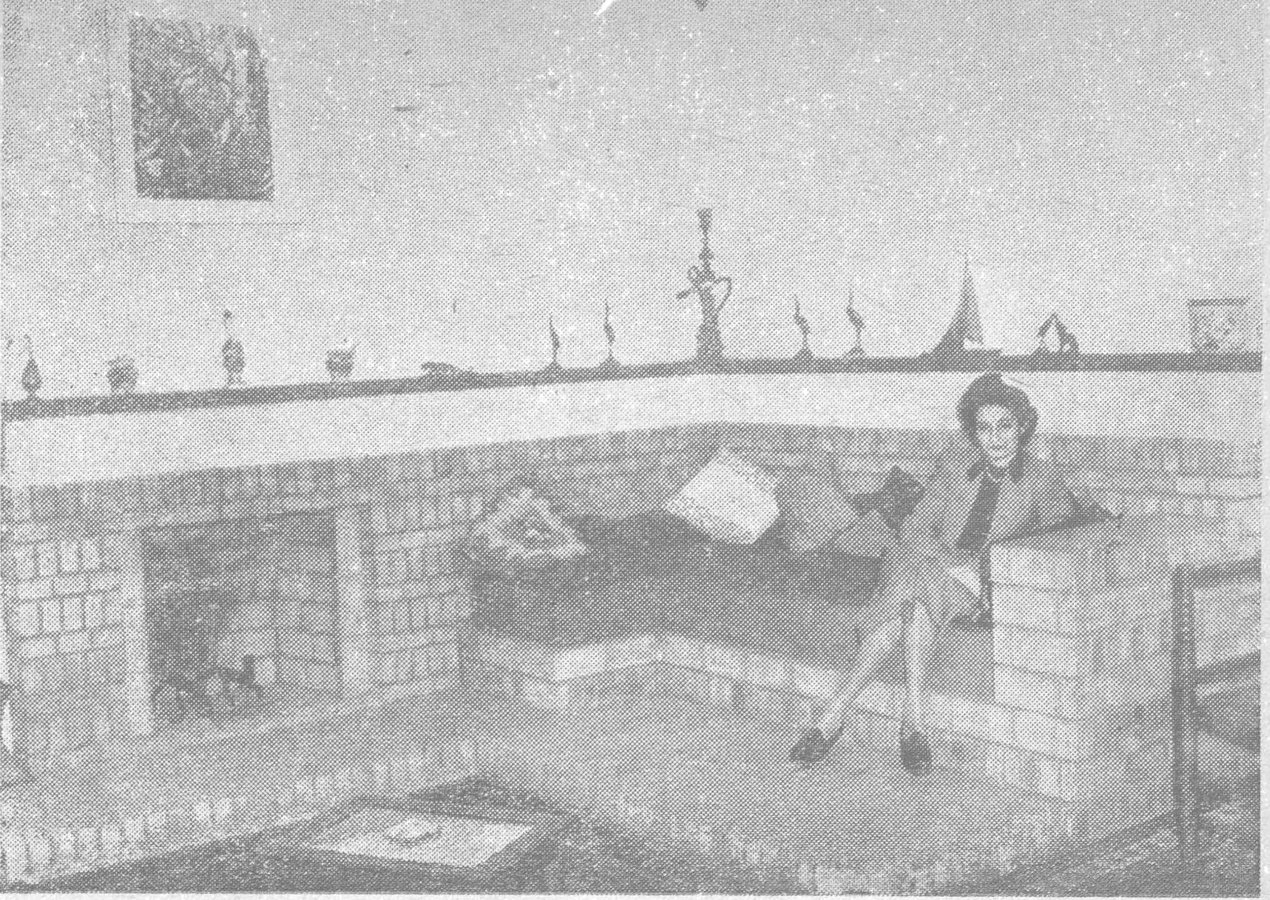
The lady wife of Emir Maurice Chehab in one of the corners of the reception hall of her beautiful home. The furniture appears arranged in horizontal, oblong lines, which turns the eye away from the high ceilings that are no longer in favor.

Your home is the outward expression of your personality. Just as, to a certain extent, we judge a lady we meet for the first time by her outward appearance, so we glance with interest about the house we enter for the first time, to see how its aspect tells of its owners. The home is the natural mirror of what stirs within us of knowledge and experience, of taste and moral courage.
If you feel one day that your home is not as you would wish it, remember that the remedy lies in your own hands. For beautifying the home there are a few requirements or conditions that must be known to every one of us, for they are the very same conditions required in appraising all works of art — and Persian carpets.
First, and before all else, your home must be comfortable. To secure this atmosphere, consider the kind of furniture, its size and its measurements, so that they
suit the purpose for which they were made. An incident of this sort happened to me which might well happen every day to other ladies. It chanced that one of the guests in my house, a man of large build, sat down upon a chair of delicate make and fragile appearance. He was not comfortable, and neither was I. I felt no ease of mind until I saw him move to another chair better suited to his frame and his appearance.
Among the other conditions or laws of beautifying the home is this: horizontal lines suggest strength and balance. The Arab divan, or its Western counterpart known as the 'sofa,' is an example. If your reception room is spacious, furnished with chairs of delicate make and small size, and you do not place among them low oblong pieces such as the divan, which give a feeling of balance and rest the eye — if you do not do
this, your room cannot be called well-proportioned or comfortable.
As for carpets, it is the basic color in the carpet that composes its unity of view and its strength of balance. Its shape, its size, and the manner of its placement on the floor are also important considerations. Most well-made carpets are of proportionate size in themselves, but a small carpet, if laid slantwise on the floor, loses the balance required in the floor of a room for comfort in walking. The slanting line, moreover, carries a strong suggestion of movement. Imagine a man leaning against a wall. If you removed the image of the wall, what would happen? A violent movement, no doubt! This is what takes place with a carpet flung slantwise upon the floor: if it is not in keeping with the other artistic considerations, it makes the beholder wish he could stop the slanting movement it expresses.
The law of the slanting line can here be used at times for beautification — as when the curtain fabric is striped: the wall behind the curtain, in that case, is what stops the movement given by the slanting line, and thus the required proportion is achieved. Where slanting lines are used, it is advisable that the colors contrast, to give the eye relief.
Another of the laws of beautification is the use of fabrics contrasting and opposed in color, form, and weave. If every piece in your salon is upholstered in smooth, elegant satin, and the walls are polished and smooth, and the curtains likewise of smooth satin, the eye soon wearies and seeks to look upon some rough body opposed to the smooth satin. You see that the furnishing of the salon in itself demands much taste in the