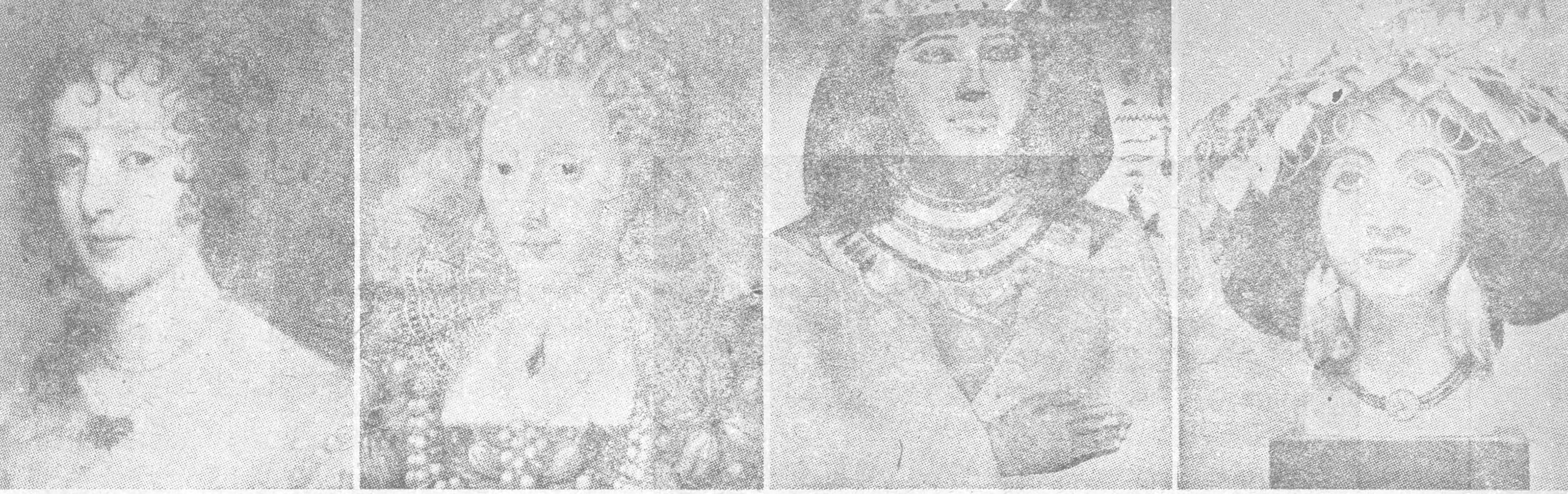
A Chaldean woman (3000 B.C.) — an Egyptian woman (2000 B.C.) — an Englishwoman (1575 B.C.) — an Englishwoman (1676 A.D.)
The craft of hairdressing is an ancient one, its history reaching back to the dawn of human civilization. In the tombs of the ancient Egyptians there have been found combs of exquisite workmanship in bone and ivory, and beautiful palettes upon which the fair one mixed her dye. Similar articles of a woman's toilette have been found in the tombs of the ancient Chaldeans at the city of Ur in Iraq, among them frames for the wigs that adorned the heads of their queens — queens whose bewitching beauty time has effaced, leaving of their tender bodies nothing but crumbling bones. The pictures and statues of the ancient Egyptians likewise attest their advancement in the art of beautifying the hair.
Hair fashions, like other fashions, have often changed suddenly and without reasonable cause. The change usually turns on the length or shortness of a woman's hair: whether it should be smooth and sleek or abundant and flowing; whether it is more fitting to knot it upon the crown of the head and fasten it with pins or a net, or to let it hang down over the neck; and finally, whether this color or that one suits it.
Hair fashions, like history, repeat themselves, and proof
enough of this is the mode of long hair or short. In ancient Egypt the noblewoman wore a wig that hung down over her shoulders in absolute flowing freedom. Who invented this fashion? I do not think anyone could answer that question, though it is supposed to have been one of the queens whose own hair was thin. The women of the common people could not afford to buy wigs, so they contented themselves with their natural hair, cutting it short; and since such hair suited the hot climate, this fashion remained current in Egypt for many centuries. The Egyptian women of the Middle East still follow this fashion to this day.
In the cold countries of Europe, on the other hand, long hair has been the prevailing fashion from remotest ages down to our present generation. A thousand years ago the Englishwoman took pride in the abundance of her hair, displaying it to view in two long braids hanging down her back. In truth, abundant hair, whose beauty the poets have so often sung, was considered a symbol of woman's vanity; for this reason nuns cut off their hair as a sign of their renunciation of that vanity.
Elizabeth, Queen of England,
was red-haired and quick to anger; and though, for all her burning intelligence and her political capacity, she was not beautiful, she nevertheless had as much vanity as any other daughter of Eve. When her hair turned gray she dyed it red, and when it began to thin and fall, she replaced it with a wig.
Hair fashions in England changed with the passing of the centuries thereafter. The fashionable women of the seventeenth century dressed their hair in braids hanging at either side, with curled locks over the forehead, and went to great lengths in adorning their hair with jewels bespeaking soundness of taste; whereas the Englishwoman of the eighteenth century arranged her hair in high pyramids ranging from two to three feet in height, padding it with rolls of horsehair and dressing it over metal cages, and she adorned it with silk ribbons of gay colors and other ornaments for the hair.
It was inevitable that this extravagance in the hair fashions of the eighteenth century should lead to a revolution founded upon considerations of