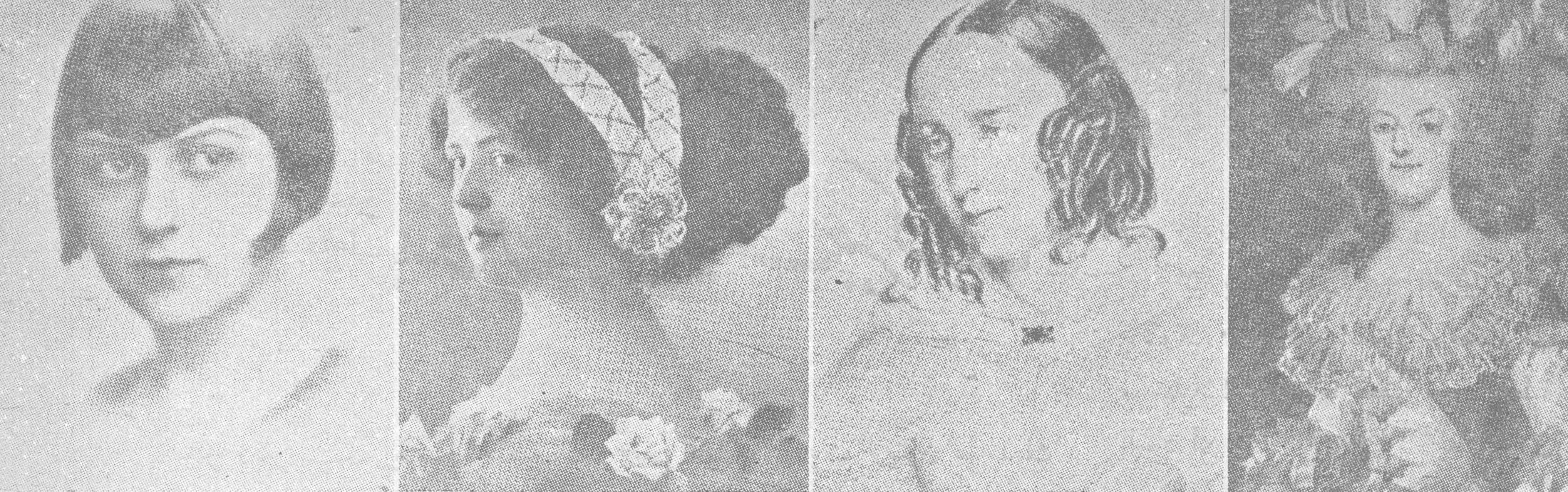
A Frenchwoman (775 A.D.) — an Englishwoman (1850 A.D.) — an Englishwoman (1905 A.D.) — a European woman (1920 A.D.)

comfort, and of the feminine charm which that extravagance had overwhelmed. So the ladies of the nineteenth century inclined toward moderation and soundness of taste, and there spread among them the mode of 'parting' the hair in the middle and sleeking it with oils, while keeping a few curled locks before the ears. In the early twentieth century there spread the mode of lifting the hair from the nape of the neck and building it high upon the head. This mode returned to view in the year 1930, and it is still current today.
The mode of short, bobbed hair is widespread in Europe and America. It began during the First World War, when the American actress
Irene Castle appeared on the stage with short hair — it was said she had cut it after an illness that befell her. Short hair suits every face, and so the mode was not long in spreading, though the actress never dreamed that this
mode would afterward sweep every corner of the inhabited world.
It is known, too, that some women of ancient Greece dyed their hair blue, in the belief that it was among the marks of grace and grandeur. The strange thing is that some old Egyptian women dye their white hair this color today. And there is a touching story of how the mode of hair falling to the shoulder appeared in France at the end of the eighteenth century. It is said that the jailers of Queen Antoinette — famed for the brilliance of her beauty and the captivating dressing of her hair — cut off her hair by force and compulsion before taking her to the guillotine for her execution. The sight of this
pampered queen in her final hour so moved the feelings of the public that, in the depth of their emotion, many of the women of that age cut their hair in mourning for her.
Today hair fashions are no longer confined within their former bounds. The experts of hairdressing have realized that the mode cannot be absolute in its rule; they have taken to studying the faces of their clients, devising for each face the hair style that suits it and heightens its charms. Indeed, it is now within the power of any famous woman to invent a new fashion in hair. It so chanced that the American actress Jean Harlow used a strong solution to bleach her hair, and its color turned to platinum blonde. To her goes the credit for the spread of this mode.
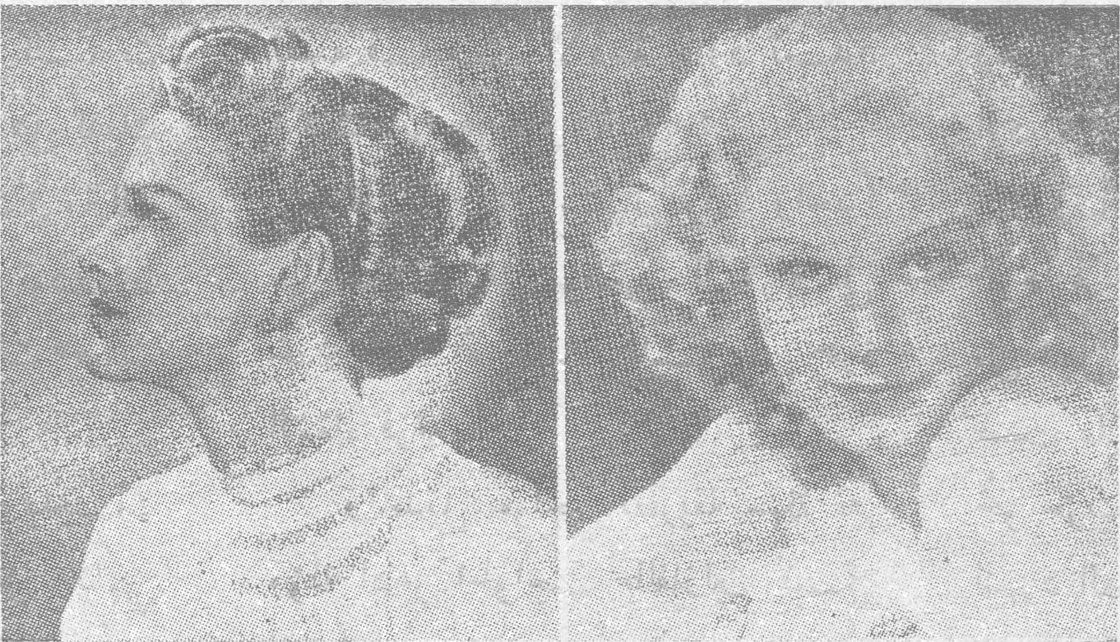
... and this mode recalls to mind the mode of 1905
The beauty Jean Harlow, who discovered the mode of bleaching the hair