In our mail this month there is a great number of letters from various regions and cities; we publish some of them and beg pardon for not publishing the others, hoping that our readers will keep up their contact with this magazine.
The gracious reader will notice that most of these letters overflow with love and tenderness for struggling Palestine.
And as we publish these letters, with all the yearning they hold for the slaughtered country, we hope that the month of May will not have passed before the Palestine question has ended as dignity, pride, and heroism would have it:
• From Miss Aliyya Tahboub, Hebron, Palestine, containing a delicate, sweet anthem she sings to the heroes on the fields of battle. She said:
To the distinguished gentleman, the editor-in-chief of the illustrious Woman's Voice, peace and greetings:
I cannot but thank you and pray God to grant success to the mission to which you have devoted your time. I have the firmest trust in God Almighty that He will grant me a visit to the magazine's offices and to the Lebanese Women's League, which my soul has long yearned to meet.
And here is an "anthem" which I ask you to publish if possible — but from the girls of Palestine. Greetings from your devoted
Aliyya Tahboub
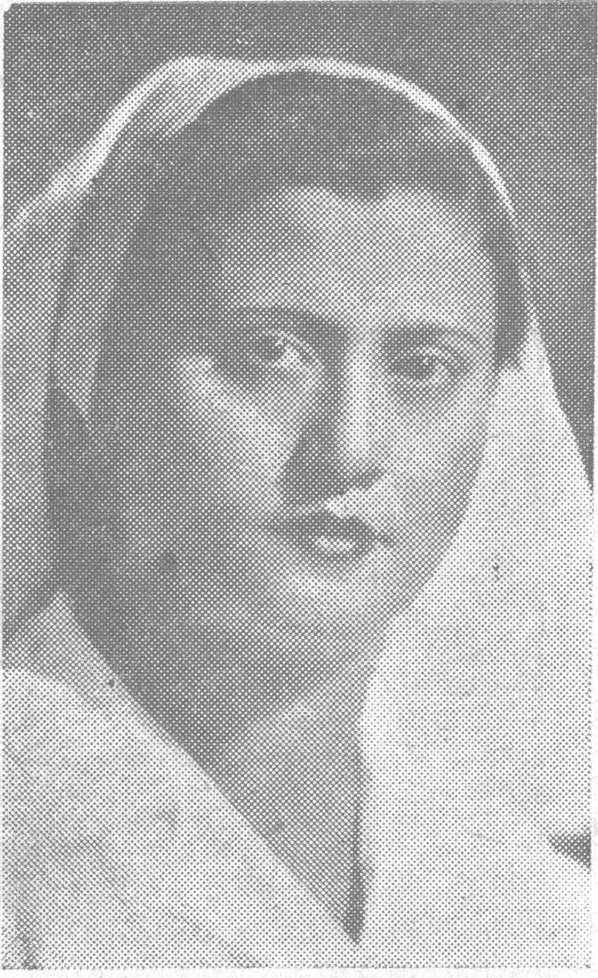
• And from Mr. Georges Baz, the champion of woman, a word about the humane nurse Alice Karam. We are grateful to Mr. Baz for this effort on behalf of the silent, struggling woman: to this day he goes on uncovering these violets hidden away in the gardens:
Alice Karam
A virtuous young lady; for ten
years the angel of the sick. Head of nursing at the Dhour el-Bachek
Sanatorium, Roumieh, Lebanon; one of the virtuous head nurses since the sanatorium began its work of treatment, twenty-five years ago — indeed among the longest in tenure and the most abundant in effort, among the most skilled in knowledge and the most devoted in work. She works quietly, without commotion, like the bending ear of wheat, and like the violet blossom whose fragrance spreads unseen.
Her mother is Jamila Nakhle Atallah, of Choueifat, kinswoman
of Metropolitan Athanasius Atallah, Metropolitan of Homs — paternal uncle of Rose Atallah Shahfa and maternal uncle of Mari Yanni Ata Allah, the two famous ladies — and a pupil of the Russian school in her town.
Among her sisters: the teacher Afifa, who has taught in several towns, president of the Ladies' Charitable Society in Furn al-Shubbak; and the nurse Asma, one of the nursing directresses at the Dhour el-Bachek Sanatorium. And among her kinswomen of Choueifat are three sisters, all nurses — Rose, Nelly, and Helen, daughters of the teacher Najib Karam — the eldest of whom is head of nursing at the Hamlin Sanatorium in Hammana.
Her father is Rashid Elias Abd al-Nour Karam, of Bchamoun, kinsman of Metropolitan Elia Karam, Metropolitan of Lebanon; of Dr. Tawfiq Girgis Karam, professor at the American Medical School in Beirut; and of Judge Tawfiq Salim Karam in Jamaica.
Alice was born in Choueifat and studied first at its Orthodox school, then at the Scientific College; among her teachers there were Yumna and Clary Malik, May Thomson Khalaf, Baqi Batrani Hanna, and Mr. Youssef Chehab — a study of the elements
of three languages: Arabic, English, and French.
She traveled to Jaffa, studied the principles of nursing at the scientific nurses' school of the Church Missionary Society, and trained practically, in keeping with her theoretical lessons, at the hospital of the English Mission, for four years; each year she sat an official examination at her own hospital and at the government hospitals of Jaffa. Her last official examination she took in Jerusalem, and she received her final official diploma in July 1941, signed by the matron of the English hospital, the government physicians, and the director of public health in Palestine. Her teacher was Dr. Reet, her instructresses Miss Morse and Miss Gland; and her classmate who finished with her, Loris Khayyat, is head nurse of the government hospital in Amman, capital of the Kingdom of Jordan.
She went to the English Gilead Hospital in Ajloun as nurse and assistant to the head, and remained three years, 1941–1944, during which she taught nursing in English to the trainees, while teaching the Armenian nurses the language of the Arabs. And she was assigned to the study of midwifery at a government hospital in Jerusalem.
She was called to the Dhour el-Bachek Sanatorium and took charge of its nursing from June 1944, and so remains all these years. Along with the headship she manages many of its most important affairs, gives lessons to the nurses, and devotes her utmost to her duties. May God multiply her like.
• And from the little Miss Haifa Rashad Darghouth, on the occasion of Children's Day:
I was small when I heard that the reformer President of Turkey, Kemal Atatürk, wished to honor childhood, and so set apart a day for the children, on which they govern the country, and the government carries out all their orders.
And I heard the people around me asking as well: How did those little children govern Turkey? Surely they caused many problems on that day!
The truth is that the children caused Turkey no problems. Rather they proved to the world that the nation's children, if their elders train them well, can be the men of tomorrow, and will carry the responsibilities.
Ever since that time one wish has haunted my soul: that the children of my beloved country should have a "day" that is theirs, like that "day" of the children of the aforesaid state.
And I thank God that this day has been decreed
thanks to the "Children's Welfare Society" and the encouragement of Her Ladyship, mother of the Lebanese, the wife of