to what he was telling; he broke in:
— Is Abu al-Rasas dead, then?
— Yes...
— A pity — such men!
And my companion asked him: and what did you do with your empty rifle?
— I returned it to my commander and went back to the village to bring out my father and my brothers; I did so, and brought them near to Beirut. But I still remember the poor thing, the wife of Abu al-Rasas: I saw her in the village — the Jews had burned out her eyes, and had slit the ears of her child. Only that...
And I rode in the car of the Lebanese Red Cross, in the company of Dr. Salwa Nassar, to the southern frontier to inspect conditions in general. The refugees in their thousands have moved into Lebanon because of its nearness to Palestine. Seven thousand five hundred came ashore at Tyre. The delegate of the General Security received them there, having set a chair and a table on the beach, registering whoever came to him and letting pass unheeded whoever slipped away... to cut the telephone lines or wreck the bridges... Of the seven thousand five hundred, some were sent on to Beirut and Damascus, and the rest were housed in the houses of the Armenians who had emigrated to Armenia. At once a committee of men was formed, headed by the benefactor Mr. Suleiman Arab, to house and feed the refugees, and a committee of ladies, called the Girl's Renaissance, under the presidency of Mrs. Fatima al-Khalil, to secure milk for the children and clothing for all.
But the work most worthy of appreciation in Tyre, over and above what has been mentioned, is the hospital project founded by Dr. Saadallah al-Khalil: a small building on the shore, in which at the outset he received 25 wounded men and performed upon them 25 surgical operations in a single day, with the help of one nurse.
At the hospital we saw Dr.
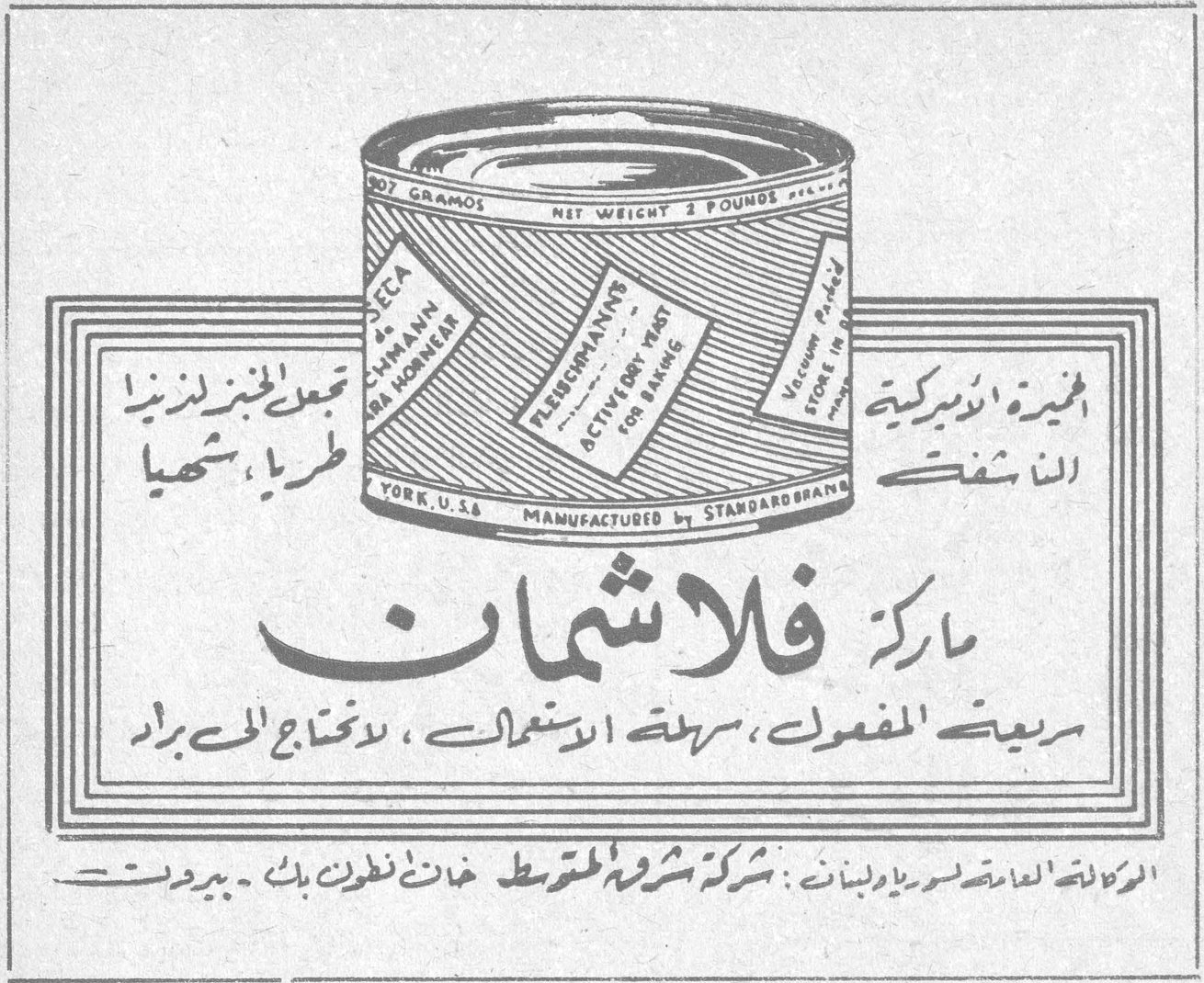
Fleischmann's Brand
The American yeast that makes bread delicious, soft, and appetizing
Fleischmann's brand
Quick-acting, easy to use, needs no refrigerator
General agency for Syria and Lebanon: the East Mediterranean Company — Khan Antoun Bey — Beirut
NET WEIGHT 2 POUNDS
FLEISCHMANN'S ACTIVE DRY YEAST FOR BAKING
MANUFACTURED BY STANDARD BRANDS
YORK, U.S.A.
Afif Nassouli, a member of the American University of Beirut mission in Bint Jbeil, come to take Dr. al-Khalil's place during his absence in Beirut. He told us about the wounded, and informed us that the battle of al-Harawi had been very fierce. And we saw the late Muhammad Zgheib, hero of al-Harawi and al-Malikiyya. I shall never forget the look in the eyes of the hero of al-Harawi as he sat upon his bed watching his comrades play checkers. He is a caged lion, wounded in the leg — as though it were he who inspired the late Ibrahim Tuqan to say:
Silent — but had he spoken, he would have uttered fire and blood. Say to him who faults his silence: resolution was created dumb.
And we saw a wounded man in whose leg a dumdum bullet had played, opening a hole big enough to hold an orange. We talked with the wounded — they were forty — and saw in them nothing but restiveness at sickness and its long duration, and a pressing desire for recovery. To return to the field.
We made for Sidon at the hour when food was being distributed to the refugees. They are scattered among the houses of Mieh Mieh, the
Qishla barracks, the houses of the Jewish quarter and its synagogue; their number is four thousand.
Dr. Zayn al-Badri supervises the government hospital.
And from Sidon we visited Deir al-Mukhalles, and there enjoyed the conversation of Father Bardaweel, the Superior General of the monastery. Father Bardaweel has only 21 orphans from among the refugees; the remaining fifty came before the events, after the partition resolution. Father Bardaweel had anticipated events, and sent word to the dioceses under his charge to spend the monasteries' funds on securing shelter for orphans and individuals whenever the need should call.
We left South Lebanon with an unaccustomed rancor in the soul and an unaccustomed thirst for requital; but joined with them is a pride in the great works our brethren have accomplished, whether in the hospitals or in the sheltering and feeding of the refugees. These are glad tidings of reassurance that we are alive — and that calamities awaken our sleeping intelligence and the noble ancestral qualities latent within us.
Mina