very fine positions and held opinions on life, on literature, on politics, and on every important matter, no less than the opinion of the best cultured woman in the Arab lands. But Alawite society looked askance at these women's participation in social life, went to extremes in its insistence on woman's seclusion, and heaped censure upon her. I do not blame the reactionary class in the mountain for its shrinking and its withdrawal into itself; but I direct all blame and reproach at the present generation, which has gone on humoring that faction as it pleases — young men and girls who drank from the springs of modern learning and looked at life as it ought to be seen, yet remained just as they were, not advancing a hair's breadth in their social life.
Some young men have said to me: What Alawite girl is fit to be the life companion of a young man who has known modern life and known its adornments? And if such a girl were found, could she provide him with the life he wants and craves and has grown used to? So I said to him: And do you know an Alawite young man
fit to be the companion in life of a simple Alawite village girl — able to guide her in a modern direction and be a teacher to her, finding in her a modest, obedient pupil, and then to stamp her with the stamp he desires?
• And from Miss Adiba Kabba of Homs, a piece entitled "Happiness," in which she expressed those deep states in which a person feels a tranquility and a well-being of unfathomed depth, springing from the depths of the contented, tranquil soul. Miss Kabba points out that happiness is an inner thing, which a person cannot obtain from outside; if happiness is not in our consciences and our hearts, we search for it in vain among people.. and that a person cannot be happy unless he makes of his life a generous giving.
"A person feels true rest — rest of soul and of mind — when he can spend all the powers of that soul, with the thought and creativity and capacity for exhausting, continuous work deposited within it, to create a work, to bring forth a thought into the world of existence in living form, to adorn what is around him with constant production!
When this person can make of his life a generous gift and a continuous giving; when the rays of his strength can master strong souls, directing them and adding to their glow and their radiance;
and weak souls, strengthening them and training them for fruitful work;
and dead, extinguished souls, breathing life into them and creating them anew — then these souls feel at rest, because they satisfy what life demands of them; and life is struggle, life is work, life is vitality.
For what is the worth of a living person except by his work, by the noble ends he sets before himself and the lofty principles his soul harbors and strives to realize? And the greater the sacrifice and the greater
the effort, the higher the worth of his work, and the more complete the rest he feels."
• And from Safita, from Miss Fatima Abd al-Karim, a letter that is truly a literary piece in its feeling, its warmth, and its ardor.
And The Woman's Voice thanks Miss Abd al-Karim for her precious confidence in it; The Woman's Voice strives only to be always as truth and goodness would have it.
Our beloved, illustrious magazine The Woman's Voice is the burning torch that lights the road before the Arab woman — the road hedged with thorns and fraught with dangers and terrors; the road of the distinguished future along which the Arab woman advances with zeal and
ardor toward a coveted goal that has beckoned to her for generations without her ever attaining it or knowing anything about it, until she had almost forgotten its name — and it is nothing but freedom, which frees her from worn-out, antiquated traditions and from the superstitions and legends they have woven around her, making her stagnant of mind and deficient in it, able to live only by her emotion — that is, mere passions that melt and dry up after a while under the burning sun of life, as the dews of night melt at sunrise and the leaves of autumn dry in the blaze of high summer. So this blessed magazine was the first of the Arab magazines to let the world know that the Arab woman
walks beside man in cutting through the stages of life, and that in her Eastern soul are treasures of genius overflowing with abundant, gushing springs, creating what the hand of extinction is powerless to erase and building of civilizations what the hand of eternity is unable to set down....
And beyond that, it is the best bridge over which the Arab woman has crossed, coming out of her silent, hollow isolation into the world of openness and good cheer. By this it has earned the Arab woman's thanks, and it has become her duty to support it materially and morally as far as she can find a way. Therefore I hope you will count me among its supporters. Farewell.
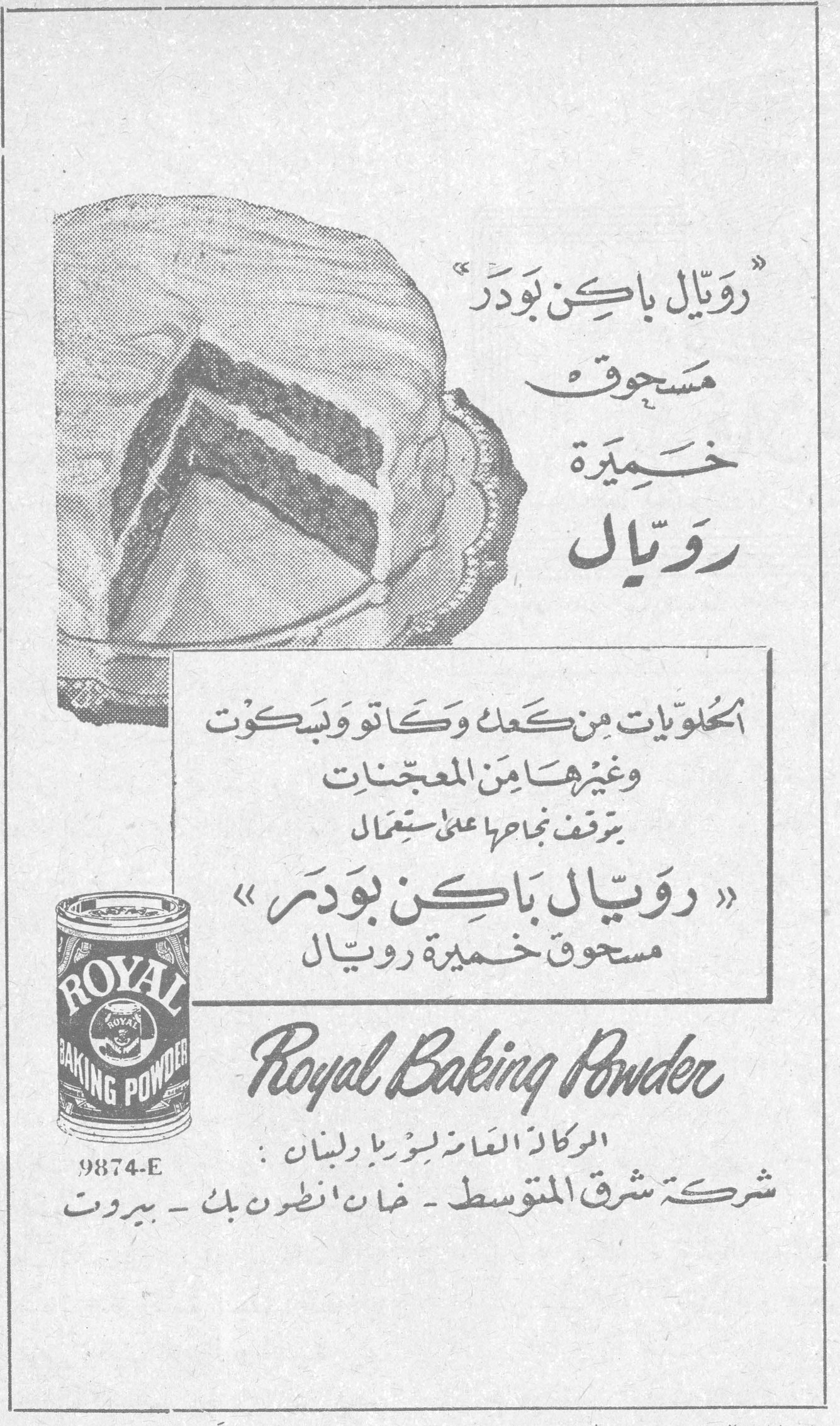
"Royal Baking Powder"
Royal yeast powder
Sweets — cakes, gâteaux, biscuits, and other pastries — depend for their success on the use of "Royal Baking Powder," Royal yeast powder
Royal Baking Powder
9874-E
General agents for Syria and Lebanon:
The East Mediterranean Company — Khan Antoun Bey — Beirut