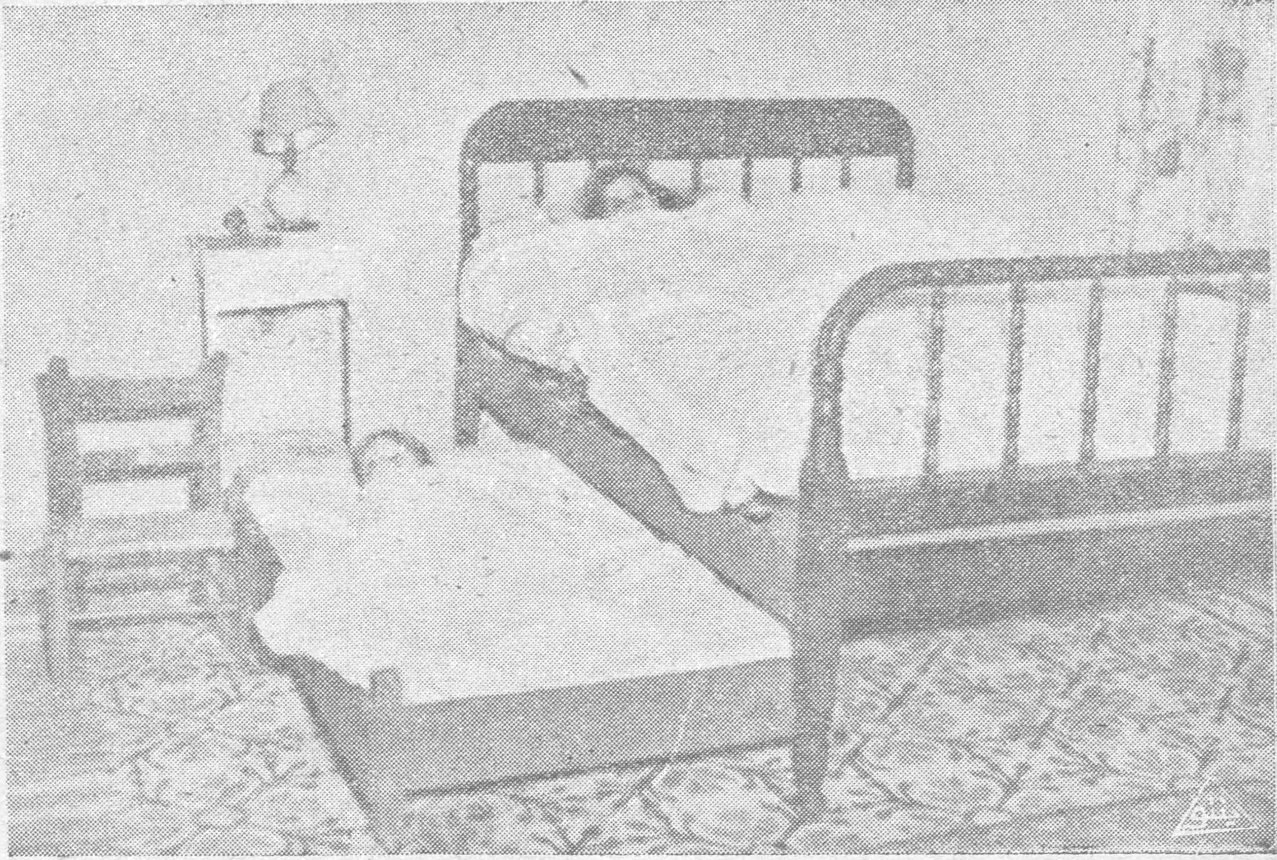

Every mother tries to give her children a room of their own, which she adorns in all sorts of ways. But how many of these mothers, one wonders, draw up a plan to follow in arranging the room? Most likely very few indeed. For most children's rooms are usually furnished with whatever has accumulated in the house from the other rooms.
The truth is that furnishing a child's room is quite an easy matter, if certain established requirements concerning the child's health and his
state of mind are observed in arranging it.
Here are five requirements the mother should observe before she begins furnishing her child's room, so that her effort may yield the greatest benefit.
1 — Choosing the furniture: In choosing the furniture the mother should take into account the child's size and build, and the tables, chairs, and the like that are in the room. The child who lives in a room fitted out for grown-ups feels just as you would feel if you were put in a room fitted out for a great giant. If you wish to use the pieces that have piled up in your house from the other rooms, out of regard for the heavy expenses this age demands of you, there is no harm in that — provided you ask a carpenter to cut down the legs of the chairs or tables and the like, so that their size suits the child; then he feels that this is his own room,
and there awakens in his little soul a love of keeping it tidy and keeping it clean.
2 — Cleanliness and order: The mother must settle how to get the child to keep the room clean and orderly, and she often fails at it — and she herself is to blame, for the child's belongings and toys often outrun the cupboards and boxes in the room. To avoid this, commission any carpenter you know to fit some low shelves in the room, on which the child can put his toys when he has finished with them, instead of their being scattered over the floor. And there is no doubt that a small wardrobe for clothes in the room, with a box or two for odds and ends, does much for the look of the room and makes it easier to keep in order.
It is advisable that the child's rug be washable, so that it can be thoroughly cleaned whenever need be. The floor, too, should be wiped
every day.
3 — Light and air: Fresh air and light are considerations whose necessity we never doubt, and yet the mother often neglects this side of the child's room for the sake of beautifying it: she hangs drapes over the windows and doors and smothers the air and light in the room. To avoid this, see to it that drapes and curtains are reduced as far as possible. It is advisable, too, to use thin, soft fabrics for them, of the washable kind. For the rooms of older children, use the strong national fabrics, such as Aleppo weave, for instance, or the cottons of Damascus and other gay, attractive cloths. From these fabrics you can also make handsome covers for the bedding.
4 — Space for play: One of the familiar problems in most houses is finding a wide space to set aside for the child's play; most often the child's bedroom is his playroom as well. How, then, can you secure enough space in the room when the bed and bedding take up the greater part of it? The best solution to this problem is the hanging beds, or what they call in English the "Bunck bed." These are beds used on steamships, consisting of a bed built in two tiers: one on the floor and another above it, reached by a small ladder. Any ordinary carpenter can make such a bed in any home. The lower bed rests on four wooden posts which rise from the floor to a height of a meter or a meter and a half above the first bed, and on top of these