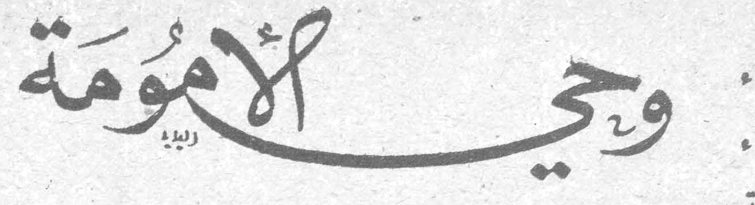
I am not concerned now with what has been said on the matter of parents and the respect children owe them, nor with the religious teachings, prophetic traditions, and literary sayings concerning them. I am concerned with one thing only: the inspiration of motherhood in Arabic poetry, and nothing more...
One notices, in surveying Arabic poetry through all its ages, that the mother, or motherhood, had no share in it; it is devoid of any mention of her, or nearly so. Most of the poetry of the ancients turns upon woman as a beloved at one moment and a paramour at another. Love verse of this kind is — or is perhaps — very nearly the widest door of literature. As for a literature of woman as a mother, with her standing and her station, you will find no trace of it. Perhaps that is owing to the Easterners' view of woman's place in human society. Here is Jarir, the Umayyad poet, ashamed to disclose his pent-up feeling the day he stood elegizing his wife, saying:
Were it not for modesty, weeping would have overcome me, and I would have visited your grave — for the beloved is visited.
And al-Mutanabbi, elegizing the mother of Sayf al-Dawla — or the sister of Sayf al-Dawla — sees no way out but qualification and circumlocution, to remain safe from the tongues of the critics, and says:
Were women all like her whom we have lost, women would be set above men.
It appears that this Eastern view of woman has begun to change into its opposite — or rather into a frank call for the respect of women, for taking their opinion, and for giving them a share, so far as may be, in the work of men. That is one of the effects of Western civilization, which has lately taken up woman's cause. Yet the Western fine arts had anticipated such a call, and we have seen woman — and the mother in particular — occupying
a great part of the hours of artists, from musicians to poets to painters. And this not upon a political and social basis, as Qasim Amin and his like urged, but out of regard for woman as a vital element in the reviving of the arts, their creation, and their inspiration. Thus motherhood, in its lofty sense, became an immortal page in the book of the fine arts; artists set themselves to immortalize it upon the canvas of art with all their artistic gifts — and whoever wishes may go to the museums of the Vatican and the other museums of Europe to verify it for himself. Perhaps Victor Hugo, one of the immortal poets of France, stands in the vanguard of the poets of motherhood in the world; to him is attributed the poem "The Mother's Heart," which Sheikh Ibrahim al-Mundhir rendered into Arabic, and it is in truth among the most marvelous things poets have imagined on this subject. The poem turns upon the tempting of a boy with money — a temptation that drove him to sacrifice his mother's heart. This undutiful son soon came back bearing it raised upon the point of his dagger; but as he ran in haste he stumbled, and the heart rolled and was covered with dust — and behold, this bleeding heart still beat with mercy. The poet says:
One day a man tempted an ignorant boy with his coins, to gain through him his desire. He said: Bring me your mother's heart, young man, and yours are the dirhams, the jewels, and the pearls. So he went and plunged a dagger into her breast, took out the heart, and returned forthwith. But in his very haste he fell, and the dust-smeared heart rolled as he stumbled. The mother's heart
called to him, covered in dust: My son, my darling — has any harm come to you?
Thus was motherhood a pure spring for poetry and a powerful incitement to its creation and invention. The Village Poet imagines a second incident which is, in my view, of the utmost beauty of creative, inventive imagination. It is told that a poet — a good and kindly man — was taken by God, and He, glory be to Him, bestowed on him the dwelling of Paradise; yet this poet was not content with this reward, and he cried out, and the people of heaven were in an uproar over him. At last the Almighty asked him, saying: What is your complaint, O man? He answered that he wished to return to his mother's bosom, where the true bliss lay. And here God willed to uncover the secret of this bliss — and lo, his spirit was embodied in the person of Christ, and behold him a child in the bosom of the Virgin. He said:
The Lord of all the worlds bowed His head at the complaint of the poet of the dusty earth, and was troubled, and said within Himself: This is impossible — can a poet know what I do not know? Does a sinner on earth enjoy, before Me, a bliss I do not enjoy in Paradise? I shall uncover the secret of this mother's bosom, though it cost Me suffering and annihilation. And there came a night — and behold, a little boy asleep in the bosom of Mary.
The poet Elias Fayyad, brother of Dr. Nicolas Fayyad, the well-known Lebanese poet and orator, has a poem on the subject of "The Breeze in Love," in which he arrives at a beautiful and splendid moral: the moral of motherhood's conquering dominion, which by its tenderness and love was able to turn raging whirlwinds into soft and gentle breezes. The gist of the story is that the breeze fell in love with a beautiful girl and had lovely secret meetings with her, in which he toyed with her hair and