
One hundred and twenty years ago there died in London "William Blake" — poet, painter, genius, and strange, eccentric man. He died at seventy, and the source of his literary and artistic inspiration remained the innocence of his violent, dramatic imagination — an innocence like that of a sensitive child's imagination, tinged with an experience of pains and trials which, had it been found in another man, would have made him rancorous and pessimistic; but in "William Blake" it stirred a revolt of the soul and a literary indignation.
It is difficult for anyone who studies Blake's life to fix the points of criticism in his literary career. Was he a poet among the great poets, or an accomplished painter, or a brilliant philosopher, or the bearer of a new message in life? The truth is that Blake was a blend of poet, painter, and philosopher all together. His painting, like his poetry, was a means of expressing his philosophy and his message in life. He is distinguished from other poets, painters, and philosophers in that he did not withdraw himself from the masses of men in order to study them from afar, record his observations upon them, and write about them, as others have been accustomed to do; his poetry and his painting grew, and his philosophy flourished, out of his daily life and out of his sense of the existence of God and of His love. At every moment of his life he believed in the existence of God Almighty — a faith drawn from the very fact of his own existence. He did not look upon Him, exalted be He, as theologians and clergymen do; he looked upon Him as the light of life and of love: the light of the sun is of His light, and the strength of the wind of His strength, and His power shows itself to the human heart in all the appearances of life.
Blake did not wish to make of himself a celebrated figure among the great poets, nor to win for himself the world's acknowledgment that he was a successful painter. The one thing that concerned him was his message to this world. It revealed itself sometimes in poetry, sometimes in painting, and sometimes in poetry and painting together — in those beautiful books in which poems and pictures mingle so that, taken as a whole, they form a harmonious work of art, even while each of them feeds the reader's mind and sharpens his sense and his feeling for the experiences of this poet-philosopher.
The strange thing about Blake is that he received no artistic training in the sense usually understood by that phrase — save only what he gained from his work as an engraver's assistant. The only men of art who influenced his particular method were those unknown sculptors and builders whose work appears in the British churches built in the Gothic style in the Middle Ages. He was influenced also by Michelangelo, from whom Blake took his exaggeration in displaying the details of the human body, in which the rounded, sinewy muscles stand out in huge masses upon gigantic frames. He made the sight of the human body in this form a symbol of man's
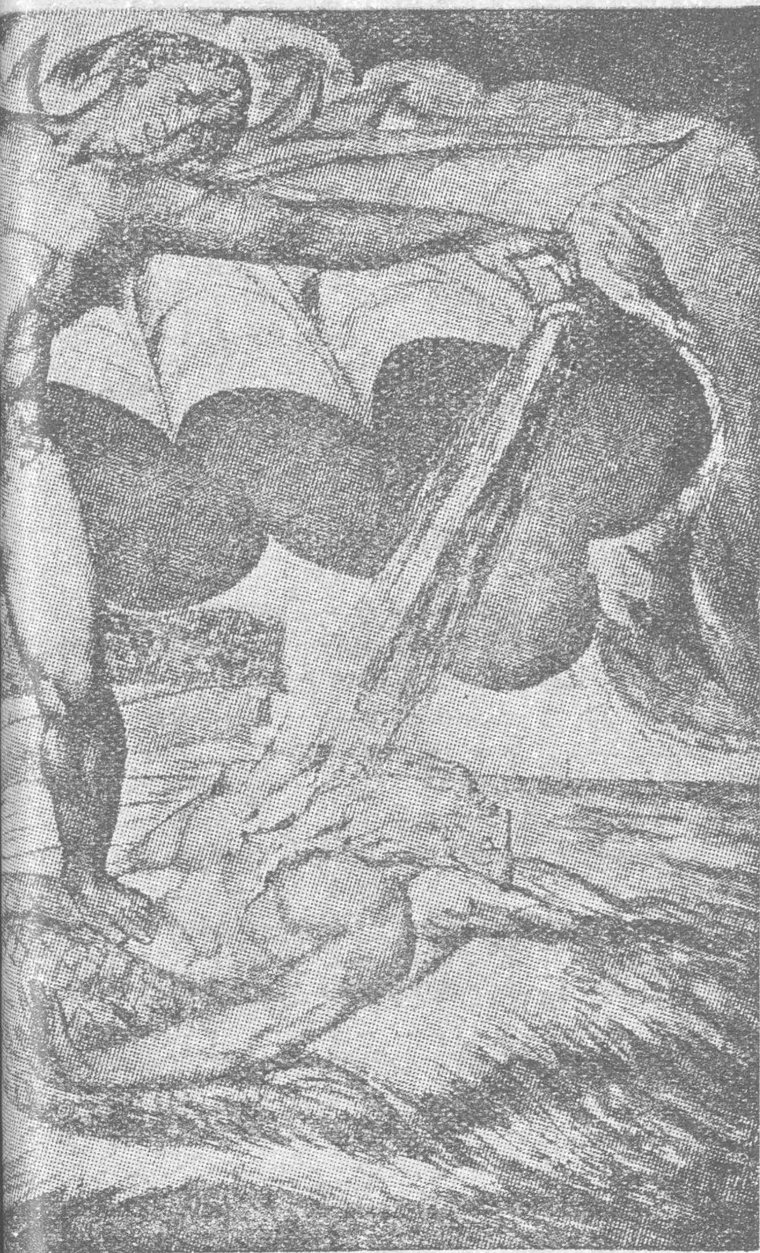
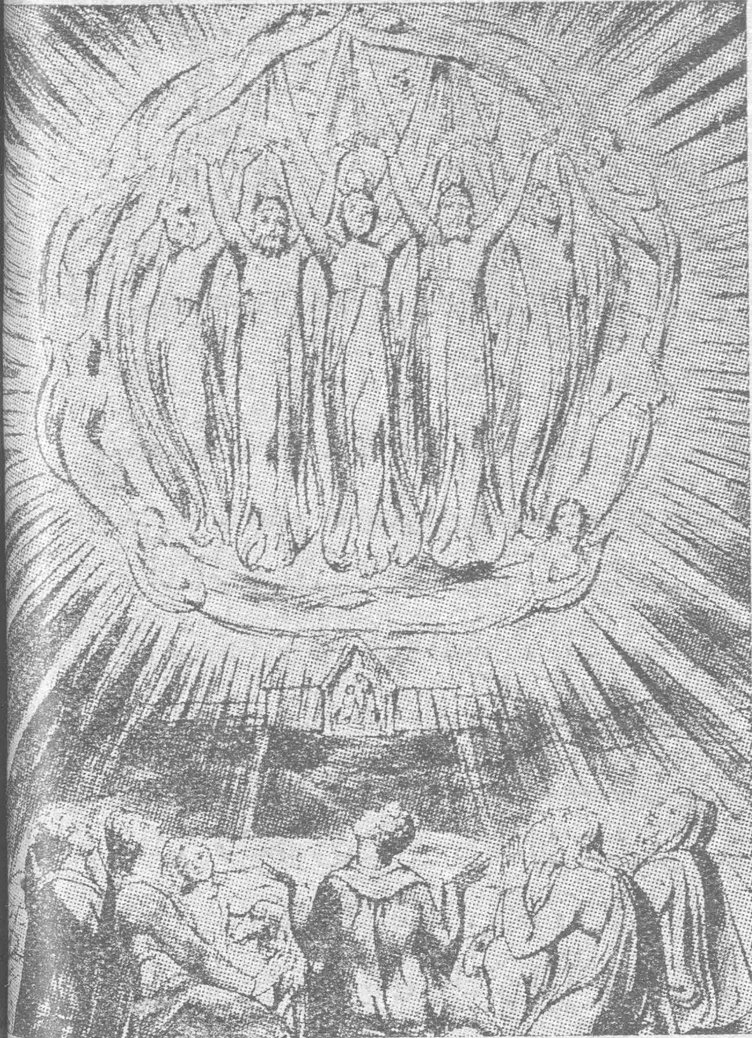
This picture shows the prophet Job, whom Satan afflicted with the disease of boils. The picture below shows the birth of Christ in Bethlehem.