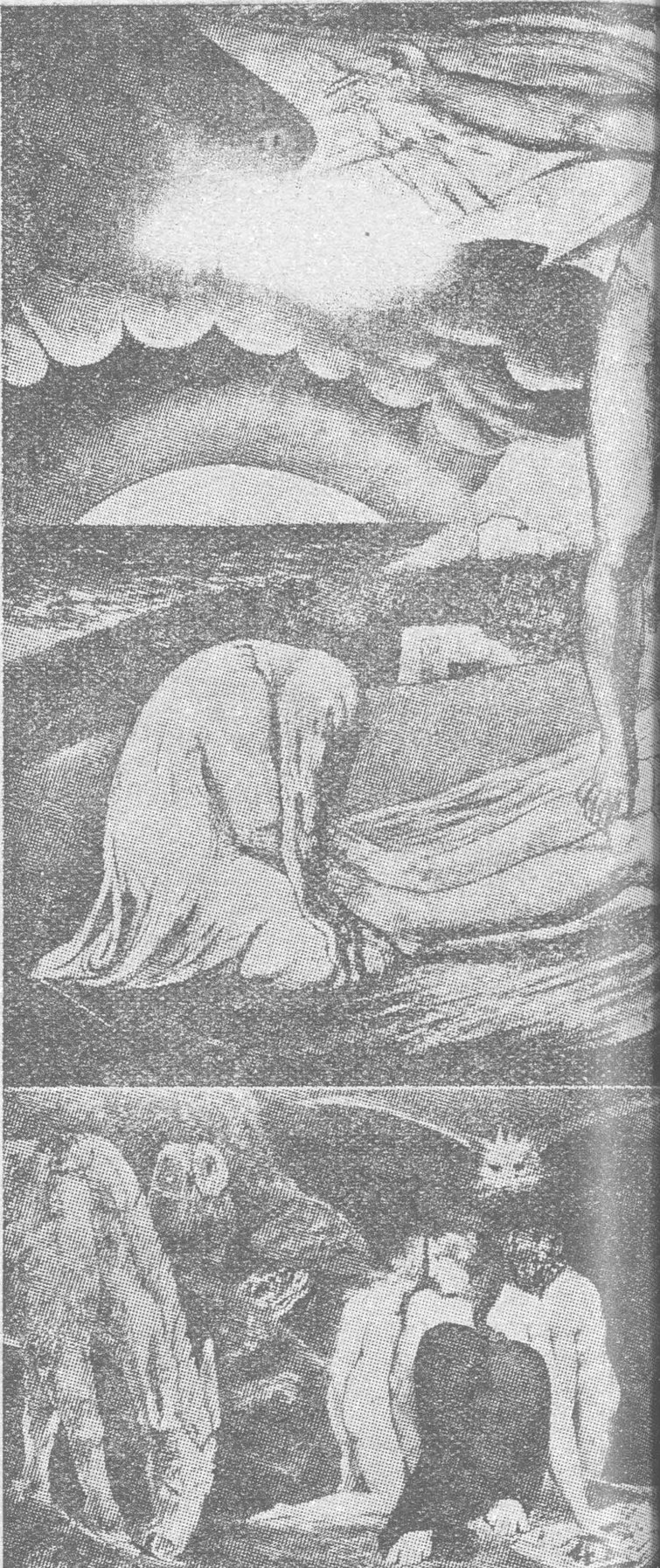
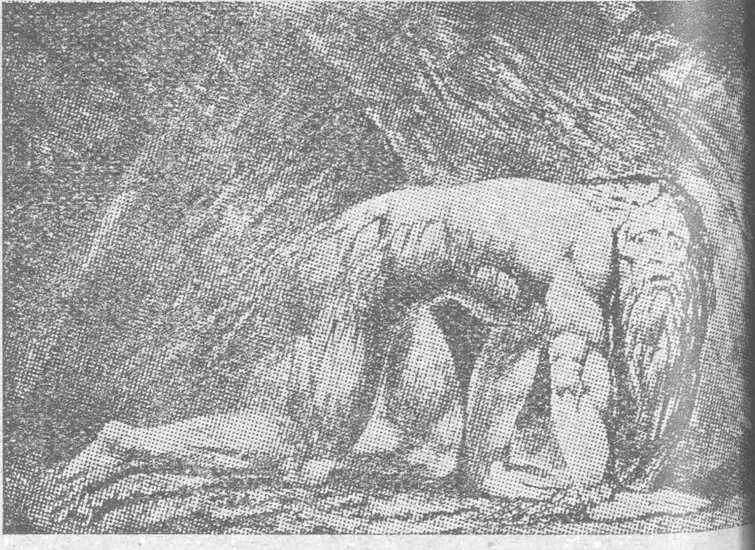
latent power and of his heroism in life. In every picture of his — even in those pictures that depict pain and torment — you see a kind of ideal heroism, or symbolic traits, that make of every man Blake drew a magnificent Adam banished that very hour from Paradise. For Blake did not paint ordinary men; in his pictures he brought out man in his most splendid aspects.
One has scarcely begun to read Blake's poetry, or to look at his pictures, before one is carried in an instant into a new world of thought and imagination. This poet-philosopher had the power to write a piece of verse of no more than a few words, with which he defied all the schools of philosophy together — as when he said:
"A bird in a cage"
"rouses the wrath of all the heavens."
This single line of English verse contains the whole philosophy of universal love.
In this way we find that all Blake's pictures represent, in varying degrees, symbolic chapters of that great universal tragedy, the tragedy of sin and love. All the figures of men that Blake's brush has drawn show us Adams driven that very hour out of Paradise. Yet in each of them there is a touch of the angelic heroism that makes them deserve deliverance from the punishment of sin — which is death.
Blake was not the most skillful of painters in expressing a particular idea; many such painters surpassed him. He did not aim to bring out in his pictures the appearances of daily, worldly life; rather he aimed to bring out in his pictures the tragedy of a wider life — the tragedy of virtue and vice, the tragedy of the soul of man and the love of God. He had his own artistic peculiarities, but they were deliberate, intended peculiarities. And these peculiarities were as necessary to what he wished to express as were the tragedies he wished to bring out in his pictures. Nothing shows his skill as a philosopher-painter better than the bold way in which he has recourse to these peculiarities of his, for they give us a true picture of his own self, which he is never afraid to show as it really is. Nor is he ever inclined to rein in the impetuosity of his inspiration out of any love of fame or gain. These peculiarities are far greater than mere familiar tricks or habits of artistic style; they are a kind of indispensable prelude to his artistic work — or rather the sole means by which he could express the splendor and the novelty of his mental invention.
Hecate, queen of evil.
Below, the mad Nebuchadnezzar roaming like a beast.