by enlisting also the international relations clubs and the centers of world studies; and finally by the exchange of scholars and teachers among the different countries.
Fourth — the creation of a committee to found an international scientific institute for the Amazon (in South America), charged with raising the standard of living and drawing full benefit from the productive possibilities of that far-flung portion of the tropical forest zone, in order to encourage and coordinate the work of scientists and specialists in the fields of the national, natural, and social sciences.
4 — The Reasons for UNESCO's Existence
In truth, the idea of UNESCO is not new. Its existence goes back to the day when there arose in man the desire to live and work in full understanding with his fellow human beings. What is truly new is that UNESCO has brought this desire out into practical existence and has come to embody that dream of realizing the human community in a form to which history knows no parallel. When the founders of this organization drew up its charter, they were careful to affirm that its duty was to devote itself to the free search for pure truth, to “the free exchange of ideas and knowledge,” and to the development and diversification of relations among peoples, so that a better understanding may come about among them and they may become acquainted with one another's ways more exactly and more truly. UNESCO is a specialized body within the United Nations organization whose aim, as its constitution states, is to encourage cooperation and understanding among the nations; to
strengthen the spread of popular education and of culture; and to help in preserving knowledge and in advancing and diffusing it, by encouraging cooperation among the nations in all branches of intellectual activity. Those are the means that help toward the attainment of UNESCO's general goal as set forth in its constitution: to work for the preservation of peace and security by binding closer the ties of cooperation among the nations
through education, science, and culture, so as to secure international respect for justice, for law, and for the human rights and fundamental freedoms necessary to all, without any distinction of race, religion, language, or sex...
UNESCO cost six million dollars in 1947. That sum barely equals the price of one light cruiser; it is the price of ten bomber aircraft; and it is one-eightieth part of what the Second World War used to cost every single day.
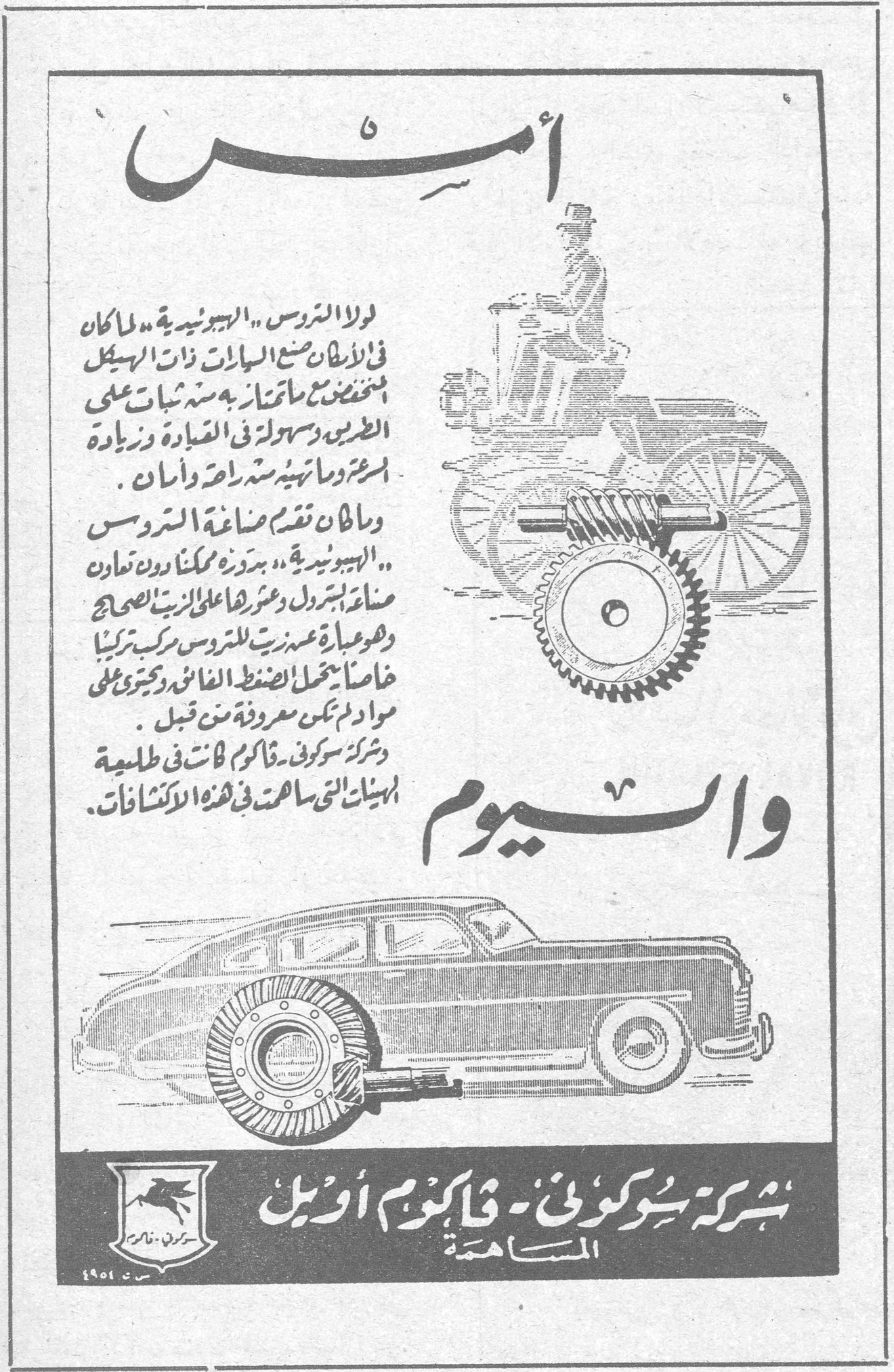
Socony-Vacuum — Yesterday and Today
Yesterday
Were it not for “hypoid” gears, it would not have been possible to build the low-bodied automobiles — with all that today's cars enjoy over others in ease of driving, greater speed, sturdiness, and safety.
Nor would the advance of “hypoid” gear manufacture have been possible without the cooperation of the petroleum industry and its offering of the right oil: a gear oil specially compounded to work under extreme pressure and containing precious materials known from before.
And the Socony-Vacuum Company stood in the forefront of the bodies that contributed to these discoveries.
And Today
Socony-Vacuum Oil Company,
Incorporated