Our correspondent in Stockholm, Miss Elvira Jureidini, wrote in her report on the women's social congress of the countries of the East that the delegation, during its visit to one of the great universities, made the acquaintance of the great orientalist Professor Nyberg, and he went round with them in the famous library, which holds 1,200,000 volumes and ancient Eastern manuscripts — Arabic, Persian, and Greek... These manuscripts were kept in glass cases, lying open for reading — this so that hands should not touch them! How great was our pride when we beheld the works of Ibn al-Athir and Ibn Battuta and others, and heard from the orientalist that the Arabic works on medicine, geometry, and the various sciences are counted among the most precious and valuable of books...
The members of the congress also visited the hospital for mild mental and nervous illnesses — for women whom some misfortune has struck and robbed of the pleasure of life, and for pregnant women who are legally entitled to terminate their pregnancies. All of these and others are under medical treatment at the hands of specialists and nurses. What caught my eye was a worker pulling a large cart, in the form of a traveling library, making her rounds among the patients, who choose from it whatever books they please... and this worker is paid a wage by the hour.
Miss Jureidini noted that most of the ladies of Sweden are active, holding official positions, and do most of their housework themselves owing to the scarcity of servants... At a luncheon given by the woman president of one of the great universities, we found that her husband is the director of a well-known bank; and in this university there is a kindergarten set apart for the children of the women students themselves — the mother enrolls at the university and places her child in its kindergarten, close by her; and this situation is quite ordinary in Sweden, with nothing strange about it at all!
The president of the congress asked her, at one of its subsidiary gatherings, to say something about my country — on condition that she not touch on politics! So she spoke of the beauty of Lebanon, the number of its schools, the character of its people, their clubs and their associations; and I would not but end my remarks with a call for peace in the

Holy Land and a description of the condition of the refugees and the homelessness and loss they endure.
In early September we visited a school for maids, and it is astonishing how much care is taken in the preparation of good maids, training them in all the affairs of household management... From there we visited a school for "massage" and the beautifying of the face; the students were young in years and possessed of great courtesy and cheerfulness.
Most of the schools in Sweden are in the charge of the government, though they were originally founded by the efforts of individual persons or of women's associations. The government spends generously on its institutes to give their students recreation and to fit them for a secure future, and it directs each into a specialty according to individual inclination. In the girls' schools the government takes care to equip the girl with everything she will need in her married and practical life.
The congress has finished its first session, which comprised observational visits to the scientific institutes, the hospitals, and the various factories of Sweden, and has begun its second session, which comprises the study of the social

program that is the principal aim of this congress...
This is a summary of what has reached us from our delegate to the congress in Sweden. The Woman's Voice thanks Miss Elvira Jureidini and hopes she will continue her
activity as a writer and send us the results of this useful congress.
The brilliant Mr. Mohammad al-Baalbaki, editor-in-chief of our great colleague "Kull Shay," is showing notable activity in the course of his journey to London with the press delegation, and he neglects no side of literary and social activity in England, for all the abundance and richness of those sides. The letters he sends every week to his paper, "Kull Shay," show that Mr. al-Baalbaki is intent on studying the general sides of the life of the English people.
Nor does the editor-in-chief of Kull Shay forget to write from time to time to the editor-in-chief of Dar al-Kitab, acquainting him with women's activity in England; and The Woman's Voice will publish important reports of his on the women's movement in the land of the English in its coming issues.
In one of his recent letters to "The Woman's Voice" he says: "If only we were together here, in this wondrous country, for you to behold the manifestations of immortal life...
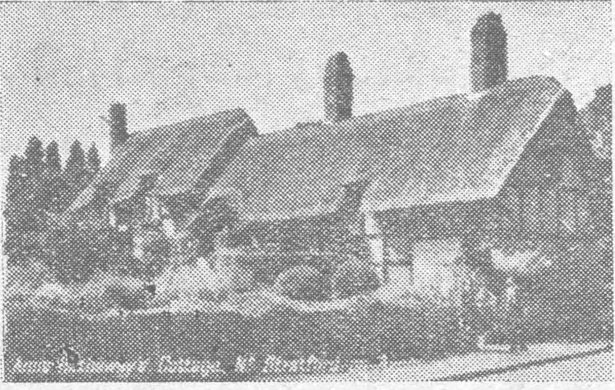
How I have choked with anguish as I watched the huge statues raised in the great squares to the poets of the world and its great writers!
In every corner an elegant statue reminds you that the place where it stands is an immortal place. We visited Shakespeare's house, in his immortal town; the whole world streams in to visit this town in which the world's greatest poet was born... Here is his wife's house — she is immortal like him. Will a house, I wonder, ever be raised among us in Lebanon for a poet's wife, or for a poet?
Miss Nahida Fadli addresses the rising young girls in this delicate essay, and in it is a call to the free life — the life of resplendent youth looking out upon the spring with a radiant smile and a bright, glowing hope. The editorial staff of "The Woman's Voice" observes that the new girl has begun to feel that she too
is called to take part practically in the goodness and beauty of this life; and indeed, there have passed