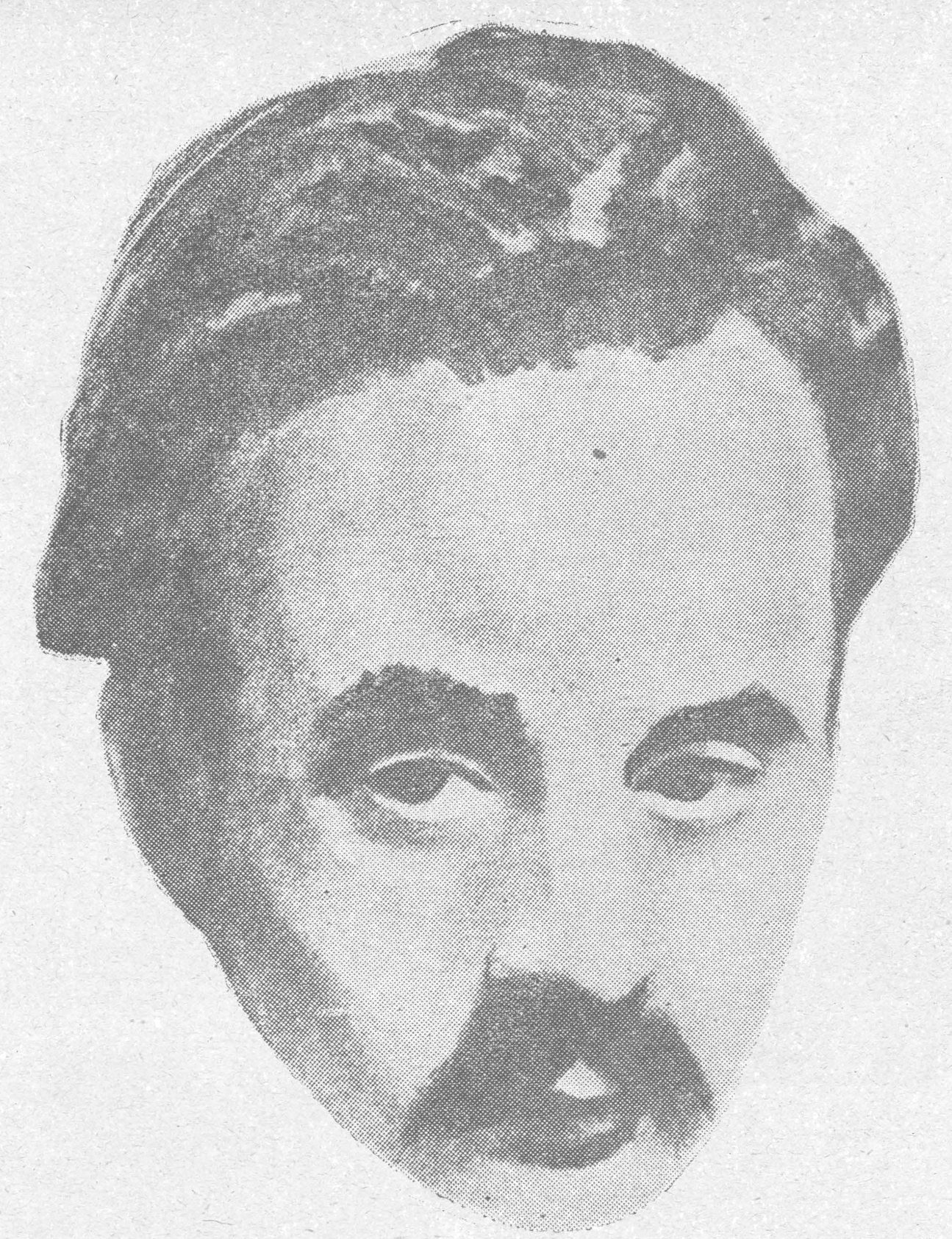
"Barbara Young" is an American poet who lived near Gibran in his last years, and to whom that singular personality revealed itself at close hand — the personality of Gibran, rich in colors, shadows, and symbols.
Upon the death of the great genius, "Barbara Young" wrote a small book about her friend Gibran entitled: "This Man from Lebanon."
Before the last war the American poet made a visit to the country in which the poet was born, and sought out the traces of his childhood in the paths and slopes and valleys that accompanied that childhood and enriched it with deep gifts. The American poet returned to her country to write a new book on her friend the poet entitled "My Friend Gibran Khalil Gibran," some translated passages of which are conveyed here to the women readers of "The Woman's Voice."
•
It is a strange coincidence that I am setting down these words while the storm's blaze has grown fierce, and the torrents pour down from the heights, turning the earth into rivers and seas, and the trees sway their trunks and toss their branches — as if Gibran's spirit were hovering about me as I write of him. For he was passionately fond of hurricanes and storms, and how often I heard him say that he felt a knot loosen and a freedom given its rein whenever winds blew and rains fell and tempests raged.
We are in the year 1944 — that is, thirteen years after his parting from this world which he loved, and sixty-one years after his coming into it. His life was short if we take the years as its measure. But Gibran did not take time as the measure of his
life, nor did he take it as the measure of his thought. He would say constantly: "Eternity is ours." And this was no mere saying, but a firm conviction by which he directed his life. "The spirit is mightier than space, stronger than time, and loftier than the stars" — this was forever on his tongue.
The Western world knows him as a poet and painter, and as the author of that black-covered book, "The Prophet," of which its author said: "While I was writing 'The Prophet,' 'The Prophet' was writing me." And a small number in the Western world know him as Nietzsche and Richard Wagner were known.
But the Gibran whom scarcely any Westerner or Easterner knows is Gibran the draftsman,
who left behind a legacy that no money and no price can measure — a legacy whose splendor is scarcely to be believed, whose existence is scarcely to be dreamed of, by more than a few hundred souls on the face of the earth. The pictures his pencil drew upon the pages of his ten English books are but one proof of that precious legacy.
A scrap of paper and a pencil stub were all that Gibran needed to express for you one of the forms of beauty — nothing beyond lines and shadows, yet unsurpassed by colors laid with the brush upon a stretch of canvas. And we do not exaggerate if we say that, when
every plant that grows in it. He held trees sacred, bearing them all veneration and