the Egyptians of
the same profession, does not mean that we have a mission in the world of journalism.
That linguists arise among us who improve the rules of the language and simplify them does not mean that we have a mission in the world of language.
That our musical institutes perform Western music and spread its teaching does not mean that we have a mission in the sphere of art.
We had missions in the past which we discharged with all our strength and sincerity, so that their memory was immortalized and there was recorded for us a precious heritage which is today our national capital:
The day we lit the world with the light of knowledge, when we spread the letters of the alphabet along the shores of the Mediterranean, which was in that day a colony of our young civilization. The day we armed the peoples with our necessary inventions — the making of glass, the art of dyeing, the building of ships, and the skillful arts of war.
The day we filled the hearts of humanity with spiritual teachings, restoring confidence to souls that had despaired, and faith — in the world and all it holds — to hearts that had denied.
The day we carried the torch of the Greek and Roman civilizations and bore it through the Dark Ages, lit with our oil, until we delivered it to the Europeans, and by its light they awoke from their deep slumber.
To world missions such as these, in the realm of civilization, we are called today — while the West flounders — to cut our path and to produce.
And our hope of answering this call rests upon the success of the mission of the living, strong, superior elements in the nation, to spread through it that renaissance which will serve as the spiritual spur driving us to the forefront of the procession of civilizations.
Georges Nasri Safir
And here is a letter addressed by the national poet Mr. Ajaj al-Mukhtar to Sheikh Khalil Takieddine, in which he directs his attention to this popular strain of literature, a precious inheritance in our life:
"Perhaps the one successful thing the Lebanese government has done, by way of putting a thing in its proper place, is its charging of the great writer Mr. Khalil Takieddine with the organizing of the departments of Radio Lebanon.
And if the directorate of broadcasting needs to be blasted from its foundations and built anew, Mr. Khalil possesses
such means of blasting and demolition and such equipment of construction and rebuilding — resolve, experience, art, and sincerity — as guarantee us brilliant results and will place the Lebanese broadcasting station in the front rank of the world's distinguished stations.
And there is no doubt that the native strain — zajal, or national verse, or popular literature — will receive a generous glance from the watchful eye of Khalil, for the native strain stands in need of organization and attention more than all the other strains of Lebanese broadcasting.
This sweet native strain, which our children utter by instinct, which our mothers sing to their children in the cradle, and which great and small among us love.
This beautiful strain, without whose refreshing tunes no wedding in our country has any gladness, and no funeral any grandeur without its plaintive melodies.
Our great writer, who savors fine zajal to the utmost degree, will without doubt banish from the broadcasting apparatus all the intruders, and with his penetrating, luminous insight he will discover the truly gifted and draw them near to Lebanese radio to display their stored-up talents; and by this work he will satisfy his living conscience, true art, and the tastes of the listeners.
Across the long generations we intoxicated the world with the airs of our popular songs and our zajal strains, and we must return
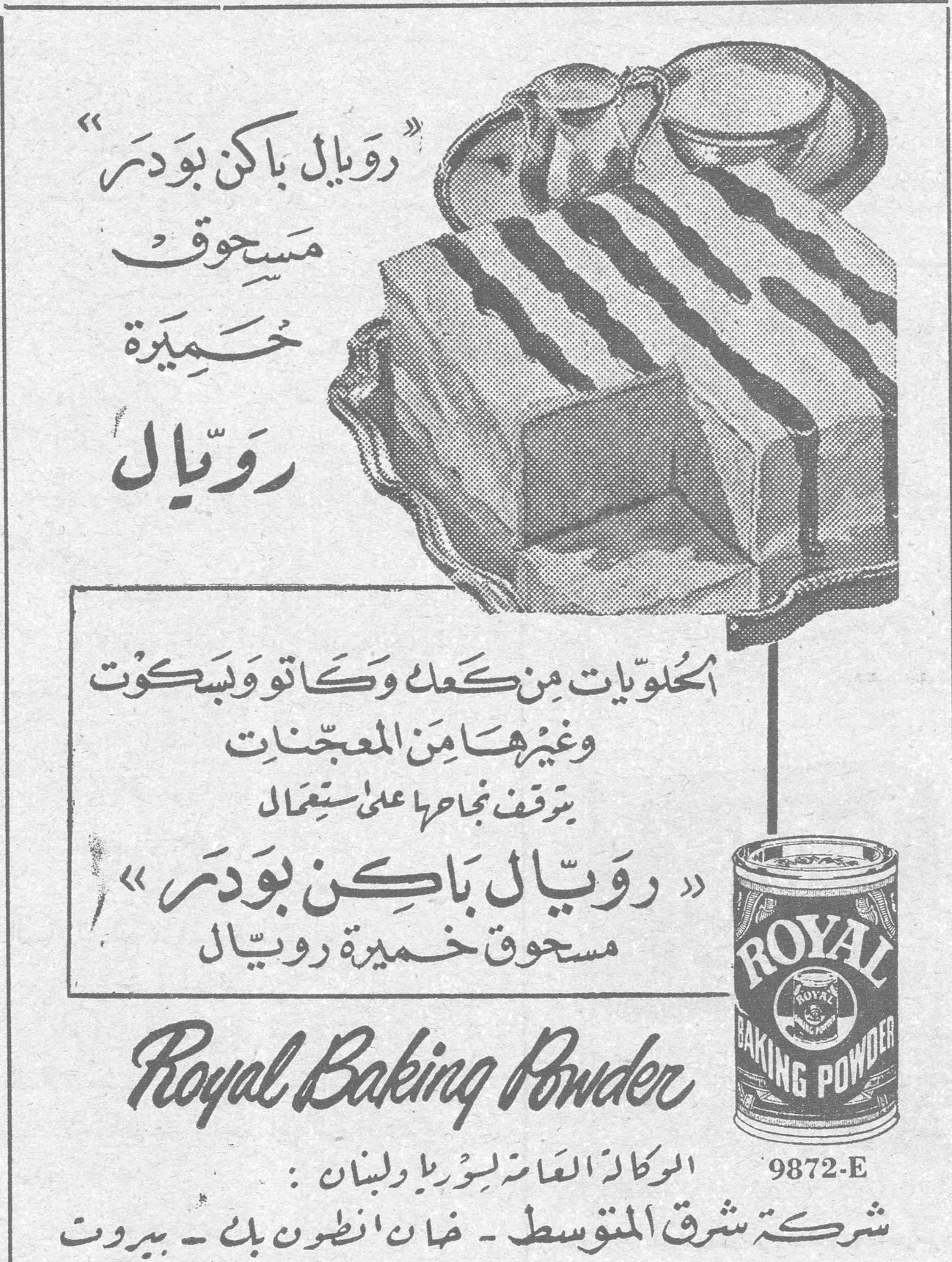
"Royal Baking Powder"
Royal yeast powder
Sweets — cakes, gâteaux, biscuits, and other pastries —
their success depends on the use of
"Royal Baking Powder"
Royal yeast powder
Royal Baking Powder
9872-E
General agency for Syria and Lebanon:
the East Mediterranean Company — Khan Antoun Bey — Beirut