It would be rash to attempt to describe in a few lines the many activities of the Lebanese Red Cross, although it dates only from July 1945. We shall therefore confine ourselves to a simple general survey.
It may be said, without false modesty, that these three years have surpassed every hope. To begin with, the work was divided into various branches, among them the committee of dispensaries and milk stations, the mobile ambulances, the School of Nursing, the Soldier's Home, the Public Assistance Committee, the workrooms, the summer camp, the tracing bureau, the regional committees, and finally the Entertainments Committee and the Secretariat. To this must be added a new and no less important task, which is aid to the refugees from Palestine.
Having started from a single dispensary, the Lebanese Red Cross at present possesses 16 dispensaries, 4 of them in Beirut, together with a milk station; a dispensary and a milk station at Zahleh; a dispensary at Rayak, another at Baalbeck, 2 at Tripoli, and one at Halba, one at Damour, one at Jounieh, one at Ain-Zhalta, one at Furn-el-Chebak, one at Beit-el-Dine, and one at Saida. The dispensaries are directed by regional committees. Physicians specializing in all the branches of medicine and surgery provide a daily service. 110,930 patients have been treated to date, 39,963 medicines administered free of charge, and 537 patients hospitalized in the various hospitals of the city. The patients' names are entered on cards which make it possible to follow the course of the illness. The management
of the dispensaries also looks after expectant mothers. The milk station provides the daily ration of the dispensary's regular visitors, who have already received some 70,350 liters of pasteurized milk. In addition to milk and medicines, staples of first necessity, such as rice, sugar, soap, meat, and clothing, are distributed to the sick.
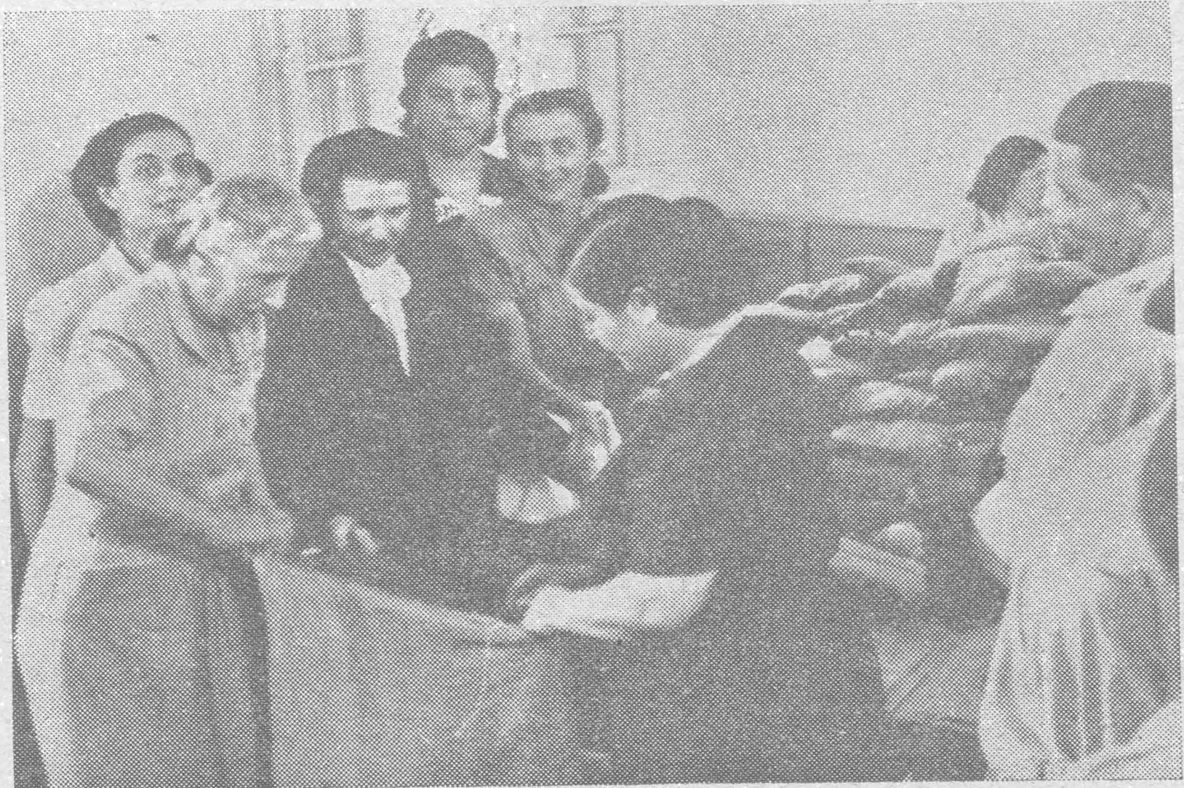
The clothing and the layettes are made in the Red Cross's own workroom: 2,500 smocks intended for the free schools, as well as 3,000 layettes for the babies of soldiers and civilians.
Social inquiries are carried out by the nurses of the Red Cross in the various quarters of the city; their purpose is to give the families of the working classes notions of